>_Programming Partner
Loading technical insights...
Loading technical insights...
Software Developer
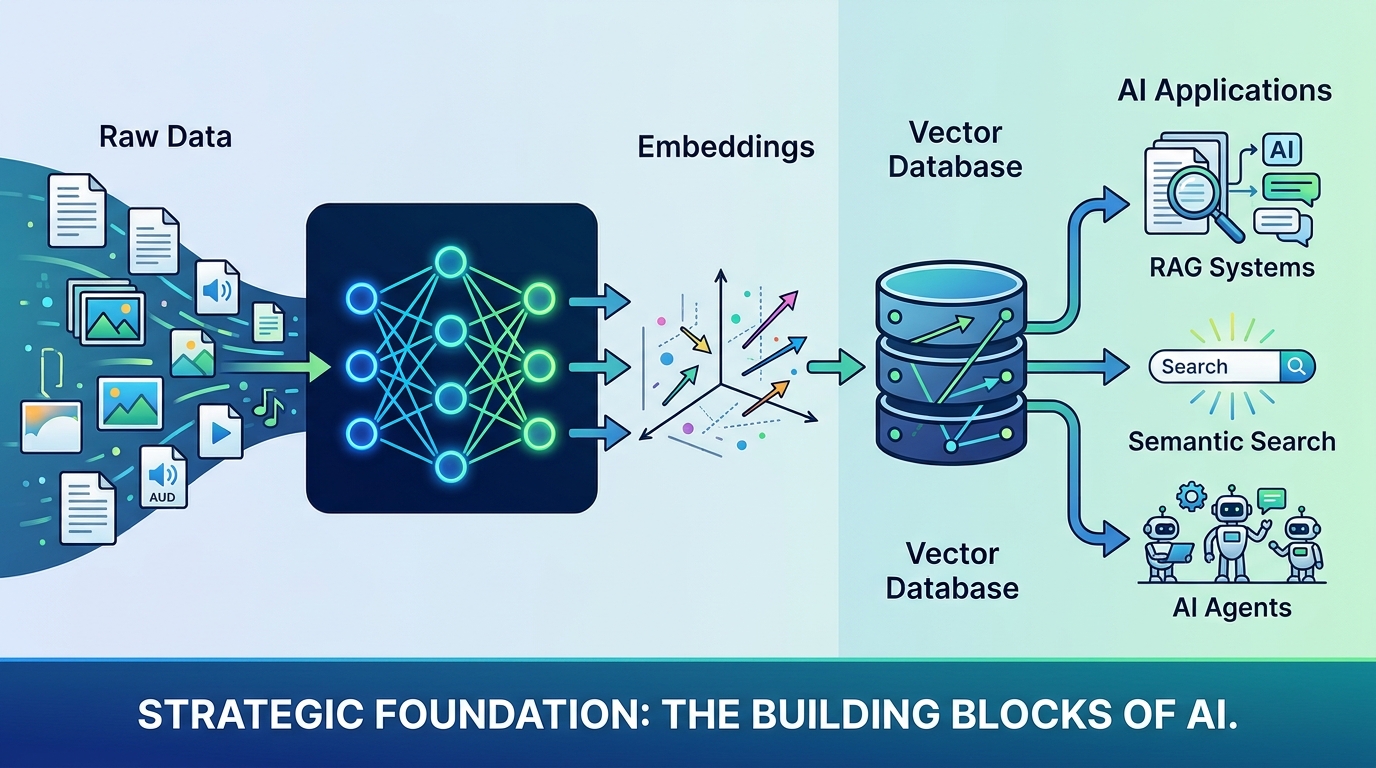
Computers, at their core, operate on numbers and logic, not the rich, nuanced language humans use daily. This fundamental difference creates a significant challenge for AI systems aiming to understand and interact with the real world. To bridge this gap, we need a way to translate human language and complex data into a format machines can readily process.
This is where embeddings come into play. Embeddings are numerical representations that capture the semantic meaning of various data types. They transform raw information into a structured, machine-readable format, making it accessible for advanced AI applications.
Understanding embeddings is crucial for anyone looking to build or comprehend modern AI systems. They are the foundational technology enabling everything from intelligent search to sophisticated AI agents.
At its heart, an embedding is a high-dimensional vector, essentially an array of numbers. This vector represents the semantic meaning of a piece of data, whether it's a word, a sentence, an image, or even an entire document.
The magic of embeddings lies in their ability to map similar concepts to nearby locations within a multi-dimensional vector space. Imagine a vast conceptual map where related ideas are clustered together.
For instance, the embedding for "king" would be numerically close to "queen" and "ruler," but far from "banana." This proximity allows machines to infer relationships and understand context in a way that simple keyword matching cannot.
The significance of embeddings cannot be overstated in the age of advanced AI. Traditional data processing often relies on exact keyword matches, which severely limits a system's ability to understand context and nuance.
Consider searching for "car repair." A keyword-based system might only find documents containing that exact phrase. An embedding-powered system, however, would also understand queries like "auto service" or "vehicle maintenance" as semantically similar.
Embeddings empower AI systems to grasp the underlying meaning and intent behind data. This capability is vital for creating intelligent applications that can truly understand and respond to human communication effectively.
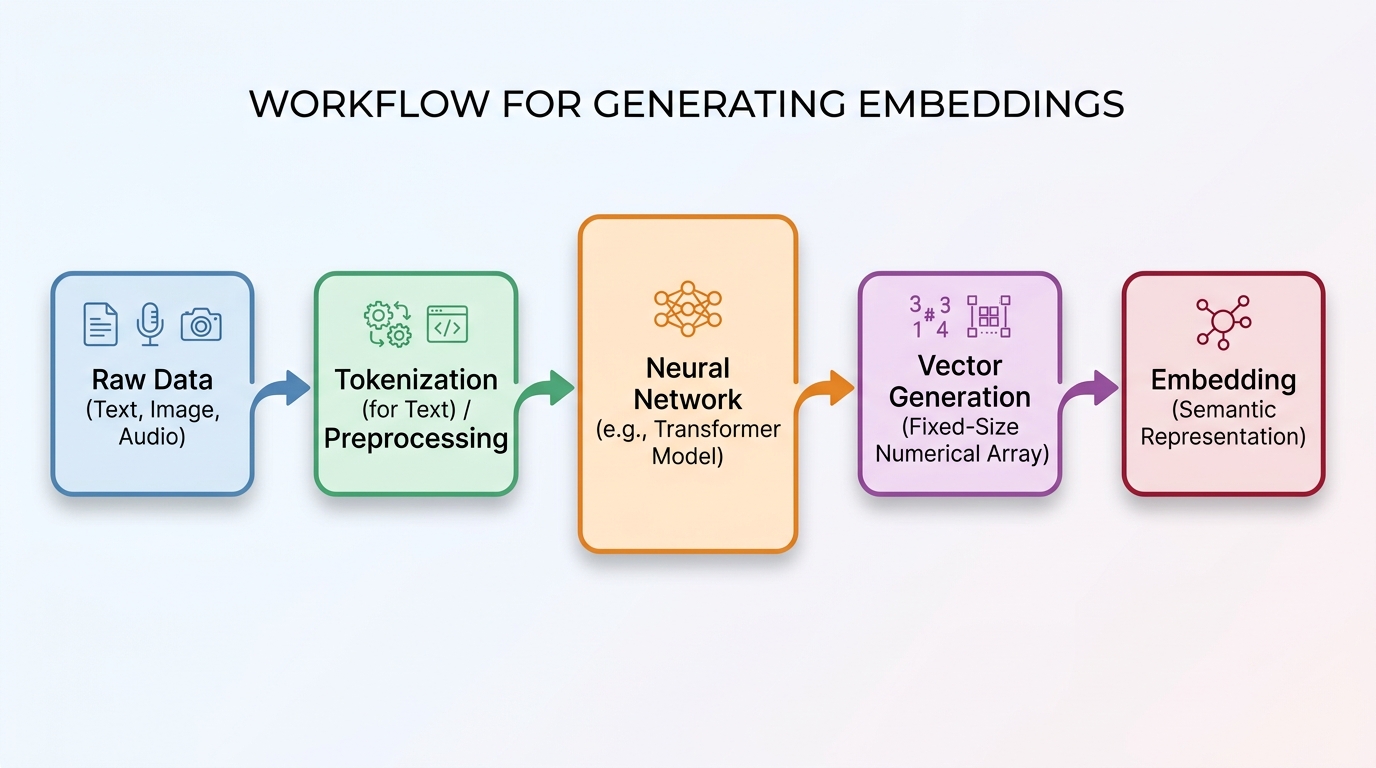
The process of generating embeddings involves several key steps, typically leveraging sophisticated neural networks. This transformation converts raw, unstructured data into a dense numerical vector.
First, the input data, such as a piece of text, an image, or an audio clip, is fed into an embedding model. For text, this often begins with tokenization, breaking the input into smaller units like words or subwords.
Next, a pre-trained neural network, often a transformer model, processes these tokens. Through its complex layers, the network learns to identify patterns and relationships within the data.
Finally, the neural network outputs a fixed-size numerical array, which is the vector generation step. This array is the embedding, a compact semantic representation of the original input's meaning.
Embeddings are not a one-size-fits-all solution; they come in various types, each designed to capture meaning from different forms of data. Understanding these distinctions helps in selecting the right tool for your AI task.
Here are some common types of embeddings and their primary applications:The field of embeddings has seen rapid innovation, leading to a diverse array of models, each with unique strengths and applications. Choosing the right model depends heavily on your specific use case and data characteristics.
Early models laid the groundwork, while more recent advancements leverage deep learning to capture richer contextual meaning. We can broadly categorize them into foundational and modern contextual models, alongside powerful API-based services.
| Model | Type | Key Characteristics | Typical Use Cases |
|---|---|---|---|
| Word2Vec | Word | Non-contextual, learns word relationships from local context (skip-gram, CBOW). | Word analogies, synonym detection, simple text classification. |
| GloVe | Word | Non-contextual, global matrix factorization, captures global word-word co-occurrence statistics. | Similar to Word2Vec, often performs well on smaller datasets. |
| FastText | Word/Subword | Non-contextual, represents words as sum of character n-grams, handles OOV words. | Text classification, large vocabulary embeddings, out-of-vocabulary handling. |
| BERT (Bidirectional Encoder Representations from Transformers) | Contextual (Sentence/Document) | Transformer-based, bidirectional context, generates different embeddings for same word based on context. | Question answering, natural language inference, semantic search. |
| Sentence Transformers | Contextual (Sentence/Document) | Fine-tuned BERT-like models for semantic similarity, optimized for sentence-level embeddings. | Semantic search, clustering, paraphrase mining, RAG systems. |
| OpenAI Embeddings (e.g., text-embedding-ada-002) | Contextual (API-based) | Proprietary, high-quality, general-purpose embeddings, easy API access. | RAG, semantic search, classification, recommendation systems, chatbots. |
| Gemini Embeddings | Contextual (API-based) | Google's proprietary multimodal embeddings, designed for diverse data types. | Multimodal search, content understanding across text and images, AI agents. |
| Voyage AI | Contextual (API-based) | Specialized for long-context and high-performance retrieval, often optimized for RAG. | Advanced RAG systems, long-document search, enterprise AI applications. |
| Cohere Embeddings | Contextual (API-based) | Proprietary, strong focus on enterprise applications, offers various embedding models. | Semantic search, text generation, classification, summarization for business use. |
Once data is transformed into numerical embeddings, the next crucial step is to quantify how similar two pieces of data are. This is achieved through various mathematical metrics that measure the proximity or orientation of vectors in the high-dimensional space.
The core idea is simple: if two embeddings are numerically similar according to these metrics, their underlying semantic meanings are also considered similar. This allows AI systems to find related content or understand relationships.
Three common methods for measuring vector similarity are: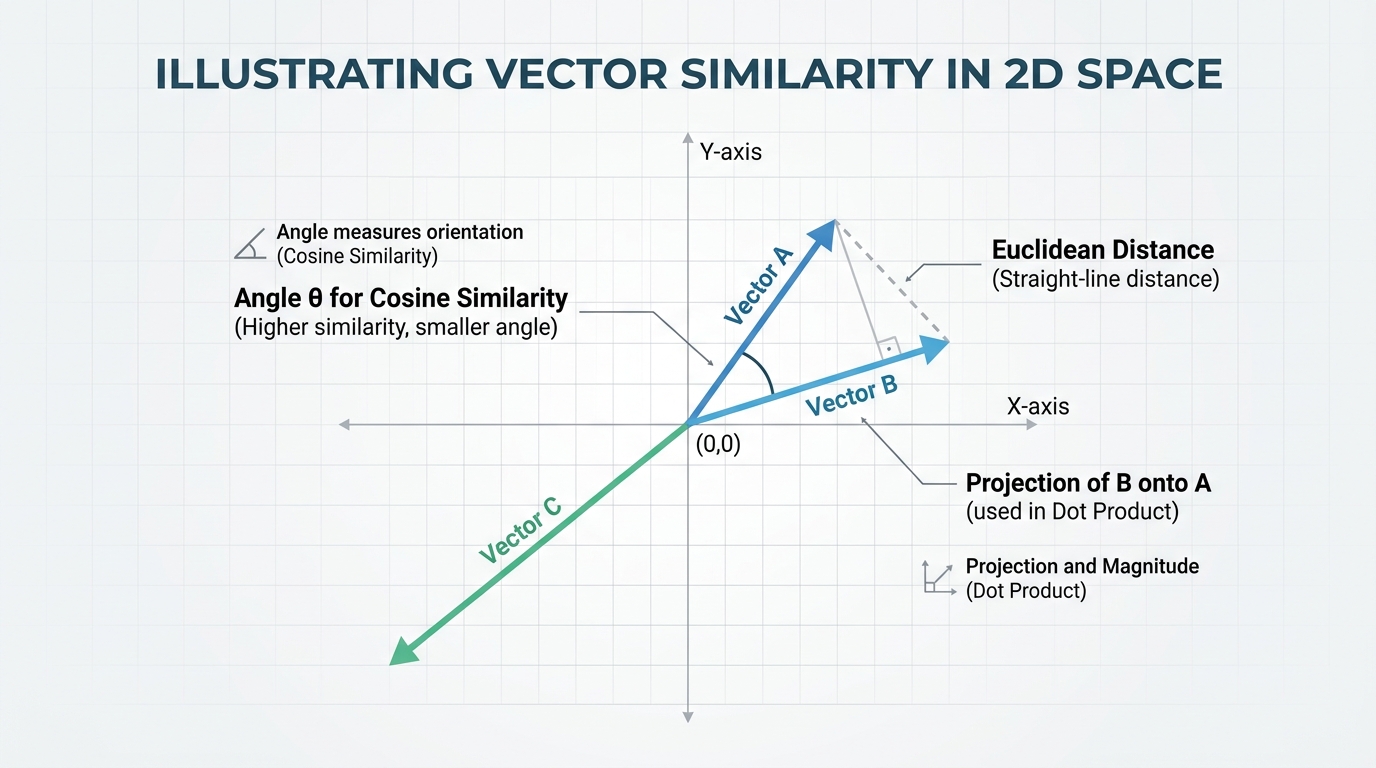
For decades, search engines and databases relied heavily on keyword matching. While effective for exact queries, this approach often falls short when users express their needs in varied or nuanced ways.
Semantic search, powered by embeddings, represents a paradigm shift. It moves beyond literal word matching to understand the underlying meaning and intent of a query, leading to far more relevant results.
| Feature | Traditional Keyword Search | Semantic Search (with Embeddings) |
|---|---|---|
| Understanding User Intent | Limited to exact keywords; struggles with synonyms or rephrasing. | Understands the meaning and context of the query, even with different phrasing. |
| Handling Synonyms/Related Terms | Requires explicit synonym lists or manual tagging. | Automatically identifies semantically similar terms; 'car' matches 'automobile'. |
| Contextual Relevance | Retrieves documents containing exact keywords, regardless of overall context. | Retrieves documents that are conceptually relevant, even if keywords aren't present. |
| Query Flexibility | Strict; minor typos or phrasing changes can lead to poor results. | Flexible; more forgiving of variations in language, understands natural language questions. |
| Example Query: 'best places for a summer vacation' | Might only find pages with 'summer vacation'. | Could find 'top beach destinations', 'holiday spots in July', 'warm weather getaways'. |
This table clearly illustrates how embeddings provide a superior search experience. They enable systems to anticipate user needs and deliver information that truly answers the underlying question, not just the literal words.
Embeddings are not just theoretical constructs; they are the backbone of many advanced AI applications we interact with daily. Their ability to represent meaning numerically unlocks a vast array of possibilities.
Here are some prominent real-world applications where embeddings play a crucial role:While embeddings provide the semantic understanding, they need a specialized home for efficient storage and retrieval. This is where vector databases enter the picture, forming a symbiotic relationship with embeddings.
Once embeddings are generated from raw data, they are stored in a vector database. Traditional relational or NoSQL databases are not optimized for handling high-dimensional vector data and performing rapid similarity searches across millions or billions of vectors.
Vector databases are purpose-built for this task. They employ advanced indexing techniques, such as Approximate Nearest Neighbor (ANN) algorithms, to quickly find the most similar vectors to a given query vector. This efficiency is critical for real-time AI applications like semantic search and RAG.
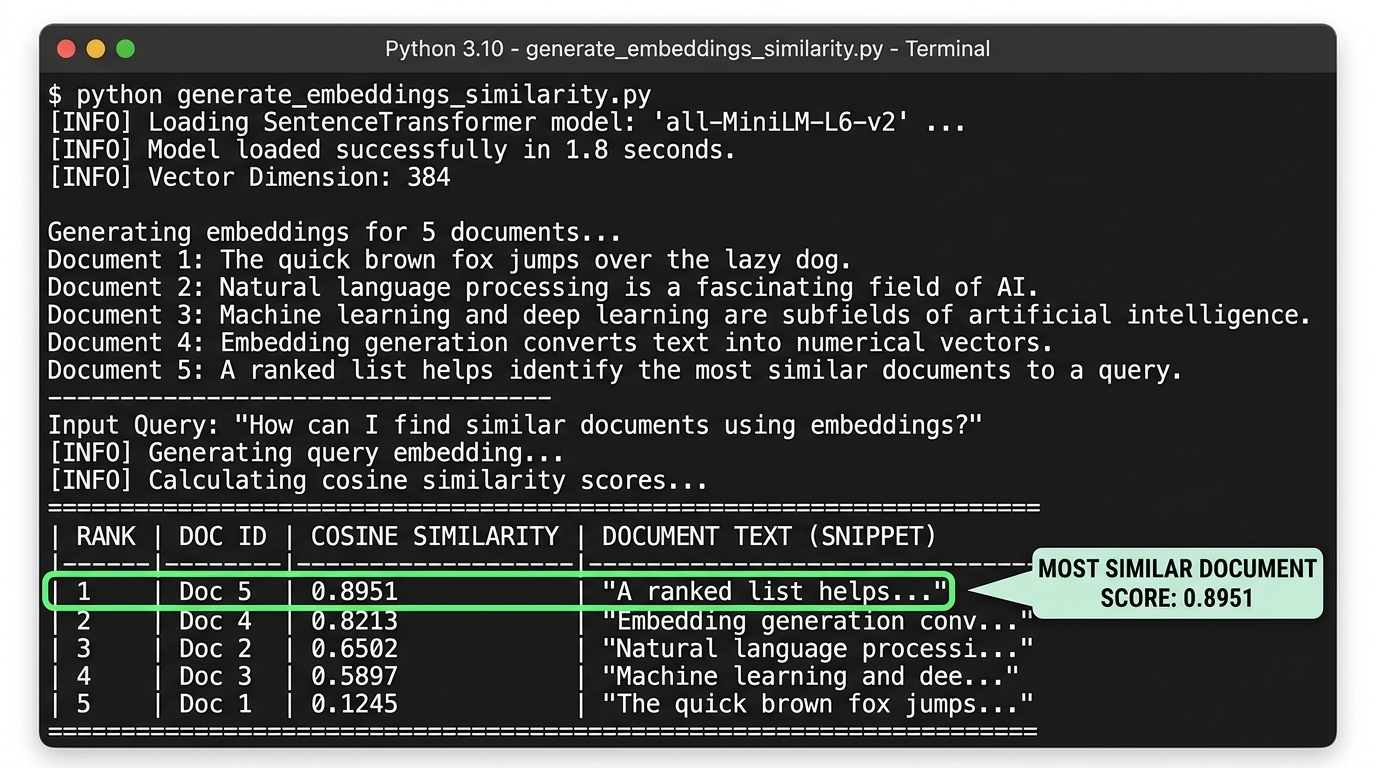
Let's dive into a practical example of how to generate and use embeddings in Python. We'll use the popular sentence-transformers library, which provides pre-trained models optimized for sentence and text embeddings.
This workflow will demonstrate how to convert text into vectors, calculate their similarity, and perform a simple search for relevant content. First, ensure you have the necessary libraries installed.
pip install sentence-transformers numpy scikit-learnNow, let's write some Python code to generate embeddings and find similar sentences. We'll load a pre-trained model, encode our text, and then use cosine similarity to find the most relevant match.
from sentence_transformers import SentenceTransformer
from sklearn.metrics.pairwise import cosine_similarity
import numpy as np

# 1. Load an embedding model
# We'll use a pre-trained model optimized for sentence embeddings
print("Loading SentenceTransformer model...")
model = SentenceTransformer('all-MiniLM-L6-v2')
print("Model loaded.")

# Define a list of documents/sentences to embed
documents = [
    "The quick brown fox jumps over the lazy dog.",
    "A fast, reddish-brown canine leaps over a sluggish hound.",
    "Artificial intelligence is transforming industries worldwide.",
    "Machine learning algorithms are at the core of modern AI.",
    "Cats love to chase mice and play with yarn."
]

# 2. Convert text into vectors (embeddings)
print("Generating embeddings for documents...")
document_embeddings = model.encode(documents)
print(f"Generated {len(document_embeddings) embeddings, each with dimension {document_embeddings.shape[1].")

# Define a query text
query = "What is AI and machine learning?"

# Generate embedding for the query
print(f"Generating embedding for query: '{query'...")
query_embedding = model.encode([query])[0] # [0] because encode returns a list of embeddings
print("Query embedding generated.")

# 3. Calculate similarity between vectors
# We'll use cosine similarity to find the most relevant document
print("Calculating cosine similarities...")
similarities = cosine_similarity([query_embedding], document_embeddings)[0]

# 4. Search for relevant content based on similarity
# Find the index of the most similar document
most_similarᵢndex = np.argmax(similarities)
most_similar_document = documents[most_similarᵢndex]
max_similarity_score = similarities[most_similarᵢndex]

print("\n--- Search Results ---")
print(f"Query: '{query'")
print(f"Most similar document: '{most_similar_document'")
print(f"Similarity score: {max_similarity_score:.4f")

# Display all similarities for context
print("\nAll similarities:")
for i, (doc, score) in enumerate(zip(documents, similarities)):
    print(f"  [{i+1] '{doc' (Score: {score:.4f)")
This Python script demonstrates the fundamental steps of using embeddings. It showcases how a query's meaning can be matched against a corpus of documents, retrieving the most semantically similar ones.
The sentence-transformers library simplifies the process significantly, abstracting away the complexities of neural network inference. This makes it accessible for developers to integrate semantic understanding into their applications.
While incredibly powerful, embeddings are not without their challenges and limitations. Awareness of these factors is crucial for effective implementation and troubleshooting in real-world AI projects.
Some key considerations include:To maximize the effectiveness of embeddings in your AI applications, adhering to certain best practices is essential. These guidelines can help you navigate the complexities and build robust, high-performing systems.
Consider the following advice:Embeddings are undeniably a cornerstone of contemporary artificial intelligence. They provide the crucial mechanism for machines to move beyond superficial keyword matching and truly grasp the meaning and context of diverse data types.
From powering intelligent semantic search to enabling robust Retrieval-Augmented Generation (RAG) systems, embeddings are indispensable. They are the silent enablers behind more intuitive chatbots, sophisticated AI agents, and highly personalized recommendation engines.
As AI continues to evolve, the role of embeddings will only grow, paving the way for even more powerful, nuanced, and human-like interactions with technology. Mastering embeddings is key to unlocking the full potential of the semantic future of AI.
Traditional databases excel at storing structured data and performing exact matches or range queries. Vector databases, however, are optimized for storing high-dimensional vectors (embeddings) and performing similarity searches, which is crucial for AI applications that rely on semantic understanding.
Yes, absolutely. While general-purpose models are widely available, fine-tuning existing models or training new ones on domain-specific datasets can significantly improve performance for specialized tasks. This allows the embeddings to capture nuances unique to your industry or data.
Many modern embedding models are trained on vast multilingual datasets, allowing them to generate embeddings that capture semantic meaning across different languages. These "multilingual embeddings" enable cross-lingual information retrieval and understanding, even if the query and document are in different languages.
Generating embeddings, especially for large datasets, can be computationally intensive, requiring significant GPU resources for neural network inference. Storing them also demands considerable disk space, as each embedding is a high-dimensional vector. Efficient indexing and retrieval in vector databases help manage these costs during query time.
While embeddings themselves are numerical representations, their ability to group semantically similar items can aid in model explainability. By visualizing embedding spaces or analyzing which vectors are close to each other, developers can gain insights into how a model perceives relationships between data points, helping to understand its decision-making process.
Yes, embeddings can inherit biases present in their training data, leading to unfair or discriminatory outcomes in AI applications. It's crucial to be aware of potential biases, evaluate models for fairness, and implement strategies to mitigate these issues, such as using debiased training data or post-processing techniques.
Build a powerful AI agent with Python and MCP, covering server setup, tool creation, agent connection, and dynamic tool calling for intelligent interactions
Unlock Random Forest mastery with our Python guide. Explore core concepts, implementation, hyperparameters, and real-world applications for robust ML
Master Decision Trees in ML, learning their mechanics, splitting criteria, Python implementation, and overfitting prevention for classification and regression