>_Programming Partner
Loading technical insights...
Loading technical insights...
Software Developer
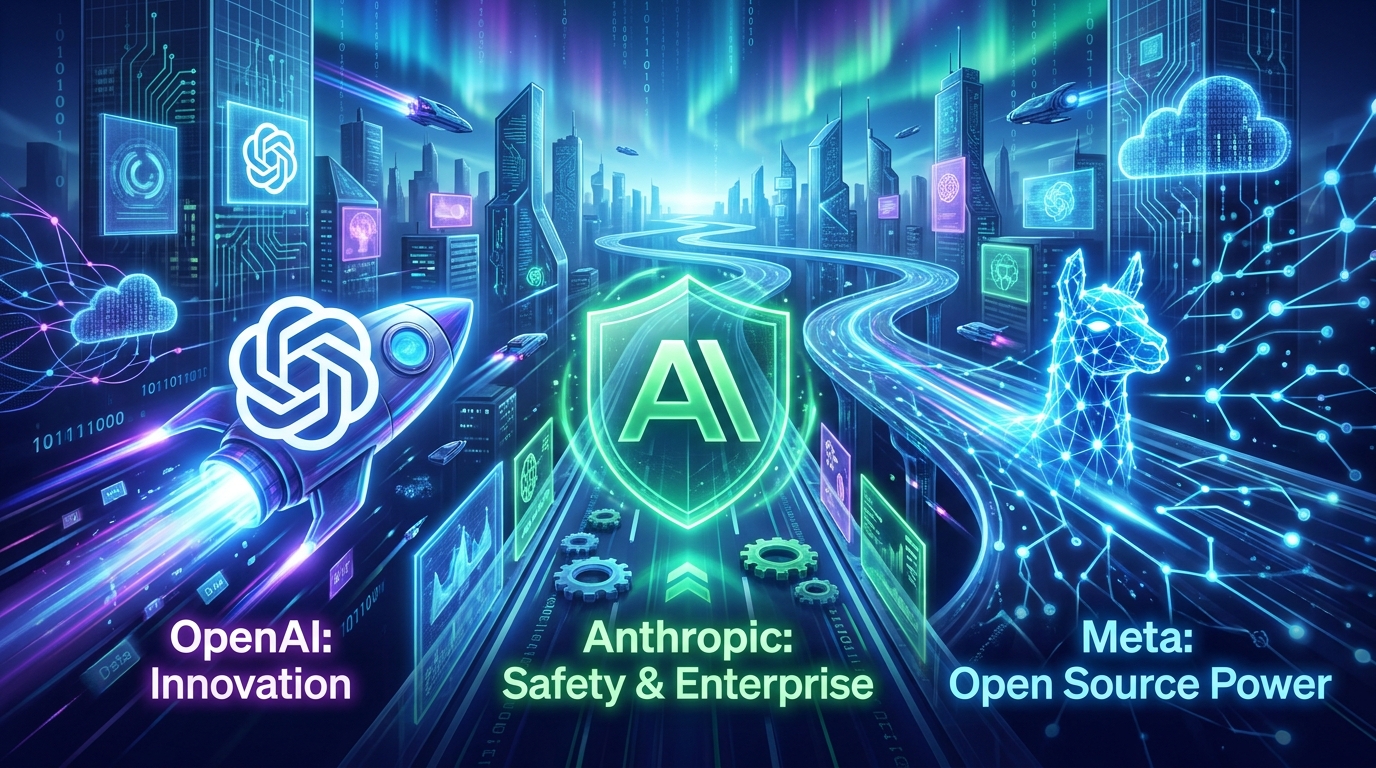
The year 2026 marks a pivotal moment in the artificial intelligence landscape, with three major players-OpenAI, Anthropic, and Meta-leading an intense and rapidly evolving race. Each company brings a unique philosophy and set of strengths to the table, shaping the future of AI in distinct ways. This competition is not just about raw model power; it encompasses a broader battle for developer mindshare, enterprise adoption, and foundational infrastructure.
We will dive deep into their latest model capabilities, their strategies for winning over businesses, their impact on the coding community, and the massive investments underpinning their ambitions. By examining these key dimensions, we aim to uncover who truly holds the lead in this high-stakes technological contest. Understanding their approaches will help developers and businesses make informed decisions in a rapidly changing AI world.
OpenAI continues to set the pace for innovation, consistently pushing the boundaries of what large language models can achieve. With releases like GPT-4o and its anticipated future iterations, OpenAI maintains a strong lead in general-purpose AI capabilities, excelling in multimodal understanding and generation. Their models are renowned for their versatility, handling everything from complex reasoning to creative content generation with impressive fluency.
The company's robust developer ecosystem, powered by a widely adopted API, fosters rapid experimentation and application development across industries. Strategic partnerships, most notably with Microsoft, have cemented OpenAI's position in the enterprise sector, integrating their powerful models into a vast array of business tools and cloud services. This synergy allows businesses to leverage cutting-edge AI with enterprise-grade reliability and support.
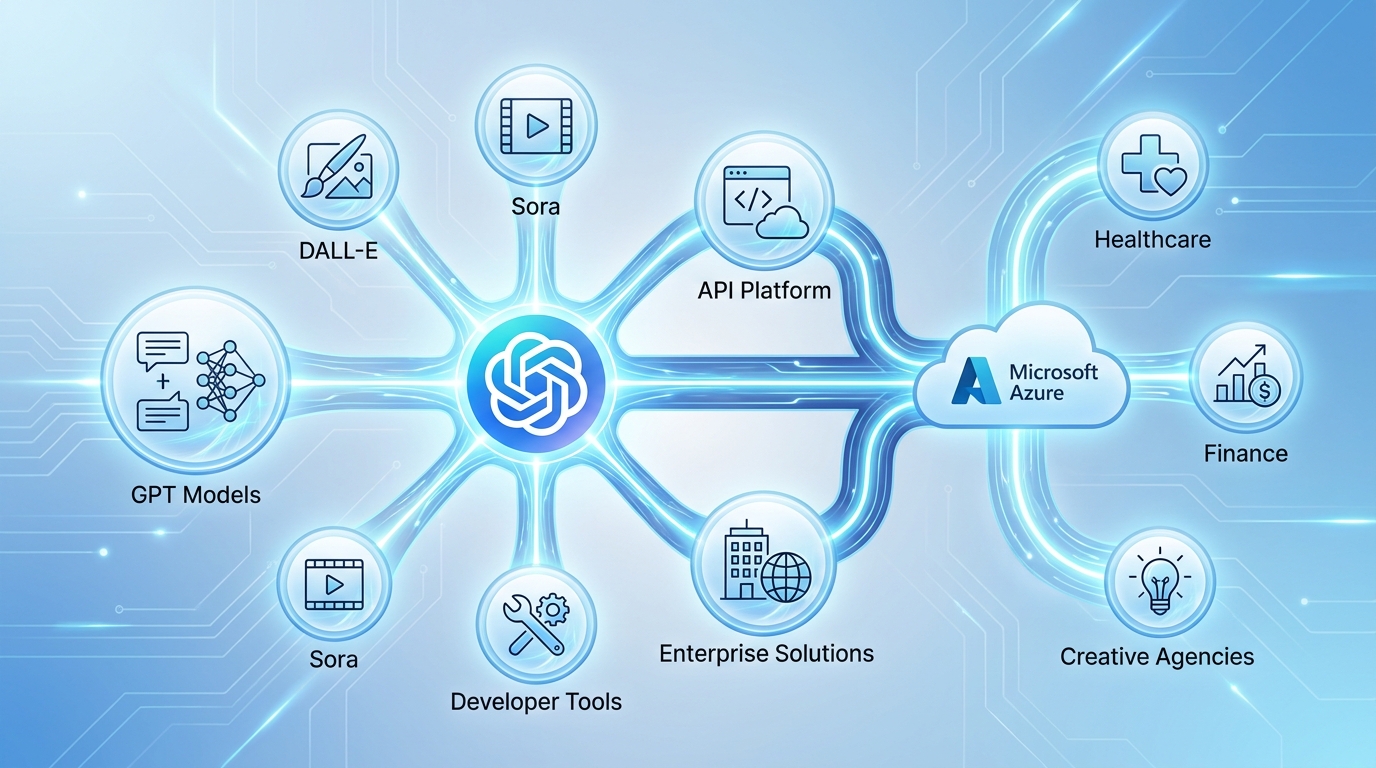
OpenAI's API is straightforward to integrate, allowing developers to quickly build applications that harness advanced text generation. This example demonstrates how to generate a creative story snippet based on a user prompt, showcasing the model's ability to understand context and produce imaginative content. We'll use the openai Python library for this task.
import os
from openai import OpenAI

# Set your OpenAI API key from environment variables for security
# Make sure to set OPENAI_API_KEY in your environment
client = OpenAI(api_key=os.environ.get("OPENAI_API_KEY"))

def generate_story_snippet(prompt: str, model: str = "gpt-4o") -> str:
    """Generates a creative story snippet using OpenAI's API."""
    try:
        response = client.chat.completions.create(
            model=model,
            messages=[
                {"role": "system", "content": "You are a creative storyteller. Generate a captivating story snippet."},
                {"role": "user", "content": prompt}
            ],
            max_tokens=200, # Limit the length of the generated story
            temperature=0.7 # Controls randomness: higher means more creative
        )
        return response.choices[0].message.content
    except Exception as e:
        return f"An error occurred: {e}"

# Example usage
user_prompt = "A lone astronaut discovers an ancient alien artifact on a desolate moon."
story = generate_story_snippet(user_prompt)
print("Generated Story Snippet:")
print(story)Anthropic has carved out a significant niche by prioritizing AI safety and responsible development, a philosophy deeply embedded in their Claude models. Their constitutional AI approach emphasizes ethical guardrails, making Claude a preferred choice for applications requiring high levels of trustworthiness and reduced bias. This focus resonates strongly with enterprises concerned about the ethical implications of AI deployment.
Models like Claude 3.5 Sonnet boast industry-leading context windows, allowing them to process and understand vast amounts of information in a single query. This capability is invaluable for tasks such as comprehensive document analysis, legal review, and long-form content generation, where maintaining context over extended interactions is critical. Anthropic's rapid growth in the enterprise sector is a testament to its unique blend of performance and safety.
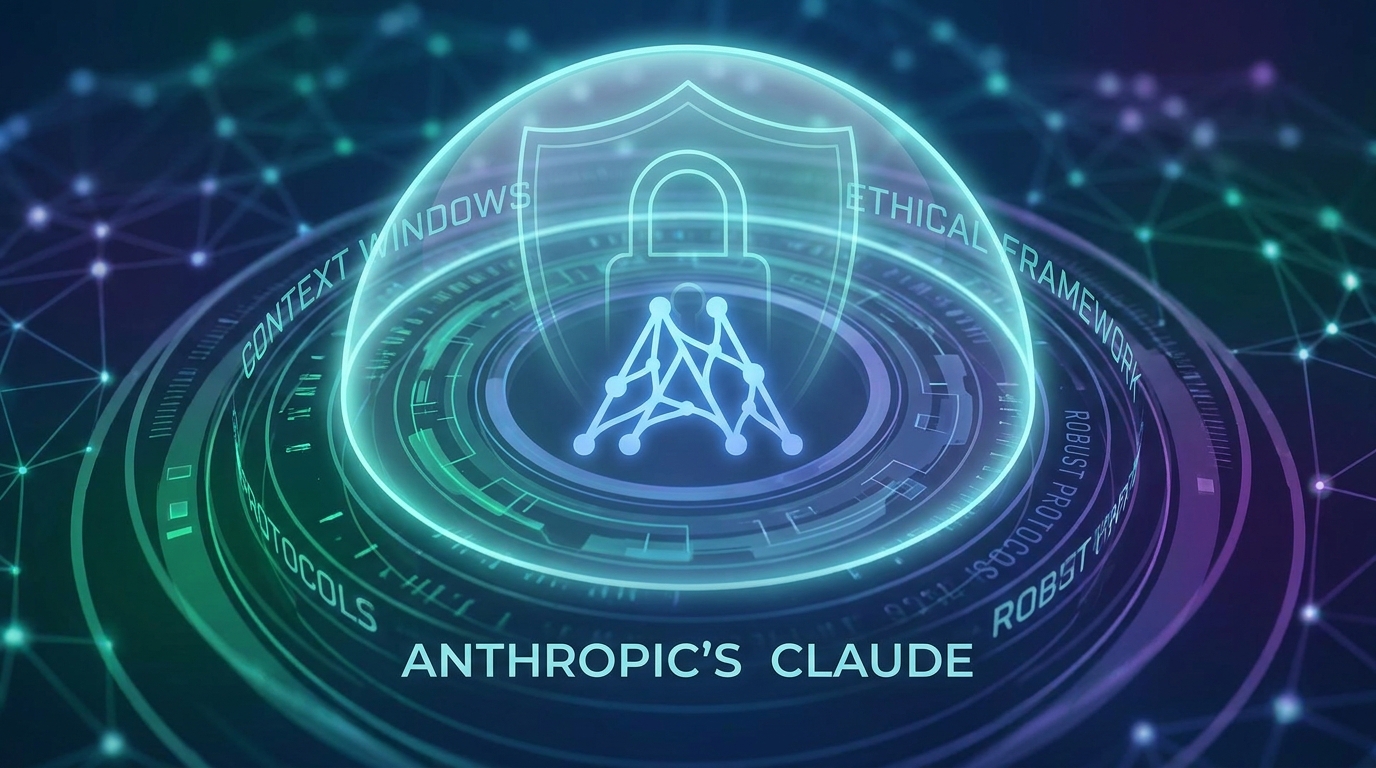
Anthropic's Claude API is designed with safety in mind, making it excellent for applications like content moderation or analyzing sensitive documents. This example shows how to use Claude to evaluate a user comment for potentially harmful content, leveraging its inherent safety mechanisms. We'll use the anthropic Python client.
import os
from anthropic import Anthropic

# Set your Anthropic API key from environment variables
# Make sure to set ANTHROPIC_API_KEY in your environment
client = Anthropic(api_key=os.environ.get("ANTHROPIC_API_KEY"))

def moderate_content(text: str, model: str = "claude-3-5-sonnet-20240620") -> str:
    """Evaluates content for safety using Anthropic's Claude API."""
    try:
        response = client.messages.create(
            model=model,
            max_tokens=100,
            messages=[
                {"role": "user", "content": f"Review the following user comment for any harmful, offensive, or inappropriate content. Provide a concise safety assessment: {text}"}
            ]
        )
        return response.content[0].text
    except Exception as e:
        return f"An error occurred: {e}"

# Example usage with a potentially problematic comment
user_comment_1 = "This is a great product, I love it!"
assessment_1 = moderate_content(user_comment_1)
print(f"Comment 1: '{user_comment_1}'\nAssessment: {assessment_1}\n")

user_comment_2 = "I hate this company and everyone who works there. They should all be fired!"
assessment_2 = moderate_content(user_comment_2)
print(f"Comment 2: '{user_comment_2}'\nAssessment: {assessment_2}")
Meta's strategy in the AI race stands in stark contrast to its competitors, primarily through its commitment to open-source AI with the Llama family of models. By releasing powerful models like Llama 3 to the public, Meta has democratized access to advanced AI, fostering an explosion of innovation within the developer and research communities. This approach challenges the closed-source dominance of OpenAI and Anthropic, promoting transparency and collaborative development.
The Llama ecosystem thrives on community contributions, with countless fine-tuned versions and specialized applications emerging daily. Meta's substantial investments in AI research and infrastructure, including custom hardware and massive data centers, underpin this open-source initiative. This strategy aims for widespread adoption and influence, positioning Llama as a foundational technology for the next generation of AI applications globally.
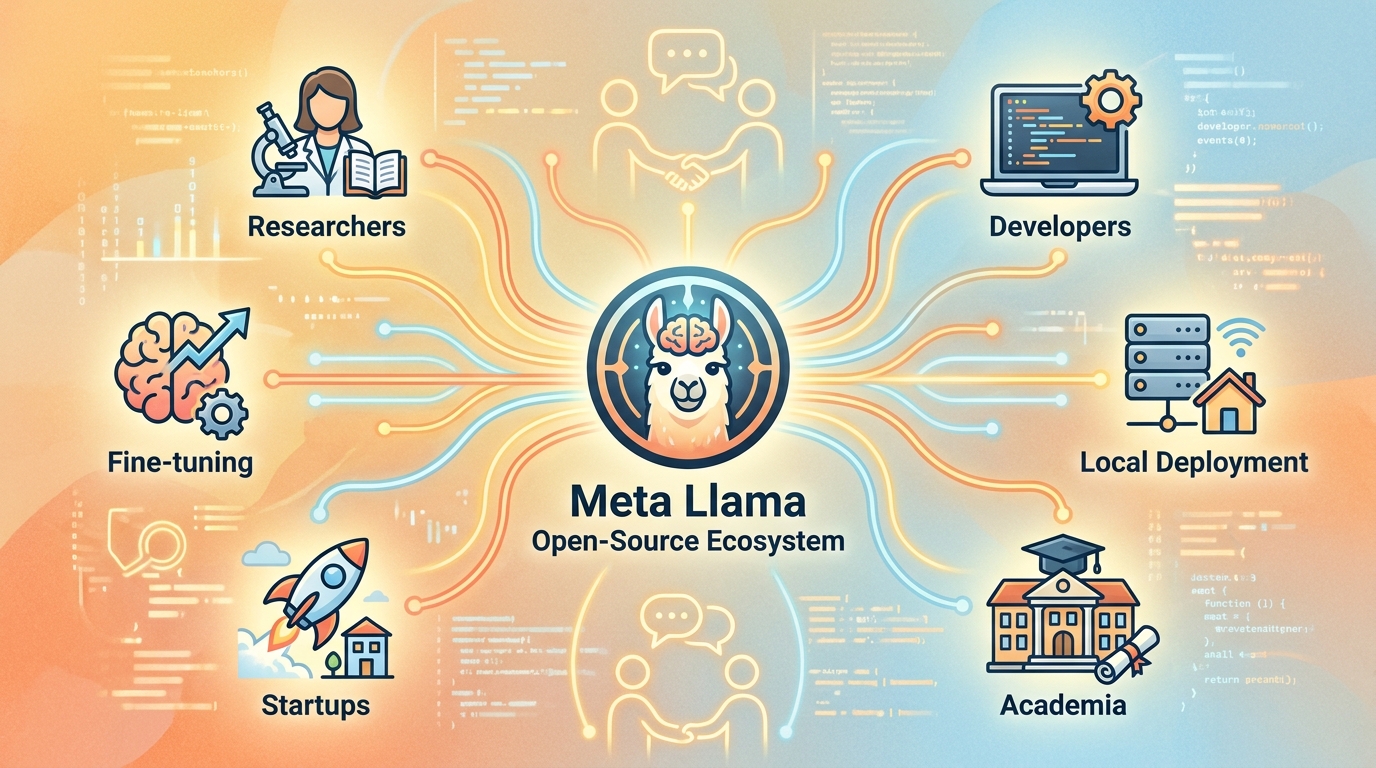
Meta's Llama models are highly accessible, especially through platforms like Hugging Face, enabling local inference or fine-tuning on custom datasets. This example demonstrates how to perform a simple text classification task using a pre-trained Llama model (or a smaller, compatible model for local execution) with the transformers library. This highlights the ease of integrating Llama into various applications.
from transformers import pipeline

# For local inference, you'd typically load a smaller Llama variant or a compatible model.
# For demonstration, we'll use a general text classification model from Hugging Face
# that can be easily run locally. Replace 'distilbert-base-uncased-finetuned-sst-2-english'
# with a Llama-based model if you have it downloaded and configured.

# Initialize the text classification pipeline
# This will download the model if not already present
classifier = pipeline("sentiment-analysis", model="distilbert-base-uncased-finetuned-sst-2-english")

def classify_text_with_llama_like(text: str) -> dict:
    """Performs text classification using a Llama-like model for local inference."""
    # In a real Llama setup, you'd load a Llama tokenizer and model directly.
    # For this example, we simulate a classification task.
    result = classifier(text)
    return result[0]

# Example usage
text_to_classify_1 = "I really enjoyed the new movie, it was fantastic!"
prediction_1 = classify_text_with_llama_like(text_to_classify_1)
print(f"Text: '{text_to_classify_1}'\nPrediction: {prediction_1}\n")

text_to_classify_2 = "The service was terrible and I'm very disappointed."
prediction_2 = classify_text_with_llama_like(text_to_classify_2)
print(f"Text: '{text_to_classify_2}'\nPrediction: {prediction_2}")
The AI race is not just about algorithms; it's fundamentally a battle of infrastructure and capital. OpenAI, backed by Microsoft, leverages vast Azure cloud resources, including specialized AI supercomputers, to train and deploy its cutting-edge models. This partnership provides unparalleled compute power and global reach, enabling rapid iteration and scaling.
Anthropic, while also utilizing cloud providers like AWS and Google Cloud, focuses its investments on developing highly efficient and safe training methodologies, often requiring significant compute for constitutional AI. Meta, on the other hand, invests heavily in its own custom AI chips and massive data centers, building a proprietary infrastructure optimized for training and serving its Llama models. This vertical integration gives Meta unique control over its AI stack.
Strategic partnerships and funding rounds further define their trajectories. OpenAI's deep ties with Microsoft are a clear advantage, while Anthropic has secured substantial investments from Google and Amazon, validating its safety-first approach. Meta's strength lies in its vast internal resources and a long-term vision for an open AI ecosystem, attracting a different kind of investment: community engagement and widespread adoption.

To better understand the competitive landscape, let's look at a side-by-side comparison of these AI titans across several critical dimensions. This table highlights their distinct strengths and strategic focuses as of 2026. Each company has carved out a unique path, appealing to different segments of the AI market.
| Category | OpenAI | Anthropic | Meta |
|---|---|---|---|
| Model Releases | GPT-4o, future multimodal models (leading general-purpose) | Claude 3.5 Sonnet, future Claude models (leading safety/context) | Llama 3, Llama 4 (leading open-source, community-driven) |
| Enterprise Adoption | Strong via Microsoft Azure, broad industry integration | Rapid growth, favored for high-stakes, safety-critical applications | Growing via open-source deployments, custom solutions |
| Coding Capabilities | Excellent API, extensive developer tools, strong ecosystem | Robust API, focus on safe and long-context interactions | Open-source models, fine-tuning flexibility, community libraries |
| Infrastructure | Microsoft Azure (massive compute, global scale) | AWS, Google Cloud (optimized for safety-first training) | Proprietary data centers, custom AI chips (vertical integration) |
| Open-Source Stance | Primarily closed-source, API-driven | Primarily closed-source, API-driven, strong safety research sharing | Strongly open-source (Llama models), community-centric |
| Safety Focus | Significant investment in alignment, safety features | Core philosophy (Constitutional AI), industry leader in safety | Community-driven safety, responsible release guidelines |
| Market Momentum | High innovation, broad market appeal, strong brand recognition | Rapid enterprise adoption, trusted for ethical AI | Widespread developer adoption, democratizing AI access |
This comparison reveals that while OpenAI excels in raw innovation and broad market reach, Anthropic dominates the safety and long-context niche. Meta, through its open-source Llama models, is rapidly becoming the backbone for a new wave of community-driven AI development. The 'winner' often depends on the specific needs and priorities of the user or enterprise.
OpenAI's strength lies in its relentless pursuit of general intelligence and its powerful ecosystem, but it faces challenges in maintaining trust amidst rapid advancements and potential ethical concerns. Anthropic's safety-first approach is a clear differentiator, yet its more controlled development might limit its pace compared to OpenAI's aggressive innovation. Meta's open-source strategy fosters immense community engagement, but ensuring quality and consistency across a decentralized ecosystem can be a hurdle.
Emerging trends like smaller, more efficient models (SLMs), specialized domain-specific AI, and advanced agentic systems will further shape the landscape. Developers choosing between these platforms should consider their project's specific requirements: OpenAI for cutting-edge general capabilities, Anthropic for safety-critical or high-context applications, and Meta's Llama for maximum flexibility, customization, and local deployment. A common pitfall is to assume a one-size-fits-all solution; the best choice is often context-dependent.
The AI race in 2026 is not a simple sprint but a complex marathon with multiple finish lines. OpenAI leads in raw innovation and broad commercialization, Anthropic excels in safety and enterprise trust, and Meta champions open-source accessibility and community empowerment. Each player is 'winning' in its own strategic domain, catering to different needs and values within the vast AI ecosystem.
The future of AI leadership will likely remain dynamic, with shifts influenced by technological breakthroughs, regulatory changes, and evolving market demands. Developers and businesses are fortunate to have such diverse and powerful options, allowing them to choose the platform that best aligns with their goals and ethical considerations. The true victory in this race might ultimately be the collective advancement of AI for the benefit of all.
Smaller AI startups often thrive by focusing on highly specialized niche markets or specific industry verticals. They can develop highly optimized models for unique problems, offering tailored solutions that the general-purpose models from larger players might not address as effectively. Leveraging open-source models like Meta's Llama also allows them to build sophisticated applications without the immense R&D costs of training foundational models from scratch.
Hardware innovation, especially the development of custom AI chips (like Google's TPUs or Nvidia's specialized GPUs), is absolutely crucial. These chips are designed for the specific computational demands of AI workloads, offering significant speed and efficiency advantages over general-purpose CPUs. Companies that can design, procure, or even manufacture their own advanced AI hardware gain a substantial competitive edge in model training, inference speed, and cost efficiency, directly impacting their ability to scale and innovate.
Ethical considerations are increasingly paramount. Key areas include mitigating algorithmic bias to ensure fairness across diverse user groups, ensuring data privacy and security in model training and deployment, and developing robust safety mechanisms to prevent harmful or unintended AI behaviors. Responsible AI development also involves transparency in model capabilities and limitations, and establishing clear governance frameworks for AI's societal impact.
Harness Claude AI agents to create intelligent, autonomous workflows. Discover how to design, deploy, and adapt AI systems for powerful real-world automation
Discover how to earn $1000 monthly leveraging Claude Co-work. This guide shows normal people how to start a profitable content creation business step-by-step
Find the top AI transcription APIs for Indian languages like Hindi, Gujarati, and Tamil. We compare accuracy, speed, features, and pricing to guide your choice