>_Programming Partner
Loading technical insights...
Loading technical insights...
Software Developer
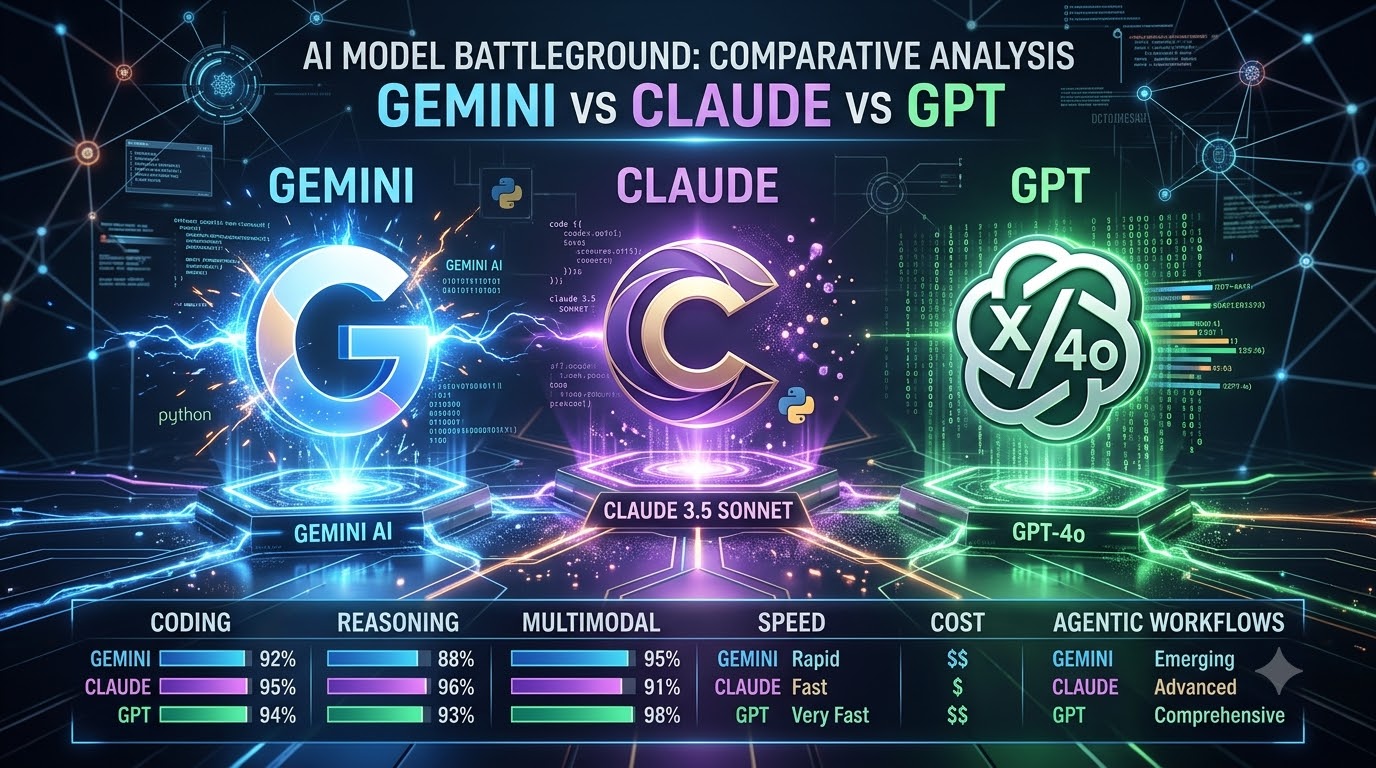
The world of artificial intelligence is currently a vibrant battleground, with Google's Gemini, Anthropic's Claude, and OpenAI's GPT models leading the charge. Each platform pushes the boundaries of what AI can achieve, offering unique strengths and capabilities. This intense competition drives rapid innovation, benefiting developers and users alike.
This article provides a practical, hands-on comparison of these leading AI models. We will focus on crucial factors like reasoning, coding proficiency, multimodal capabilities, speed, and overall cost-effectiveness. Our goal is to help you understand their real-world use cases, rather than simply declaring a single universal winner.
The AI landscape is constantly evolving, with new iterations of models being released regularly. For this comparison, we are focusing on Google's Gemini 3.7 Flash, the latest Claude models (e.g., Claude 3 Opus, Sonnet, Haiku), and recent OpenAI GPT versions (e.g., GPT-4o, GPT-4 Turbo).
Google positions Gemini 3.7 Flash as an efficient powerhouse, particularly suited for reliable AI-agent workloads and high-volume tasks. Meanwhile, Anthropic's Claude and OpenAI's GPT releases continue to emphasize their strengths in complex reasoning, advanced coding, and professional applications. Each model family carves out its niche, offering distinct advantages for different development needs.
Understanding the core features of each model is essential for making informed decisions. This table provides a quick overview of their key specifications and capabilities. We aim to keep this information as up-to-date as possible with the latest model releases.
| Feature | Gemini 3.7 Flash | Claude 3 (Opus/Sonnet/Haiku) | GPT-4o / GPT-4 Turbo |
|---|---|---|---|
| Context Window | 1M tokens | 200K tokens | 128K tokens |
| Multimodal | Strong (Text, Image, Audio, Video) | Strong (Text, Image) | Strong (Text, Image, Audio, Video) |
| Core Reasoning | Good for agentic workflows | Excellent, nuanced | Excellent, broad |
| Coding Proficiency | Good, efficient | Excellent, robust | Excellent, versatile |
| Tool Use | Excellent, agentic vision | Excellent, function calling | Excellent, function calling |
| API Availability | Yes | Yes | Yes |
| Typical Speed | Very Fast | Fast | Fast |
| Pricing Structure | Pay-per-token | Pay-per-token | Pay-per-token |
For developers, the ability of an AI model to generate, debug, and refactor code is paramount. We'll compare how Gemini, Claude, and GPT handle various programming tasks. This includes generating solutions from scratch, identifying and fixing bugs, explaining complex code, and suggesting improvements for larger development tasks.
The differences often lie in the nuance of their output, the efficiency of their solutions, and their adherence to best practices. Observing these variations with identical prompts helps us understand each model's unique coding personality. Let's dive into some practical examples.
Generating clean, functional code is a core capability for these models. We'll use a common algorithm to see how each model approaches the task. The prompt asks for a Python function to calculate the factorial of a number using recursion.
Notice the differences in error handling, docstrings, and overall code structure. Each model has a slightly different approach to what it considers a 'complete' or 'best practice' solution.
Prompt: "Write a Python function to calculate the factorial of a non-negative integer using recursion. Include docstrings and basic error handling for negative input."
Gemini 3.7 Flash Response:
def factorial_gemini(n: int) -> int:
    """
    Calculates the factorial of a non-negative integer using recursion.

    Args:
        n: The non-negative integer.

    Returns:
        The factorial of n.

    Raises:
        ValueError: If n is a negative integer.
    """
    if not isinstance(n, int):
        raise TypeError("Input must be an integer.")
    if n < 0:
        raise ValueError("Factorial is not defined for negative numbers.")
    if n == 0:
        return 1
    else:
        return n * factorial_gemini(n - 1)

# Example usage:
# print(f"Factorial of 5 (Gemini): {factorial_gemini(5)") # Output: 120
# print(f"Factorial of 0 (Gemini): {factorial_gemini(0)") # Output: 1
# try:
#     factorial_gemini(-1)
# except ValueError as e:
#     print(f"Error (Gemini): {e")
Claude 3 Opus Response:
def factorial_claude(n: int) -> int:
    """
    Calculates the factorial of a non-negative integer using recursion.

    Args:
        n: The non-negative integer.

    Returns:
        The factorial of n.

    Raises:
        ValueError: If the input is negative.
    """
    if n < 0:
        raise ValueError("Input must be a non-negative integer.")
    elif n == 0:
        return 1
    else:
        return n * factorial_claude(n - 1)

# Example usage:
# print(f"Factorial of 5 (Claude): {factorial_claude(5)") # Output: 120
# print(f"Factorial of 0 (Claude): {factorial_claude(0)") # Output: 1
# try:
#     factorial_claude(-1)
# except ValueError as e:
#     print(f"Error (Claude): {e")
GPT-4o Response:
def factorial_gpt(n: int) -> int:
    """
    Calculates the factorial of a non-negative integer using recursion.

    Args:
        n (int): The non-negative integer for which to calculate the factorial.

    Returns:
        int: The factorial of the given integer.

    Raises:
        ValueError: If the input integer `n` is negative.
    """
    if not isinstance(n, int):
        raise TypeError("Input must be an integer.")
    if n < 0:
        raise ValueError("Factorial is not defined for negative numbers.")
    # Base case
    if n == 0:
        return 1
    # Recursive case
    else:
        return n * factorial_gpt(n - 1)

# Example usage:
# print(f"Factorial of 5 (GPT): {factorial_gpt(5)") # Output: 120
# print(f"Factorial of 0 (GPT): {factorial_gpt(0)") # Output: 1
# try:
#     factorial_gpt(-1)
# except ValueError as e:
# print(f"Error (GPT): {e")Beyond generating new code, an AI's ability to debug and refactor existing code is incredibly valuable. We'll present a simple Python function with a subtle bug and ask each model to identify and fix it. This demonstrates their analytical capabilities.
The prompt also asks for refactoring to improve readability and efficiency. This tests their understanding of best practices and their ability to suggest meaningful improvements. Pay attention to how each model explains its changes.
Prompt: "The following Python function is intended to find the sum of all even numbers in a list. It has a bug. Identify the bug, fix it, and then refactor the function for better readability and efficiency. Explain your changes."
def sum_evenₙumbers_buggy(numbers):
    total = 0
    for num in numbers:
        if num % 2 != 0: # Bug: should be == 0 for even numbers
            total += num
    return total

# Example usage:
# print(sum_evenₙumbers_buggy([1, 2, 3, 4, 5, 6])) # Expected: 12 (2+4+6), Actual: 9 (1+3+5)
Gemini 3.7 Flash Fix and Refactor:
def sum_evenₙumbers_gemini(numbers: list[int]) -> int:
    """
    Calculates the sum of all even numbers in a list.

    Args:
        numbers: A list of integers.

    Returns:
        The sum of even numbers.
    """
    if not isinstance(numbers, list):
        raise TypeError("Input must be a list.")
    total = 0
    for num in numbers:
        if isinstance(num, int) and num % 2 == 0: # Fixed bug and added type check
            total += num
    return total

# Explanation of changes:
# 1. Bug Fix: Changed `num % 2 != 0` to `num % 2 == 0` to correctly identify even numbers.
# 2. Refactoring:
#    - Added type hints for better code clarity and maintainability.
#    - Added a docstring to explain the function's purpose, arguments, and return value.
#    - Included a check to ensure the input is a list and elements are integers, improving robustness.

# print(f"Sum of even numbers (Gemini): {sum_evenₙumbers_gemini([1, 2, 3, 4, 5, 6])") # Output: 12
Claude 3 Opus Fix and Refactor:
def sum_evenₙumbers_claude(numbers: list[int]) -> int:
    """
    Calculates the sum of all even numbers in a list of integers.

    Args:
        numbers: A list of integers.

    Returns:
        The sum of the even numbers in the list.
    """
    if not all(isinstance(n, int) for n in numbers):
        raise TypeError("All elements in the list must be integers.")
    return sum(num for num in numbers if num % 2 == 0) # Fixed bug and refactored using generator expression

# Explanation of changes:
# 1. Bug Fix: The original condition `num % 2 != 0` was incorrect for even numbers. It has been changed to `num % 2 == 0`.
# 2. Refactoring for Readability and Efficiency:
#    - Used a generator expression within the `sum()` function. This is more concise and often more Pythonic.
#    - Added type hints for `numbers` and the return value for better code clarity.
#    - Added a docstring to clearly explain the function's purpose.
#    - Added a check to ensure all elements in the input list are integers.

# print(f"Sum of even numbers (Claude): {sum_evenₙumbers_claude([1, 2, 3, 4, 5, 6])") # Output: 12
GPT-4o Fix and Refactor:
def sum_evenₙumbers_gpt(numbers: list) -> int:
    """
    Calculates the sum of all even numbers in a list of integers.

    Args:
        numbers (list): A list of integers.

    Returns:
        int: The sum of the even numbers.

    Raises:
        TypeError: If the input is not a list or contains non-integer elements.
    """
    if not isinstance(numbers, list):
        raise TypeError("Input must be a list.")

    total = 0
    for num in numbers:
        if not isinstance(num, int):
            raise TypeError(f"List element '{num' is not an integer.")
        if num % 2 == 0: # Fixed: changed != to == to correctly identify even numbers
            total += num
    return total

# Explanation of changes:
# 1. Bug Fix: The original condition `if num % 2 != 0:` incorrectly added odd numbers. It was changed to `if num % 2 == 0:` to correctly sum even numbers.
# 2. Refactoring:
#    - Added type hints for better readability and maintainability.
#    - Included a comprehensive docstring explaining the function's purpose, arguments, return value, and potential errors.
#    - Added explicit type checking for both the input `numbers` list and its individual elements to ensure robustness.

# print(f"Sum of even numbers (GPT): {sum_evenₙumbers_gpt([1, 2, 3, 4, 5, 6])") # Output: 12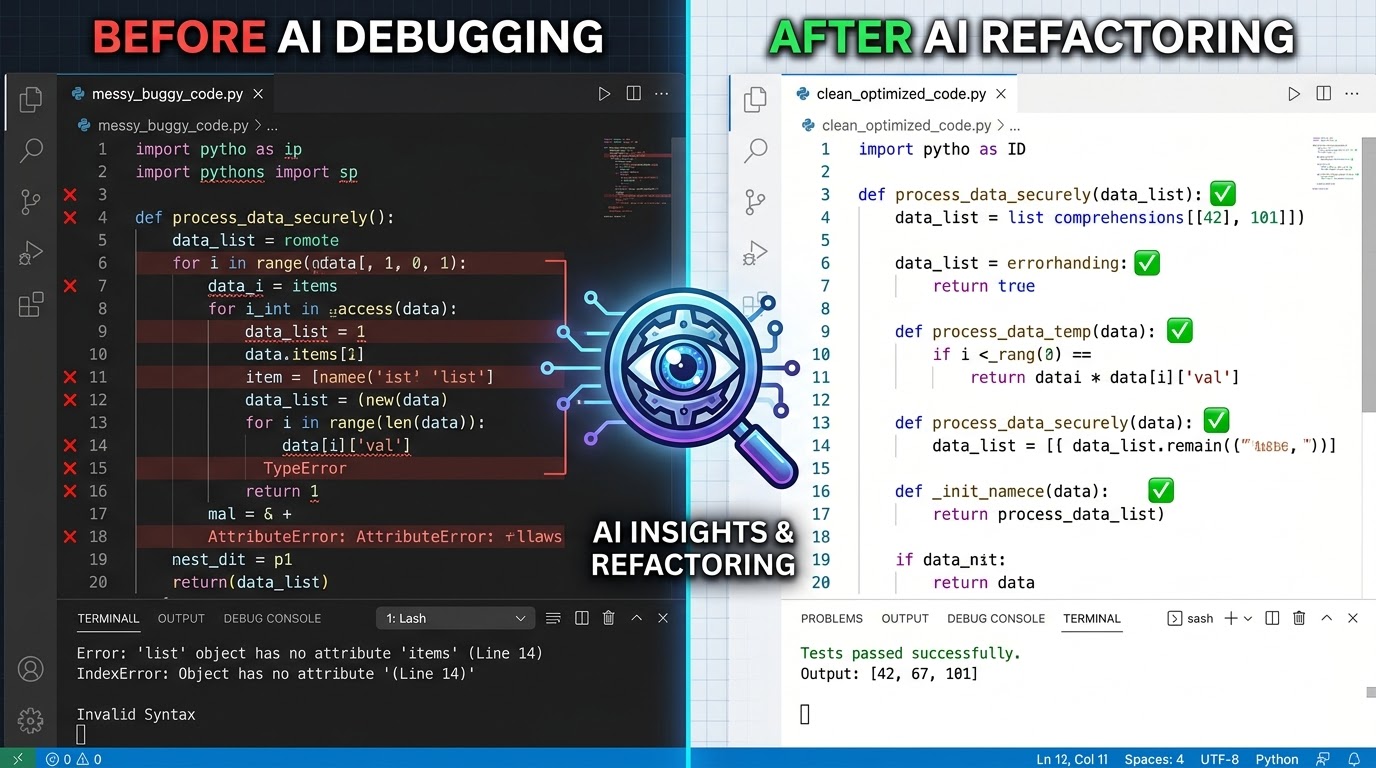
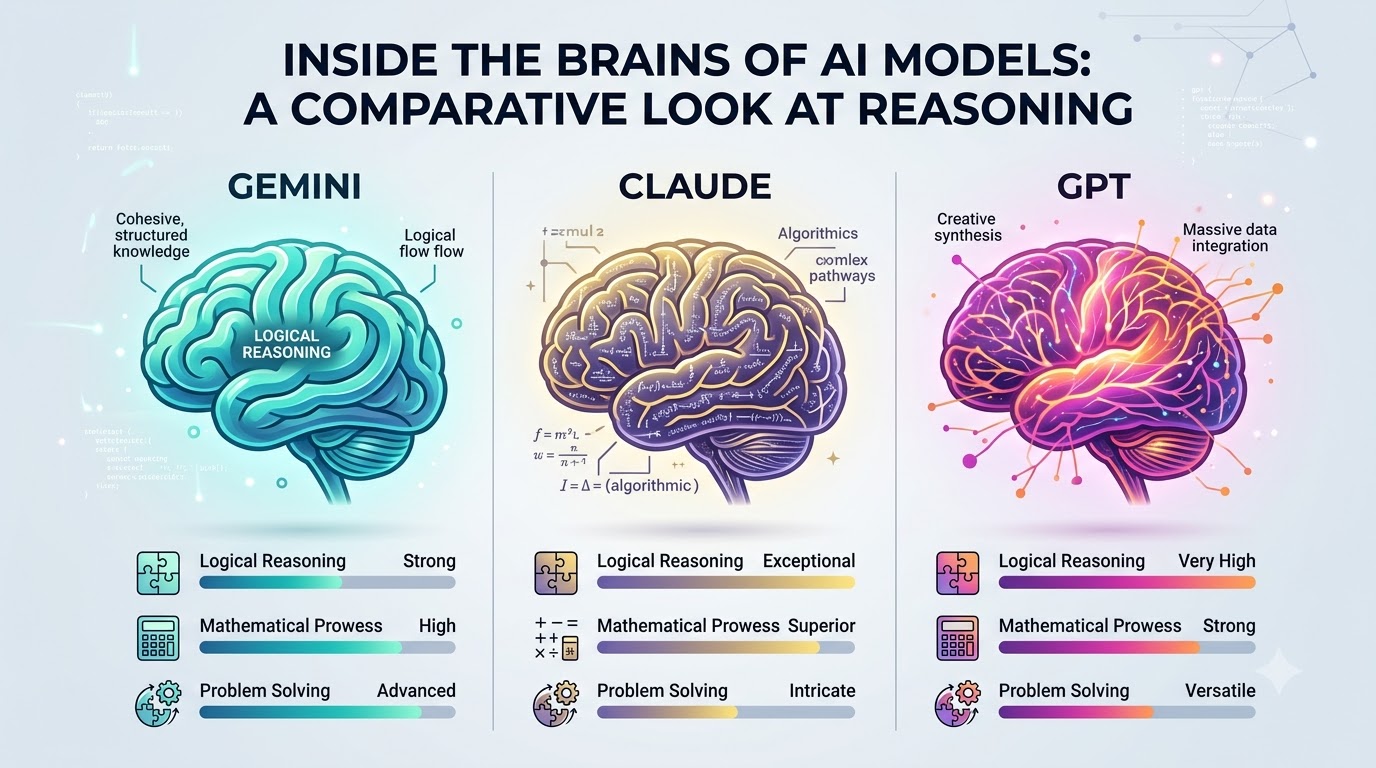
Beyond code, the true power of these LLMs lies in their reasoning and problem-solving capabilities. This includes tackling mathematical problems, logical puzzles, and multi-step research-style questions. Each model exhibits varying strengths in these areas.
While benchmark scores offer a quantitative measure, they don't always capture real-world performance nuances. A model might score high on a specific math benchmark but struggle with a creatively phrased logical problem. Practical evaluation often requires more than just raw scores.
Claude 3 Opus, for instance, is often lauded for its strong logical reasoning and ability to follow complex instructions over long contexts. GPT-4o demonstrates broad general knowledge and robust performance across diverse reasoning tasks. Gemini 3.7 Flash, while optimized for speed, still provides solid reasoning, especially when integrated into agentic workflows.
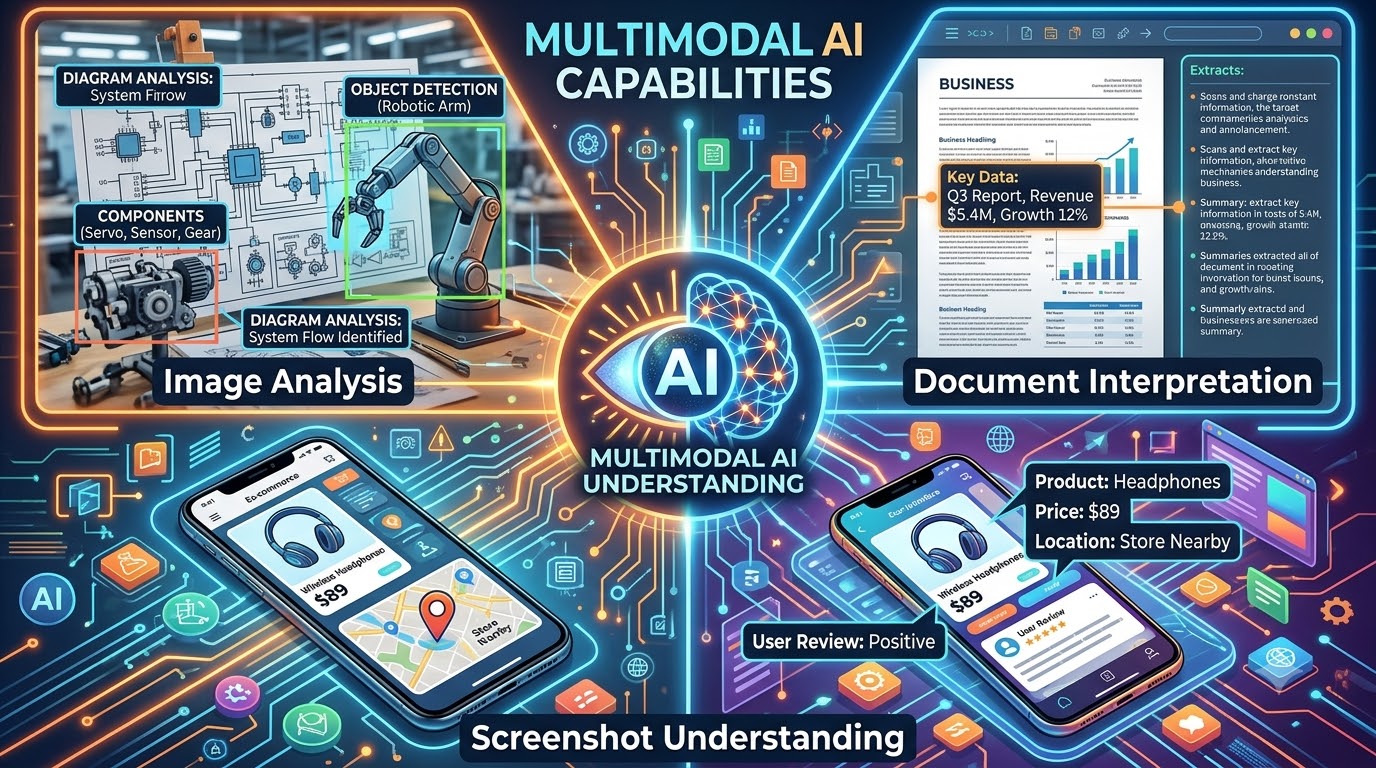
The ability to interpret and respond to queries based on various media types is a game-changer. Multimodal capabilities allow these models to go beyond text, understanding images, documents, screenshots, and even audio or video. This opens up a vast array of new applications.
Google's Gemini family, particularly Gemini 3 Flash, places a strong emphasis on multimodal understanding and 'agentic vision'. This means it can not only describe what's in an image but also understand its context and use that information to perform actions. For example, it could analyze a screenshot of a UI and suggest the next steps for a user.
GPT-4o also boasts impressive multimodal capabilities, handling text, image, and audio inputs and outputs seamlessly. Claude 3 models are strong with text and image understanding, excelling at interpreting complex charts or diagrams within documents. These capabilities are crucial for tasks like document analysis, visual search, and automated content creation from diverse sources.
The true frontier of AI application lies in building intelligent agents. These models serve as the reasoning engine for AI agents, enabling them to perform complex, multi-step workflows. This involves calling external APIs, searching for information, and interacting with various tools to achieve a goal.
Agentic vision, as seen in Gemini, allows agents to 'see' and interpret visual information, making them capable of interacting with graphical user interfaces or understanding complex diagrams. All three model families provide robust function calling capabilities, allowing developers to define tools that the AI can choose to use. This transforms LLMs from mere conversationalists into powerful orchestrators.
For a deeper dive into building such systems, you might find our article "How to Build AI Agents with Anthropic's Claude" particularly insightful. It explores practical approaches to leveraging these models for agentic applications. The ability to chain together actions and make decisions based on real-time data is a hallmark of advanced AI agents.
Integrating LLMs with external tools is fundamental for building practical AI agents. This allows the AI to extend its capabilities beyond its training data, accessing real-time information or performing specific actions. We'll demonstrate a simple example of an agent using a hypothetical weather API.
The model is prompted to understand when to call the get_current_weather tool and how to interpret its output. This showcases the power of function calling, where the LLM acts as a planner and executor. The agent decides which tool to use based on the user's request.
import json

# Define a mock tool function
def get_current_weather(location: str, unit: str = "celsius") -> str:
    """
    Gets the current weather in a given location.

    Args:
        location: The city and state, e.g. "San Francisco, CA"
        unit: The unit of temperature, either "celsius" or "fahrenheit".
              Defaults to "celsius".

    Returns:
        A JSON string with weather information.
    """
    if location == "London, UK":
        return json.dumps({"location": location, "temperature": "15", "unit": unit, "forecast": "cloudy")
    elif location == "New York, USA":
        return json.dumps({"location": location, "temperature": "22", "unit": unit, "forecast": "sunny")
    else:
        return json.dumps({"location": location, "temperature": "unknown", "unit": unit, "forecast": "unknown")

# This is how an LLM might 'call' the tool based on a user prompt
# In a real scenario, the LLM would generate a tool call object/string
# For demonstration, we simulate the tool call here.

def simulate_llm_tool_use(user_query: str):
    if "weather" in user_query.lower() and "london" in user_query.lower():
        print("LLM detected weather query for London. Calling get_current_weather...")
        weather_data = get_current_weather("London, UK", "celsius")
        print(f"Tool output: {weather_data")
        print("LLM would now summarize this: The current weather in London, UK is 15 degrees Celsius and cloudy.")
    elif "weather" in user_query.lower() and "new york" in user_query.lower():
        print("LLM detected weather query for New York. Calling get_current_weather...")
        weather_data = get_current_weather("New York, USA", "fahrenheit")
        print(f"Tool output: {weather_data")
        print("LLM would now summarize this: The current weather in New York, USA is 22 degrees Fahrenheit and sunny.")
    else:
        print("LLM did not detect a relevant tool call for this query.")

# Example usage:
# simulate_llm_tool_use("What's the weather like in London?")
# simulate_llm_tool_use("Tell me about the weather in New York in Fahrenheit.")
# simulate_llm_tool_use("Write a poem.")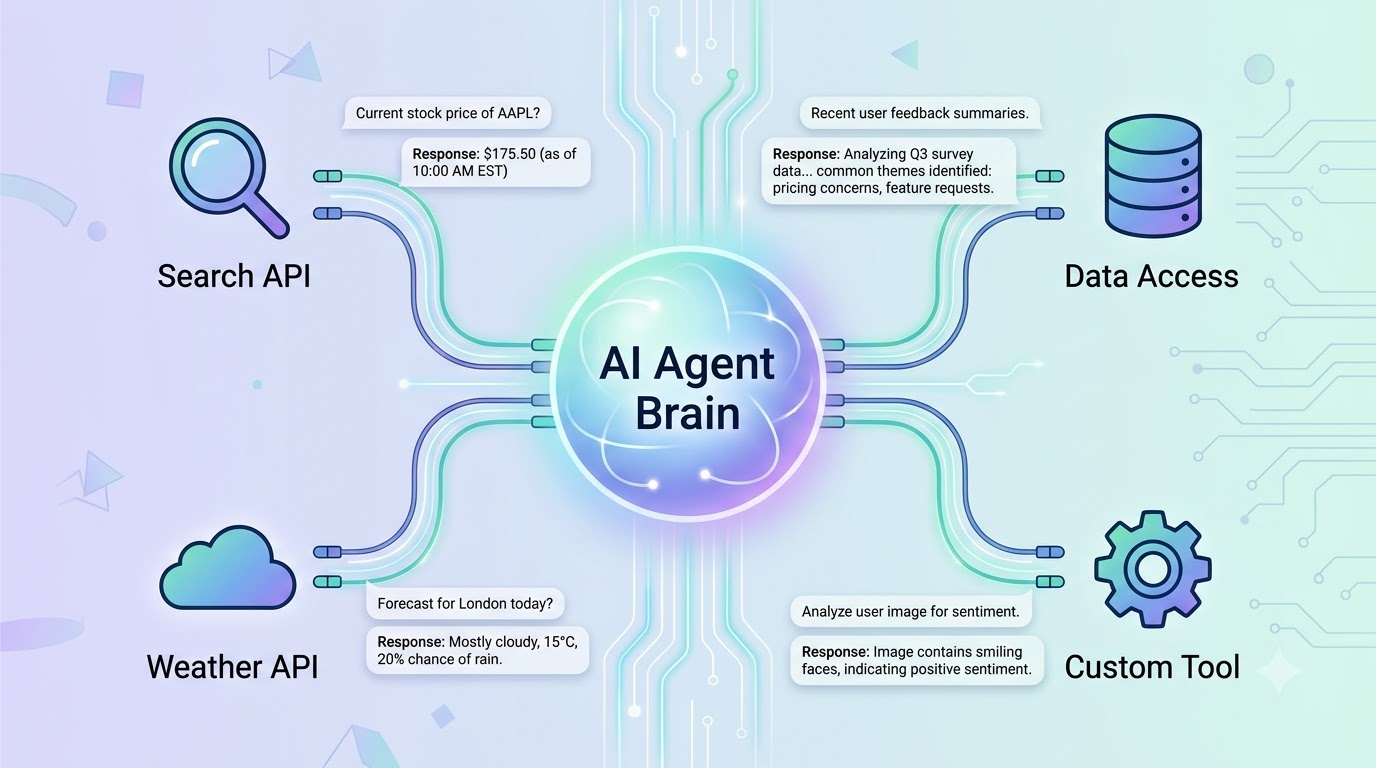
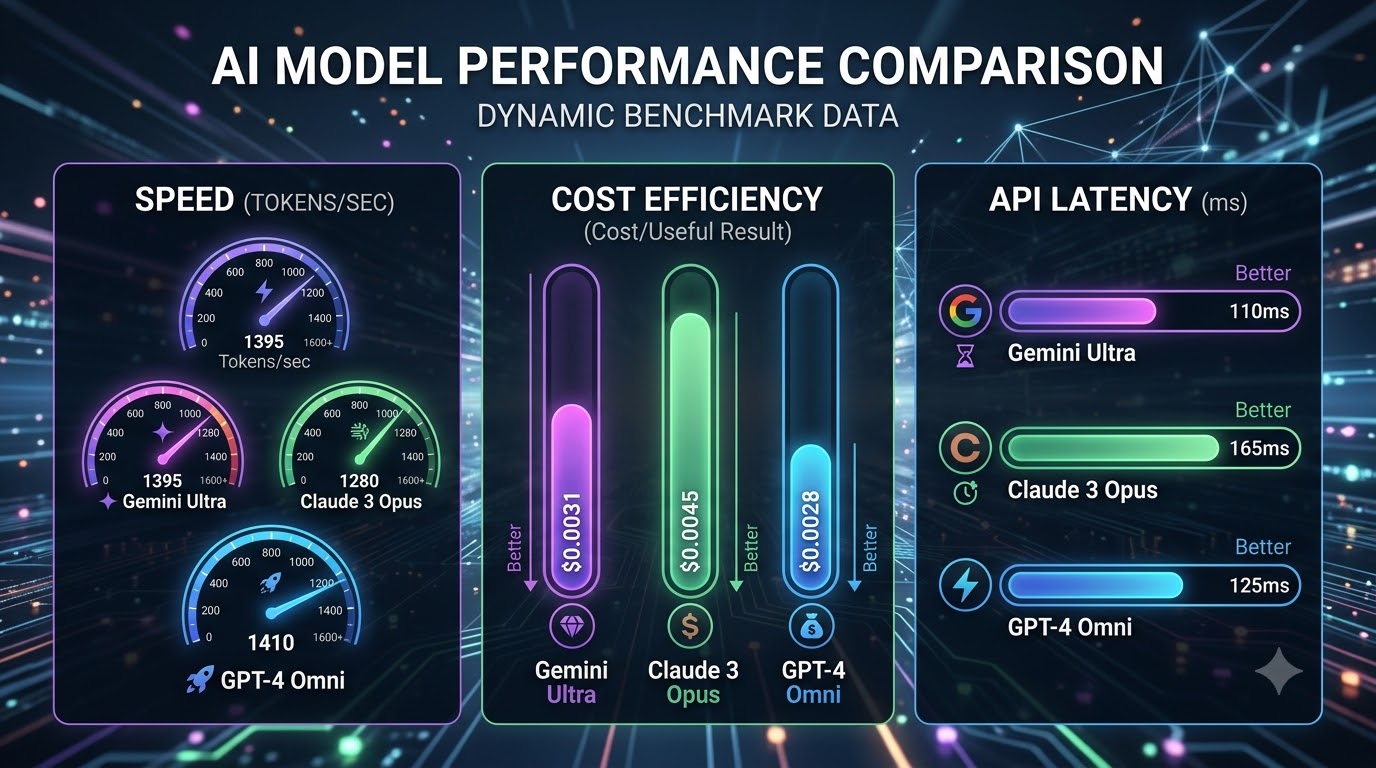
When deploying AI models in production, speed and cost are critical factors. Developers need to consider not just the raw token price but also the overall cost per useful result. A cheaper model that requires more tokens or more complex prompting might end up being more expensive in the long run.
Response speed, measured in tokens per second or latency, directly impacts user experience and application responsiveness. API availability and ease of integration are also crucial for developers. Each model offers a robust API, but their specific pricing tiers and rate limits can vary significantly.
| Metric | Gemini 3.7 Flash | Claude 3 (Opus/Sonnet/Haiku) | GPT-4o / GPT-4 Turbo |
|---|---|---|---|
| Input Token Price (approx.) | Very Low | Low to Medium | Low to Medium |
| Output Token Price (approx.) | Very Low | Medium to High | Medium to High |
| Response Speed | Extremely Fast | Fast | Fast |
| Token Efficiency | High (for flash) | High | High |
| API Latency | Very Low | Low | Low |
| Cost per Useful Result | Excellent for high-volume, simple tasks | Excellent for complex, high-quality tasks | Excellent for versatile, balanced tasks |
There isn't a single 'best' AI model; the ideal choice depends entirely on your specific requirements. Each model family excels in different areas, making them suitable for distinct use cases. Understanding these strengths helps you pick the right tool for the job.
For instance, if you're building high-volume AI agents that need to process information quickly and cost-effectively, Gemini 3.7 Flash is an excellent contender. Its speed and efficiency make it perfect for tasks where rapid iteration and low latency are crucial. This model is designed for scale.
For complex reasoning, nuanced understanding, and robust coding, Claude 3 Opus often stands out. It's a strong choice for professional applications, research, and tasks requiring deep contextual comprehension. GPT-4o and GPT-4 Turbo offer a versatile balance, performing exceptionally well across a broad spectrum of tasks, from creative writing to advanced coding and multimodal interactions. They are often a safe and powerful default for general AI application development.
In this ultimate AI showdown, we've seen that Gemini 3.7 Flash, Claude, and GPT each bring unique strengths to the table. Gemini 3.7 Flash shines in speed, cost-efficiency, and agentic vision, making it ideal for high-throughput agent workflows. Claude excels in complex reasoning, long context understanding, and robust coding, perfect for demanding professional tasks.
GPT-4o and GPT-4 Turbo offer a powerful, well-rounded performance across coding, reasoning, and multimodal capabilities, serving as a versatile choice for general AI application development. The 'best' model is not a fixed entity but rather a dynamic choice. It depends heavily on your specific task requirements, budget constraints, existing technical ecosystem, and the desired capabilities of your application.
By carefully evaluating these factors, developers can confidently navigate the evolving LLM landscape and select the AI champion that best empowers their projects. The future of AI is diverse, and embracing the strengths of each model will lead to more innovative and effective solutions.
Agentic vision refers to an AI model's ability to not only understand visual input but also to use that understanding to drive actions and decisions within an agentic workflow. It's crucial for agents that need to interpret complex visual information, like screenshots or diagrams, to complete multi-step tasks or interact with user interfaces effectively. This capability allows AI agents to 'see' and 'understand' the digital world, much like a human.
Token costs are the raw price per unit of input or output. However, real-world application expenses depend on the 'cost per useful result'. A cheaper model might generate more tokens to achieve the same quality output as a more expensive, but more efficient, model. Developers should benchmark models with their specific use cases to determine which offers the best value for money, considering both token price and output quality.
In professional settings, these LLMs excel in various advanced applications. They can power sophisticated customer support chatbots, automate complex data analysis and report generation, assist in legal document review, or even act as virtual research assistants by synthesizing information from vast datasets. Their reasoning and context handling capabilities make them invaluable for tasks requiring nuanced understanding and generation of human-like text.
When starting a new project, key considerations include the project's specific requirements, such as the need for strong coding, reasoning, or multimodal capabilities. Developers should also evaluate the model's cost-effectiveness for their expected usage, its integration ease with existing systems via APIs, and the community support or ecosystem available. Data privacy and security features are also paramount, especially for sensitive applications.
Discover how to earn $1000 monthly leveraging Claude Co-work. This guide shows normal people how to start a profitable content creation business step-by-step
Find the top AI transcription APIs for Indian languages like Hindi, Gujarati, and Tamil. We compare accuracy, speed, features, and pricing to guide your choice
Discover OpenAI's GPT-6 Astra. Learn how this AI outperforms Claude Fable and Meta AI in performance, features, and real-world applications with comparisons