>_Programming Partner
Loading technical insights...
Loading technical insights...
Software Developer
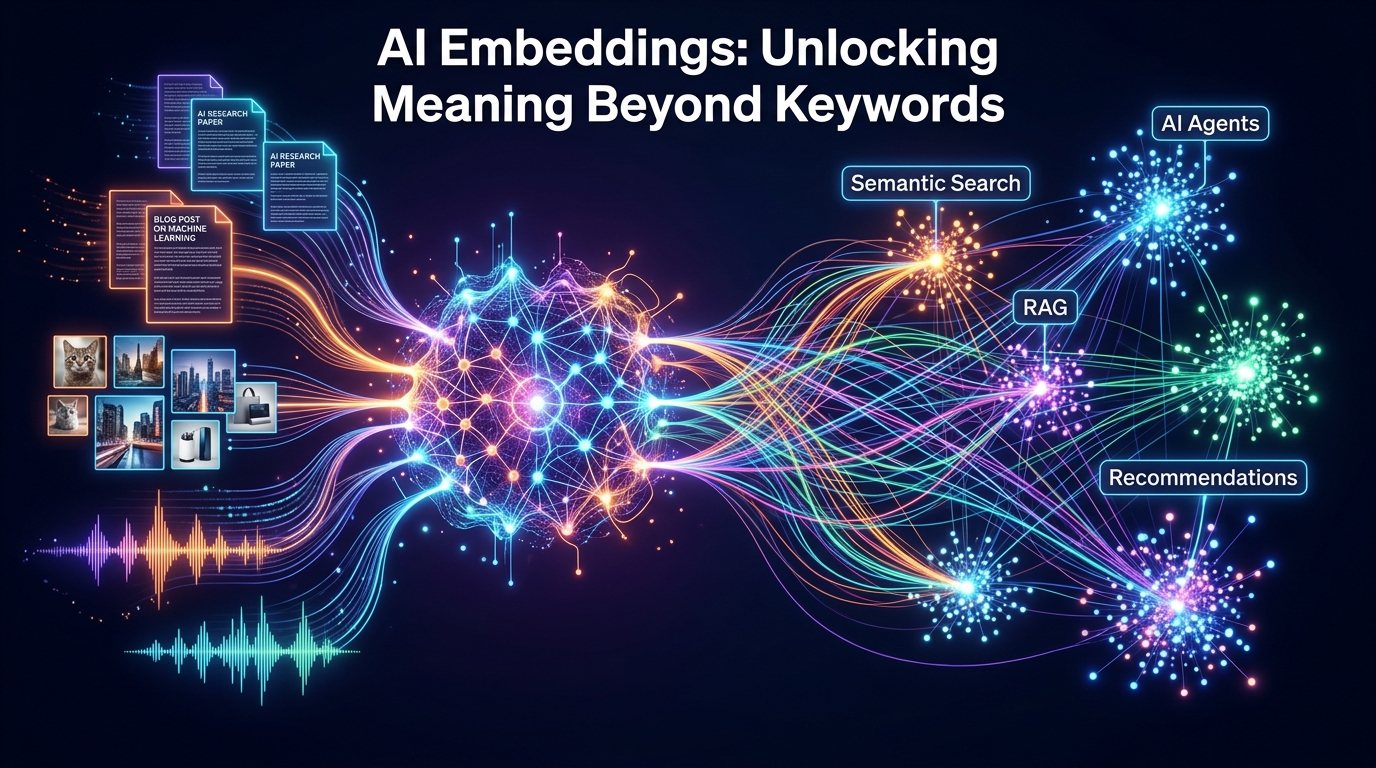
Computers traditionally struggle to understand human language beyond exact keyword matches. This fundamental limitation prevents them from grasping the true meaning and context behind our words. Imagine searching for 'large canine' and only getting results for 'big dog' if the exact phrase isn't present.
This is where AI embeddings revolutionize how machines process information. Embeddings bridge this gap by capturing the meaning and context of text, images, and other data. They transform raw data into a format AI can truly understand, moving beyond simple lexical matching.
This shift from lexical to semantic understanding makes advanced AI applications possible. Modern systems like ChatGPT, sophisticated semantic search engines, and intelligent AI assistants all rely heavily on embeddings. They are the secret sauce enabling AI to comprehend and interact with the world in a more human-like way.
At their core, embeddings are numerical vector representations of data. Think of them as a list of numbers that mathematically describe a piece of information, whether it's a word, a sentence, an entire document, an image, or even an audio clip. Each number in the vector represents a specific semantic feature or characteristic of the data.
These vectors are typically high-dimensional, meaning they contain many numbers (e.g., 128, 768, or even thousands of dimensions). The magic happens because data points with similar meanings or characteristics are located close to each other in this abstract vector space. Conversely, unrelated concepts are positioned far apart.
Consider an analogy: imagine plotting cities on a map. Cities that are geographically close are similar in location. Similarly, in an embedding space, words like 'king' and 'queen' would be very close, while 'king' and 'pizza' would be far apart. This proximity allows AI to infer relationships and understand context.
Traditional keyword-based search systems have inherent limitations. They rely on exact matches or simple stemming, often failing to grasp synonyms, context, or the true intent behind a user's query. A search for 'car' might not return results for 'automobile' or 'vehicle', even though they mean the same thing.
Embeddings overcome these issues by allowing AI to understand the relationships between concepts. Instead of just matching words, they match meanings. This means a search for 'healthy food' can return articles about 'nutritious meals' or 'dietary benefits', even if the exact phrase 'healthy food' isn't present.
This semantic understanding leads to significantly more accurate, relevant, and intelligent responses across various applications. From finding the right document to generating human-like text, embeddings empower AI to move beyond superficial keyword matching and delve into the deeper layers of meaning.
The process of generating embeddings involves a sophisticated pipeline that transforms raw data into meaningful numerical vectors. This pipeline typically starts with your input text and goes through several stages before producing the final embedding.
First, the input text is prepared for the model. Then, a specialized embedding model, often a neural network, processes this prepared text. This model has been trained on vast amounts of data to learn the intricate patterns of language and meaning.
Finally, the model outputs a high-dimensional vector. This vector is a mathematical encapsulation of the semantic meaning of the original input. It represents the text's context, nuances, and relationships to other concepts in a way that computers can process and compare efficiently.
Let's break down the embedding generation process into its core steps, illustrating how text is transformed into a numerical representation.
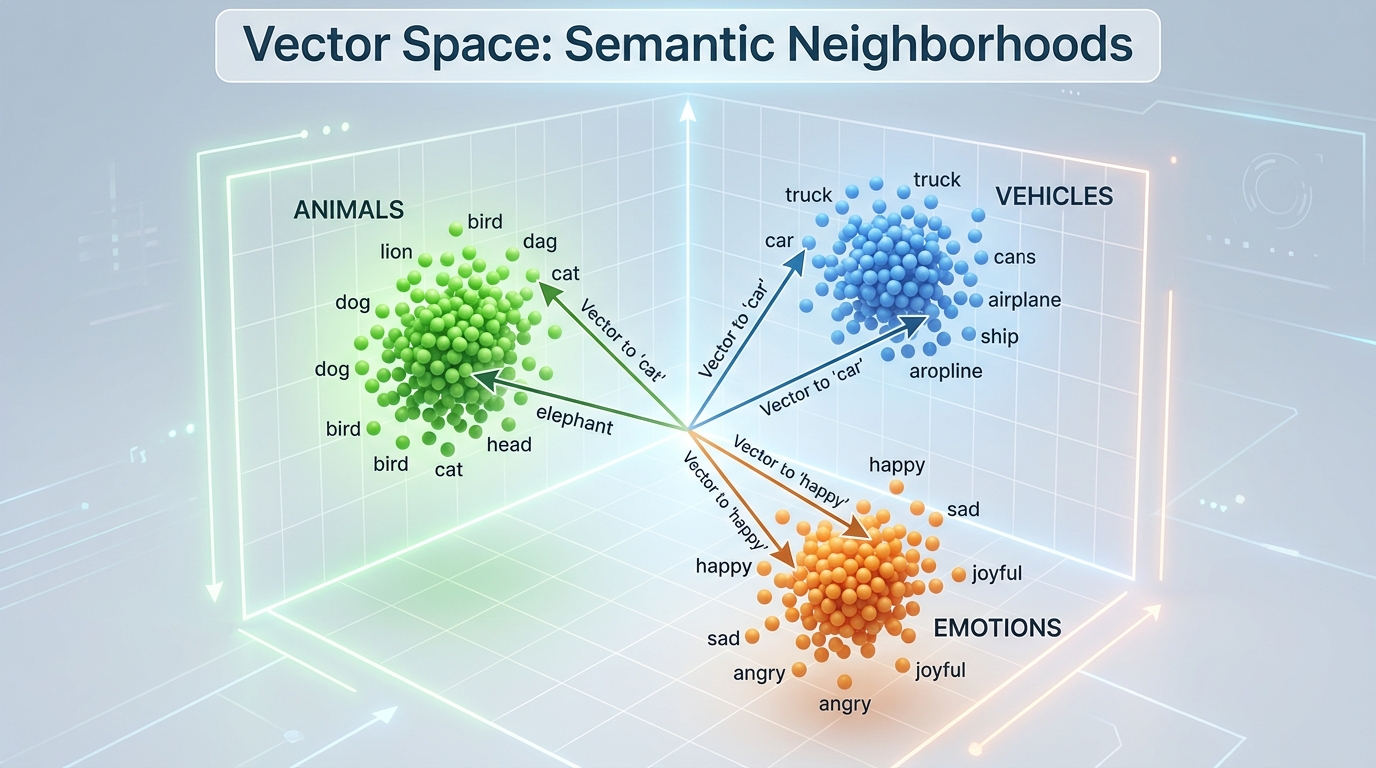
[0.12, -0.05, 0.88, ..., 0.34].Imagine a vast, abstract space where every piece of content you can think of-a word, a sentence, a document, an image-exists as a single point. This is the concept of a vector space, a multi-dimensional mathematical environment where embeddings reside.
In this space, the proximity of points is crucial. Content that is semantically similar will appear closer together, forming distinct 'neighborhoods' or clusters. For instance, all documents about 'dogs' might cluster in one area, while documents about 'cars' would be in another, distant region.
Conversely, content that is unrelated will be positioned farther apart in this space. This spatial arrangement allows AI systems to quickly identify and retrieve information that is conceptually similar, even if the exact keywords are not present. It's how AI understands relationships without explicit rules.
Embeddings are not a one-size-fits-all solution; they come in various types, each designed to capture meaning at different granularities and across different data modalities. Understanding these distinctions is key to leveraging their full power in AI applications.
The most common types include word, sentence, and document embeddings, which focus on textual data. Beyond text, embeddings extend to other forms of data, enabling AI to understand images, audio, and even combinations of these.
Each type serves a specific purpose, allowing AI systems to process and relate information effectively. This diversity ensures that AI can build a comprehensive understanding of complex data sets.
Let's delve into the nuances of different embedding types and their primary applications:
The field of embeddings has seen rapid innovation, leading to the development of numerous powerful models. These models differ in their architecture, training data, and the specific semantic nuances they are best at capturing. Choosing the right model is crucial for optimal performance in your AI application.
Some models are designed for speed and efficiency, while others prioritize deep contextual understanding. Many are open-source and can be run locally, while others are offered as commercial APIs, providing convenience and scalability.
Understanding the strengths and typical use cases of these popular models helps in selecting the best tool for your specific needs. They form the backbone of many modern AI systems.
Here's a look at some widely used embedding models and their characteristics:
| Model Name | Key Features | Strengths | Common Applications |
|---|---|---|---|
| Word2Vec | Predicts context from word or word from context | Fast training, captures word relationships | Word similarity, analogy tasks |
| GloVe | Global matrix factorization, local context windows | Efficient, good for smaller datasets | Named entity recognition, sentiment analysis |
| FastText | Learns embeddings for character n-grams | Handles OOV words, multilingual support | Text classification, rare word embeddings |
| BERT | Transformer-based, bidirectional context | Deep contextual understanding, state-of-the-art | Question answering, natural language inference |
| Sentence Transformers | Fine-tuned BERT/RoBERTa for sentence similarity | Optimized for sentence/paragraph embeddings, efficient | Semantic search, clustering, RAG |
| OpenAI Embeddings | Proprietary, highly performant API | High quality, easy to use, scalable | ChatGPT context, semantic search, recommendations |
| Gemini Embeddings | Google's multimodal embedding API | Multimodal capabilities, strong performance | Cross-modal search, content understanding |
| Voyage AI | Specialized for long context and high accuracy | High accuracy for long documents, commercial | Enterprise search, RAG for complex documents |
| Cohere Embeddings | Commercial API, strong for semantic search | Robust, scalable, good for enterprise use | Semantic search, text classification, clustering |
Once data is transformed into numerical embeddings, AI needs a way to compare these vectors to determine how similar their underlying meanings are. This is where similarity metrics come into play. These mathematical techniques quantify the 'distance' or 'angle' between two vectors in the embedding space.
The choice of similarity metric can significantly impact the relevance of your results. While the mathematics can get complex, the intuition behind these metrics is straightforward: they help AI understand if two pieces of information are conceptually close or far apart.
By applying these metrics, AI systems can effectively identify related content, answer questions semantically, and make intelligent recommendations. This forms the basis for many advanced AI functionalities.
Here are the three primary similarity metrics used with embeddings:
Choosing the right metric depends on your specific application and the characteristics of your embeddings. Cosine similarity is generally preferred for text-based semantic search due to its focus on direction.
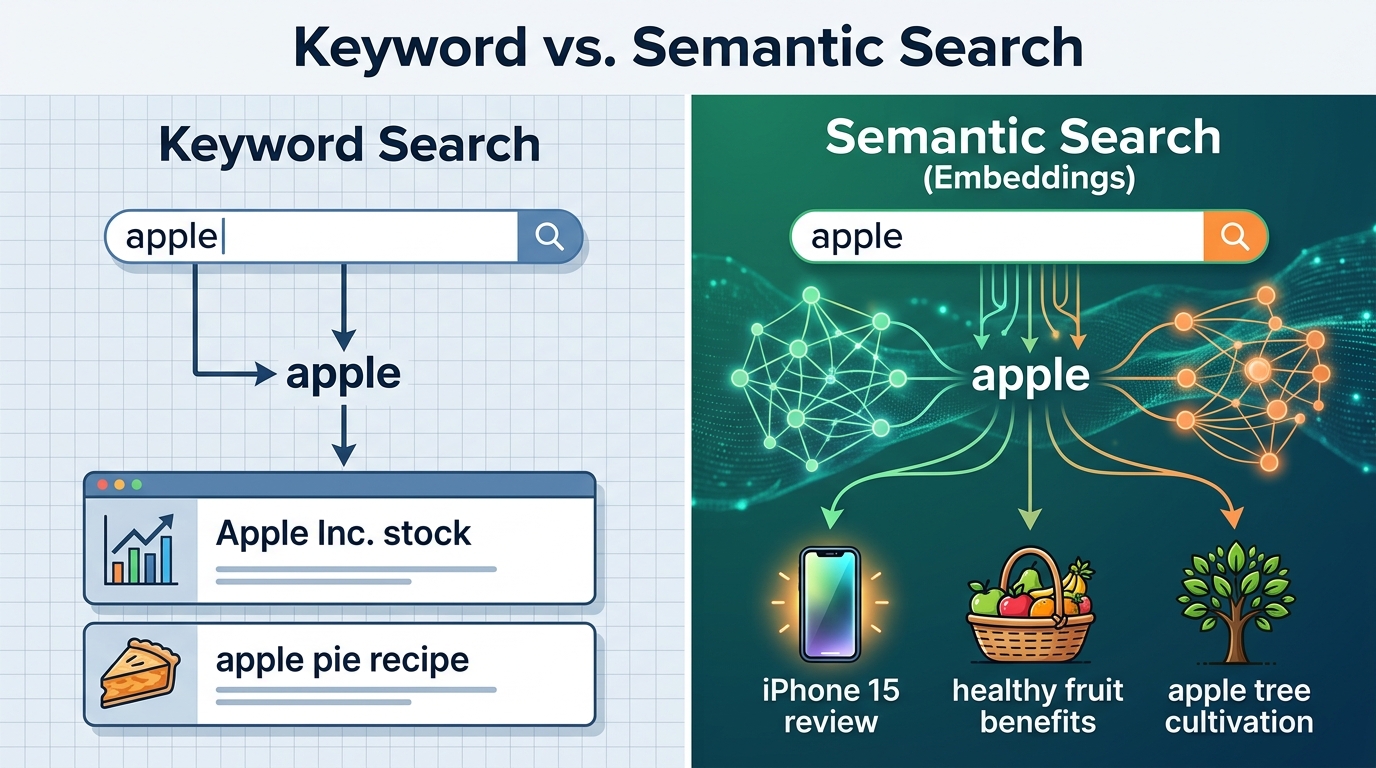
The contrast between traditional keyword search and semantic search powered by embeddings highlights a fundamental shift in how AI understands information. Keyword search is like looking for an exact phrase in a dictionary; it's precise but rigid.
If you search for 'best smartphone for photography' using keywords, a traditional system might only return results containing those exact words. It could miss an article titled 'Top camera phones for stunning pictures' because the keywords don't match exactly.
Semantic search, however, understands the meaning behind your query. Using embeddings, it recognizes that 'smartphone for photography' is semantically similar to 'camera phones for stunning pictures'. This allows it to return far more relevant results, even if the exact terms aren't present in the document.
This semantic revolution means users get more accurate and helpful information, leading to better user experiences and more powerful AI applications. It's about understanding intent, not just words.
Embeddings are not just theoretical concepts; they are the invisible engine powering many of the intelligent systems we interact with daily. Their ability to capture meaning makes them indispensable across a wide range of real-world applications and industries.
From enhancing customer service to personalizing online experiences, embeddings are transforming how we find, process, and interact with information. They enable AI to perform tasks that were once considered exclusively human domains.
These applications demonstrate the profound impact embeddings have on making AI systems more intelligent, efficient, and user-friendly. They are truly at the forefront of modern AI capabilities.

Let's explore some key applications where embeddings shine:
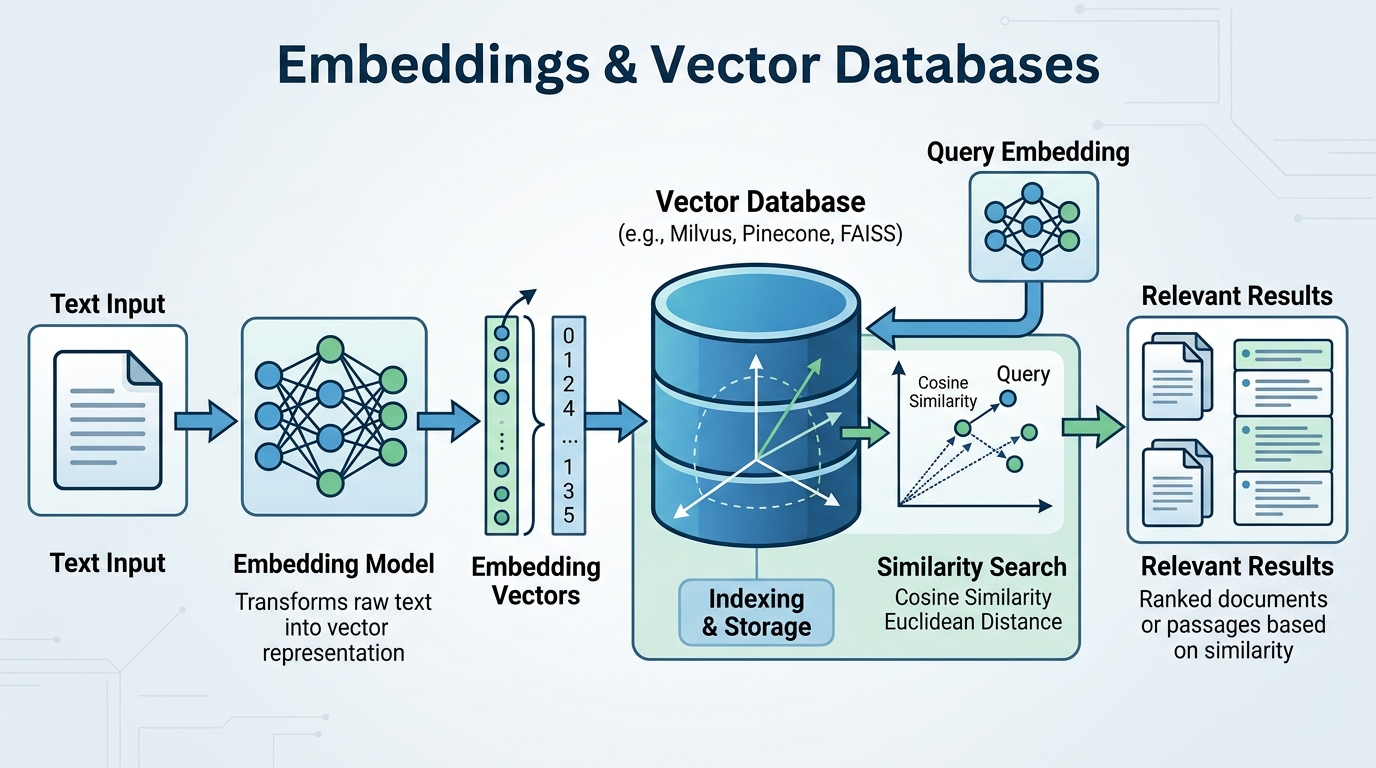
Working with embeddings at scale requires specialized infrastructure. When you have millions or billions of embedding vectors, traditional databases are simply not efficient enough for the rapid similarity searches that AI applications demand. This is where vector databases become indispensable.
Vector databases are optimized for storing, indexing, and querying high-dimensional vectors. They use advanced algorithms, such as Approximate Nearest Neighbor (ANN) search, to quickly find the most similar vectors to a given query vector, even in massive datasets.
These databases are essential for powering large-scale semantic search, RAG systems, and recommendation engines. Popular examples include Pinecone, Weaviate, Milvus, Qdrant, Chroma, FAISS (a library, not a full database), and pgvector (an extension for PostgreSQL). They provide the backbone for efficient, real-time AI applications.
Embeddings play a critical and foundational role in the architecture of advanced AI systems, particularly in Retrieval-Augmented Generation (RAG) and the emerging field of AI agents. They are the key to enabling these systems to access and utilize external knowledge effectively.
In RAG, embeddings are the bridge between a user's query and a vast knowledge base. They allow the system to intelligently retrieve the most relevant pieces of information before a large language model (LLM) generates its response. This significantly enhances the accuracy, factual consistency, and trustworthiness of the LLM's output.
For AI agents, embeddings are fundamental to their ability to 'remember' and 'reason'. Agents use embeddings for memory retrieval, allowing them to pull relevant past interactions or knowledge base entries. They also use them for understanding context, enabling more sophisticated decision-making and interaction.
Let's break down how embeddings facilitate these intelligent systems:
These retrieved documents, along with the original user query, are then passed to a large language model. The LLM uses this augmented context to generate a more informed, accurate, and relevant answer, effectively combining its generative power with external, factual knowledge.
This context embedding is then used to query its memory store, retrieving the most relevant past experiences or knowledge. This mechanism allows AI agents to exhibit more context-aware behavior, learn from interactions, and make more intelligent decisions over time, mimicking a form of long-term memory.
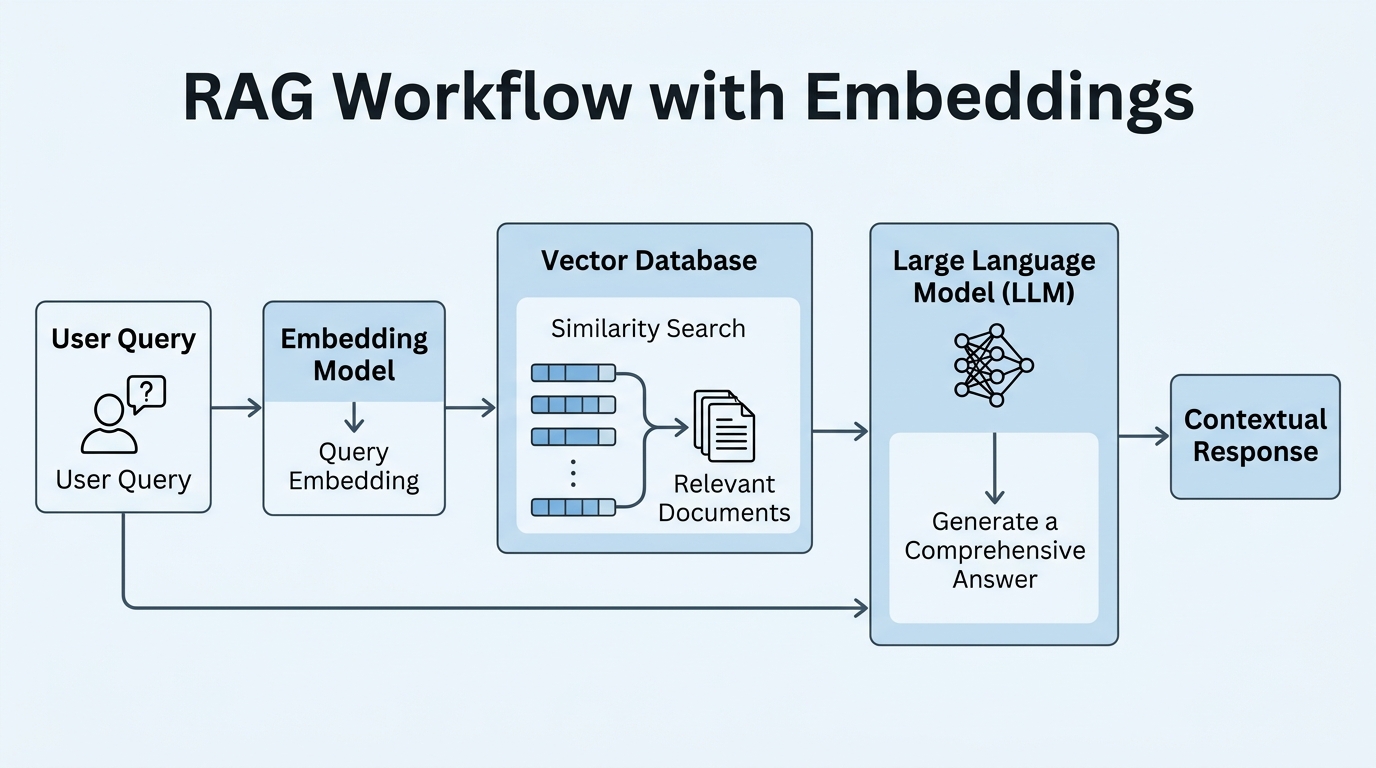
Generating embeddings in Python is a straightforward process, thanks to powerful open-source libraries. The workflow typically involves selecting an appropriate embedding model, loading it, and then using its encode method to convert your text into vectors.
Once you have the embeddings, you can then apply similarity metrics to compare them. This practical workflow forms the foundation for building semantic search, RAG, and other embedding-powered AI applications.
The goal here is to demonstrate the core steps without getting bogged down in excessive implementation details. You'll see how simple it is to transform text into numerical meaning.
This Python example uses the sentence-transformers library, a popular choice for generating high-quality sentence and paragraph embeddings. We will install the library, load a pre-trained model, convert some example texts into embeddings, and then calculate their semantic similarity using cosine similarity.
First, ensure you have the library installed: pip install sentence-transformers scikit-learn numpy.
import numpy as np
from sentence_transformers import SentenceTransformer
from sklearn.metrics.pairwise import cosine_similarity

# 1. Initialize a pre-trained embedding model
# This model maps sentences and paragraphs to a 768-dimensional dense vector space.
# It's optimized for semantic similarity tasks and is a good general-purpose choice.
model = SentenceTransformer('all-MiniLM-L6-v2')

# 2. Define example texts to embed
text1 = "The quick brown fox jumps over the lazy dog."
text2 = "A fast, reddish-brown canine leaps above a sluggish hound."
text3 = "The cat sat on the mat."

# 3. Convert texts into numerical vectors (embeddings)
# The model processes each text and returns a high-dimensional vector.
# These vectors mathematically represent the semantic meaning of the input text.
embedding1 = model.encode(text1)
embedding2 = model.encode(text2)
embedding3 = model.encode(text3)

print(f"Embedding 1 shape: {embedding1.shape")
print(f"Embedding 2 shape: {embedding2.shape")
print(f"Embedding 3 shape: {embedding3.shape")

# 4. Calculate similarity scores between embeddings
# Cosine similarity measures the cosine of the angle between two non-zero vectors.
# A value closer to 1 indicates higher similarity, 0 indicates orthogonality, and -1 indicates opposite direction.

# Reshape embeddings for sklearn's cosine_similarity function, which expects 2D arrays.
embedding1_reshaped = embedding1.reshape(1, -1)
embedding2_reshaped = embedding2.reshape(1, -1)
embedding3_reshaped = embedding3.reshape(1, -1)

# Calculate similarity between text1 and text2 (semantically similar)
# We expect a high similarity score here.
similarity₁₂ = cosine_similarity(embedding1_reshaped, embedding2_reshaped)[0][0]
print(f"Similarity between '{text1' and '{text2': {similarity₁₂:.4f")

# Calculate similarity between text1 and text3 (semantically dissimilar)
# We expect a low similarity score here.
similarity₁₃ = cosine_similarity(embedding1_reshaped, embedding3_reshaped)[0][0]
print(f"Similarity between '{text1' and '{text3': {similarity₁₃:.4f")

# Calculate similarity between text2 and text3 (semantically dissimilar)
# We also expect a low similarity score here.
similarity₂₃ = cosine_similarity(embedding2_reshaped, embedding3_reshaped)[0][0]
print(f"Similarity between '{text2' and '{text3': {similarity₂₃:.4f")
As you run this code, you'll observe that the similarity score between text1 and text2 (which are semantically similar) will be significantly higher than the scores between text1 and text3, or text2 and text3 (which are semantically dissimilar). This clearly demonstrates the power of embeddings in capturing meaning.
While embeddings are incredibly powerful, they are not without their challenges and limitations. Understanding these nuances is crucial for effectively deploying AI systems that rely on them. Ignoring these aspects can lead to suboptimal performance or biased outcomes.
One significant challenge is ensuring the quality of the embeddings themselves. Poorly trained models or insufficient data can result in embeddings that don't accurately capture semantic meaning. This directly impacts the relevance of search results or the accuracy of AI agent decisions.
Other considerations include computational costs, especially for generating and storing large numbers of high-dimensional vectors. Model bias, multilingual support, and domain-specific performance also require careful attention. Selecting the right embedding model is paramount for achieving reliable and fair results.
To maximize the effectiveness of embeddings in your AI applications, consider these actionable recommendations. Adhering to best practices can significantly improve the performance, efficiency, and reliability of your systems.
Beginners often encounter common pitfalls when first working with embeddings. Being aware of these mistakes can save significant time and effort, leading to more robust and effective AI systems from the outset.
AI embeddings represent a monumental leap in how artificial intelligence understands and interacts with the world. By transforming diverse data types into numerical vectors, they enable machines to grasp meaning, context, and relationships, moving far beyond the limitations of simple keyword matching.
These powerful numerical representations are not just a technical detail; they are the fundamental building blocks for nearly every advanced AI application we see today. From the conversational fluency of ChatGPT to the precise information retrieval of semantic search, embeddings are indispensable.
They power intelligent RAG systems, sophisticated AI agents, personalized recommendation engines, and intuitive virtual assistants. As AI continues to evolve, embeddings will remain at the core of its ability to comprehend, reason, and interact with human-like intelligence, shaping the future of technology.
Sparse embeddings, like TF-IDF, represent words with mostly zero values, indicating presence or absence. Dense embeddings, generated by neural networks, use continuous values across all dimensions to capture nuanced semantic relationships. Dense embeddings are generally more powerful for semantic understanding and are the focus of modern AI applications.
Absolutely. Embeddings are a general concept for representing any data type as a vector. They are widely used for images (e.g., for similarity search or classification), audio (e.g., speaker recognition), and even structured data, allowing AI to find patterns and relationships across diverse modalities. This versatility makes them a fundamental building block across various AI domains.
Different models handle OOV words in various ways. Some models, like FastText, build embeddings from character n-grams, allowing them to construct representations for unseen words. Others might assign a generic 'unknown' token embedding or rely on subword tokenization to break down OOV words into known components. The approach chosen significantly impacts how well a model generalizes to new vocabulary.
Dimensionality refers to the number of values in an embedding vector. Higher dimensionality can capture more nuanced semantic information but requires more computational resources and storage. Lower dimensionality can be more efficient but might lose some detail. The optimal dimension depends on the specific task, dataset size, and the complexity of semantic relationships you need to capture.
Early embeddings like Word2Vec were static, meaning each word had a fixed vector regardless of context. Modern contextual embeddings, such as those from BERT or Sentence Transformers, are dynamic. They generate different vectors for the same word based on its surrounding words in a sentence, capturing polysemy and context-specific meaning, which is crucial for understanding natural language nuances.
Choosing the right model depends on your specific use case, data type, and resource constraints. Consider factors like the language of your data, the required semantic granularity (word, sentence, document), computational budget, and whether you need a pre-trained model or one that can be fine-tuned on your domain-specific data. Benchmarking different models on your specific task and dataset is often the most effective approach to ensure optimal performance.
Build a powerful AI agent with Python and MCP, covering server setup, tool creation, agent connection, and dynamic tool calling for intelligent interactions
Unlock Random Forest mastery with our Python guide. Explore core concepts, implementation, hyperparameters, and real-world applications for robust ML
Master Decision Trees in ML, learning their mechanics, splitting criteria, Python implementation, and overfitting prevention for classification and regression