>_Programming Partner
Loading technical insights...
Loading technical insights...
Software Developer
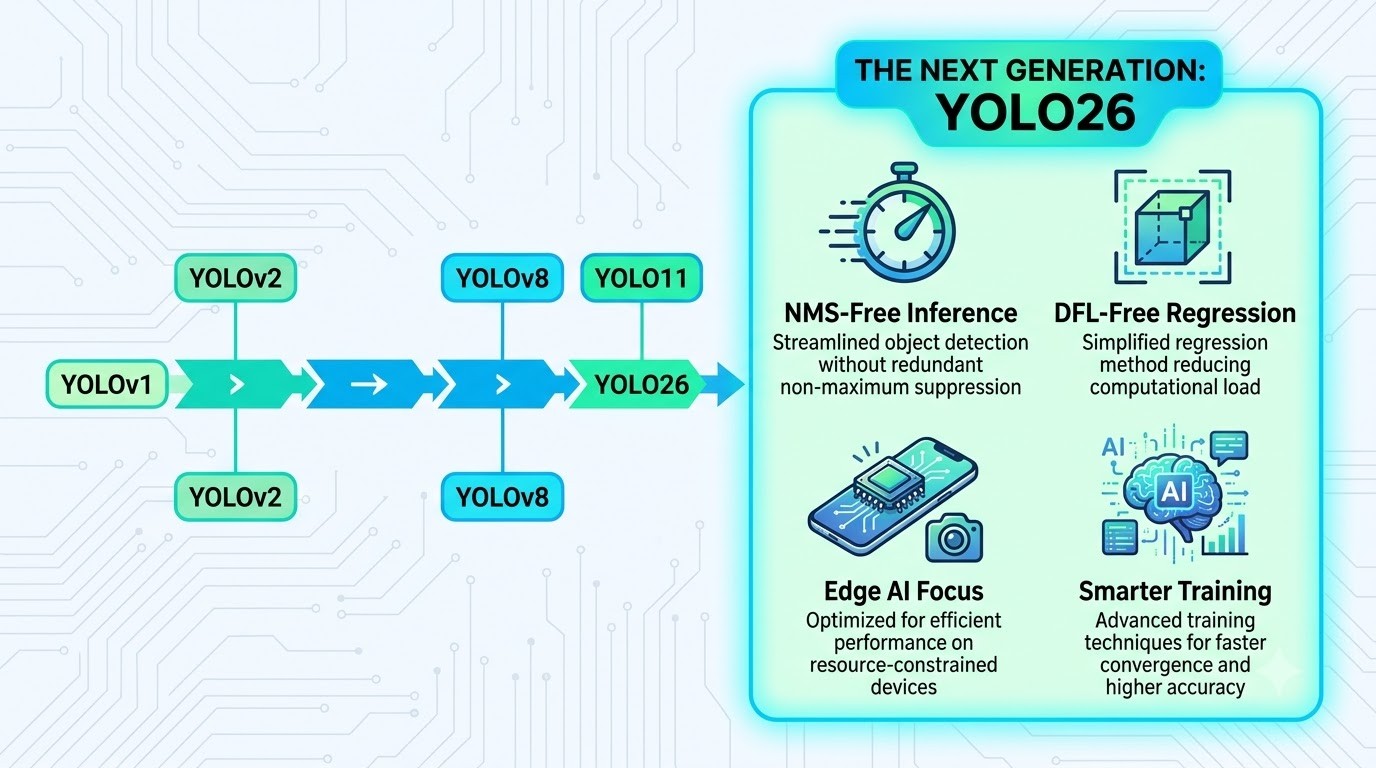
YOLO26 represents the latest generation of Ultralytics' real-time computer vision models, building upon the legacy of its predecessors. This update isn't solely focused on pushing benchmark accuracy; it places a significant emphasis on simplifying inference and deployment. The goal is to make advanced computer vision more accessible for real-time and edge applications.
This new iteration introduces several major changes that streamline the entire object detection pipeline. Readers will discover end-to-end inference, an optional NMS-free detection path, and the removal of Distribution Focal Loss (DFL). Furthermore, YOLO26 incorporates substantial training improvements and offers compelling performance compared with earlier models like YOLO11.
Previous YOLO generations, while powerful, often introduced complexities in their post-processing steps that hindered real-world deployment. The increasing demand for computer vision on diverse hardware, such as CPUs, embedded cameras, robotics, and other edge systems, highlighted these challenges. In these environments, latency, computational overhead, and deployment complexity are critical factors.
YOLO26 was introduced to address these practical pain points directly. Simplifying the entire inference pipeline, from raw input to final detection, can be just as important as achieving marginal gains in benchmark accuracy. This focus ensures that powerful models can run efficiently and reliably where they are needed most, outside of powerful cloud GPU environments.
The design philosophy behind YOLO26 prioritizes ease of integration and operational efficiency. By reducing the number of steps and dependencies in the inference process, Ultralytics aims to lower the barrier for developers deploying computer vision solutions. This makes it a more practical choice for a wider range of real-world applications.
YOLO26 brings a suite of significant improvements designed to enhance both performance and deployment efficiency. A core innovation is the introduction of optional end-to-end NMS-free inference, which simplifies the post-processing pipeline. This allows for more direct and faster detection results, especially on resource-constrained devices.
Another key change is the DFL-free bounding-box regression, leading to a lighter and more efficient detection head. Training strategies have also seen major updates, including Progressive Loss, Small-Target-Aware Label Assignment (STAL), and the MuSGD optimizer. These advancements collectively contribute to a more robust and versatile model family.
Beyond these architectural and training enhancements, YOLO26 also includes task-specific improvements. These ensure that the model performs optimally across various computer vision tasks, not just standard object detection. The following table provides a quick overview of how YOLO26 differentiates itself from earlier versions.
| Feature | YOLOv8 | YOLO11 | YOLO26 |
|---|---|---|---|
| NMS-Free Inference | No | No | Optional |
| DFL for BBox Regression | Yes | Yes | No |
| Training Optimizer | SGD/AdamW | SGD/AdamW | MuSGD |
| Loss Function | Standard | Standard | Progressive Loss |
| Label Assignment | Task-Agnostic | Task-Agnostic | STAL |
| Detection Head | Standard | Standard | Lighter, Dual-Head |
Distribution Focal Loss (DFL) was a technique used in models like YOLOv8 and YOLO11 for bounding-box regression. DFL aimed to make the bounding box predictions more precise by focusing on the distribution of predicted box coordinates. While effective, it added a layer of complexity to the detection head and the overall model architecture.
YOLO26 moves towards a more direct bounding box regression approach, eliminating the need for DFL. This architectural simplification directly contributes to a lighter detection head, which in turn results in smaller model sizes and faster inference times. The removal of DFL also makes exported models, such as ONNX or TensorRT, more straightforward and efficient.
This change aligns perfectly with YOLO26's overarching goal of reducing inference complexity and improving deployment efficiency. By streamlining the regression mechanism, the model becomes easier to optimize for various hardware platforms, especially those with limited computational resources. It's a strategic move to enhance practical applicability without sacrificing performance.
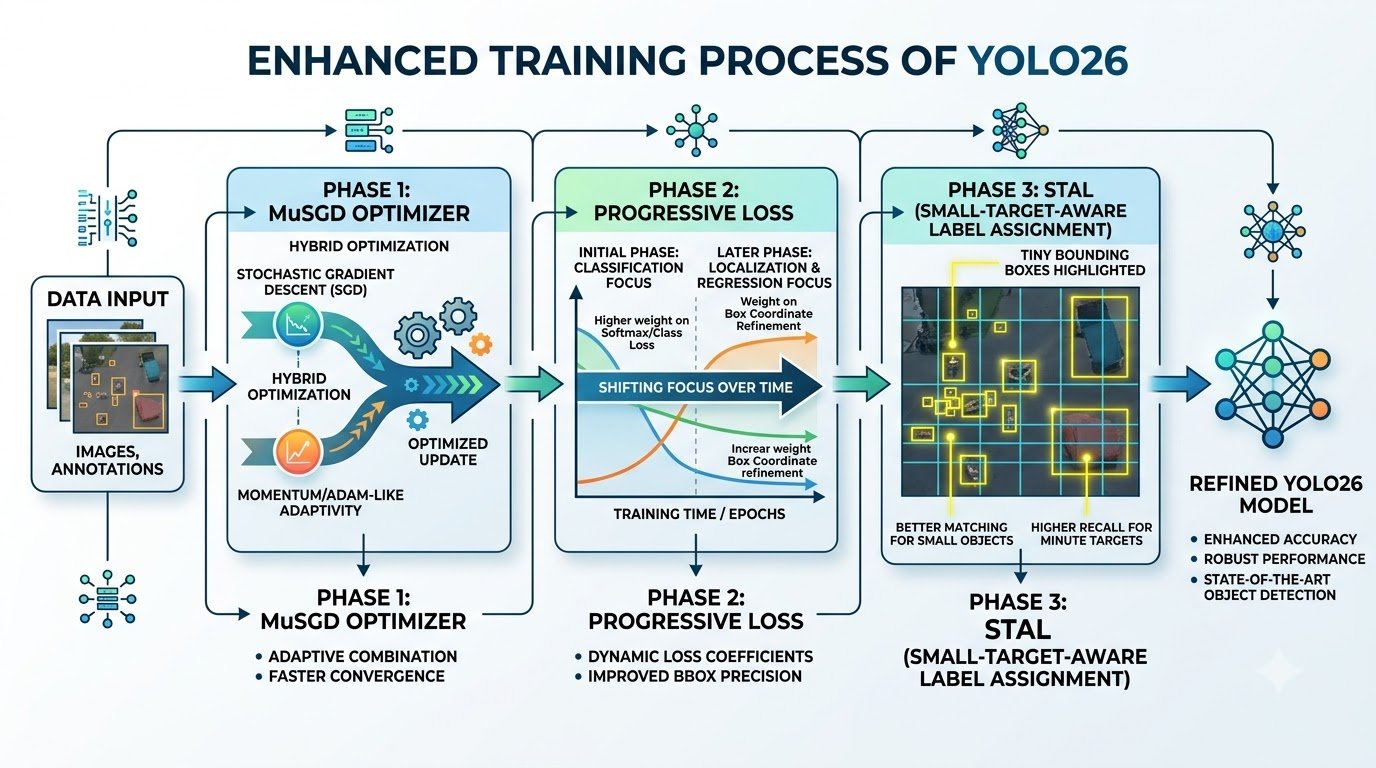
YOLO26 introduces a sophisticated set of training strategy enhancements that significantly boost its performance and robustness. One key innovation is MuSGD, a hybrid optimization approach that combines the strengths of Stochastic Gradient Descent (SGD) with a Muon-inspired optimization mechanism. This helps the model converge more effectively and find better optima during training.
Progressive Loss is another crucial addition, designed to shift training emphasis over time. Initially, it might focus on broader features, gradually refining its attention to more subtle details as training progresses. This dynamic weighting of loss components helps the model learn a more robust representation, particularly beneficial for the inference-time head.
Furthermore, Small-Target-Aware Label Assignment (STAL) addresses a common challenge in object detection: accurately identifying small objects. STAL is a technique specifically aimed at maintaining useful positive assignments for tiny objects, preventing them from being overlooked during the label assignment process. This ensures that YOLO26 excels even in scenarios with many small targets.
These training improvements are vital because they directly impact the resulting inference performance and model generalization. While users primarily experience the speed and accuracy of the deployed model, these underlying training innovations are what make YOLO26 a more capable and reliable computer vision solution. They represent a significant leap in how YOLO models learn from data.
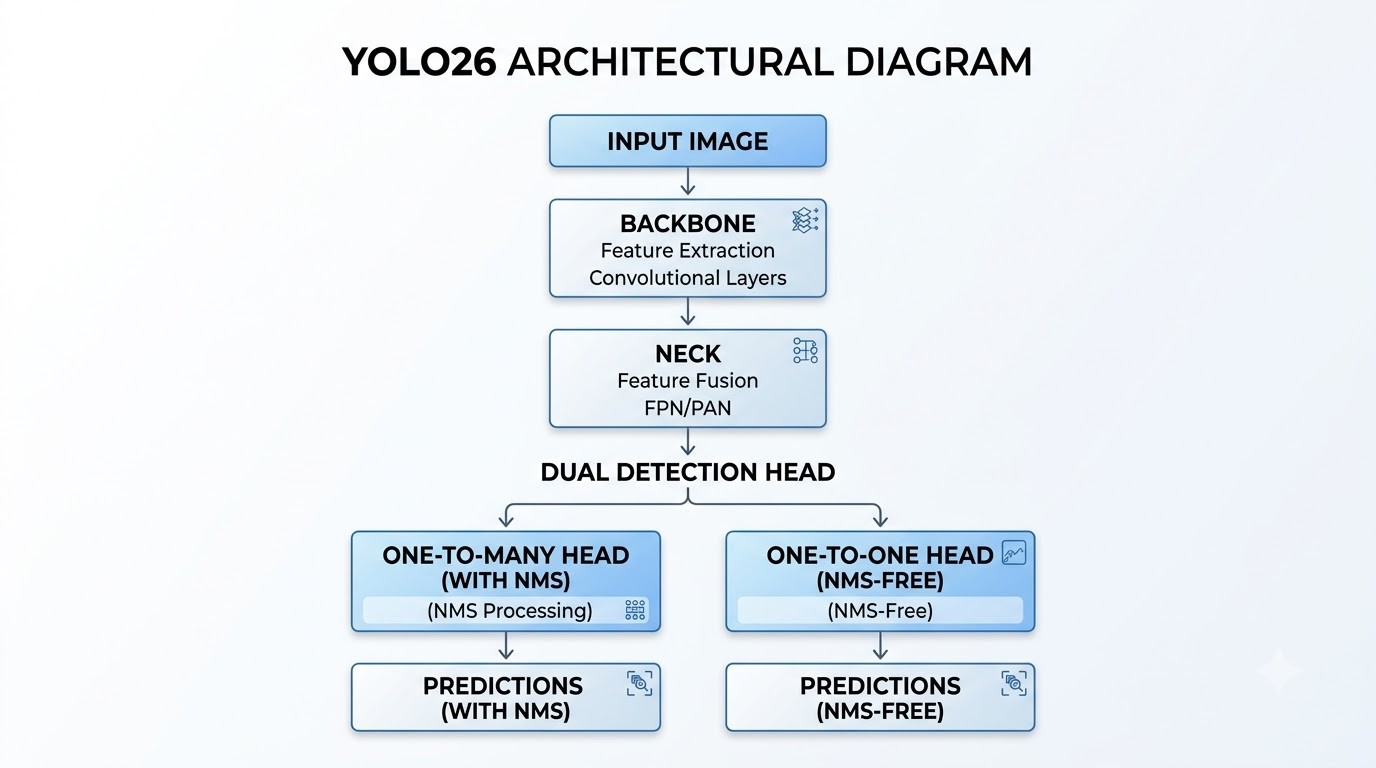
YOLO26 maintains the familiar and highly effective backbone → neck → detection head pipeline that characterizes modern object detectors. The backbone extracts hierarchical features from the input image, while the neck aggregates these features across different scales. The detection head then uses these refined features to predict bounding boxes and class probabilities.
However, YOLO26 introduces specific and impactful changes within this structure. It features a lighter regression design, which is a direct consequence of removing Distribution Focal Loss (DFL). This simplification reduces the computational burden of the detection head, making it more efficient for real-time applications and deployment on edge devices.
A key architectural innovation is its dual-head detection architecture. YOLO26 trains both a traditional one-to-many head and an optional one-to-one head simultaneously. The one-to-many head is designed for conventional object detection, typically followed by Non-Maximum Suppression (NMS) to filter redundant predictions.
The one-to-one head, on the other hand, is specifically optimized to directly produce final detections without the need for NMS. This dual-head approach provides developers with the flexibility to choose between the conventional path, which might offer slightly higher recall, and the end-to-end NMS-free inference path, which prioritizes simplicity and speed for deployment.
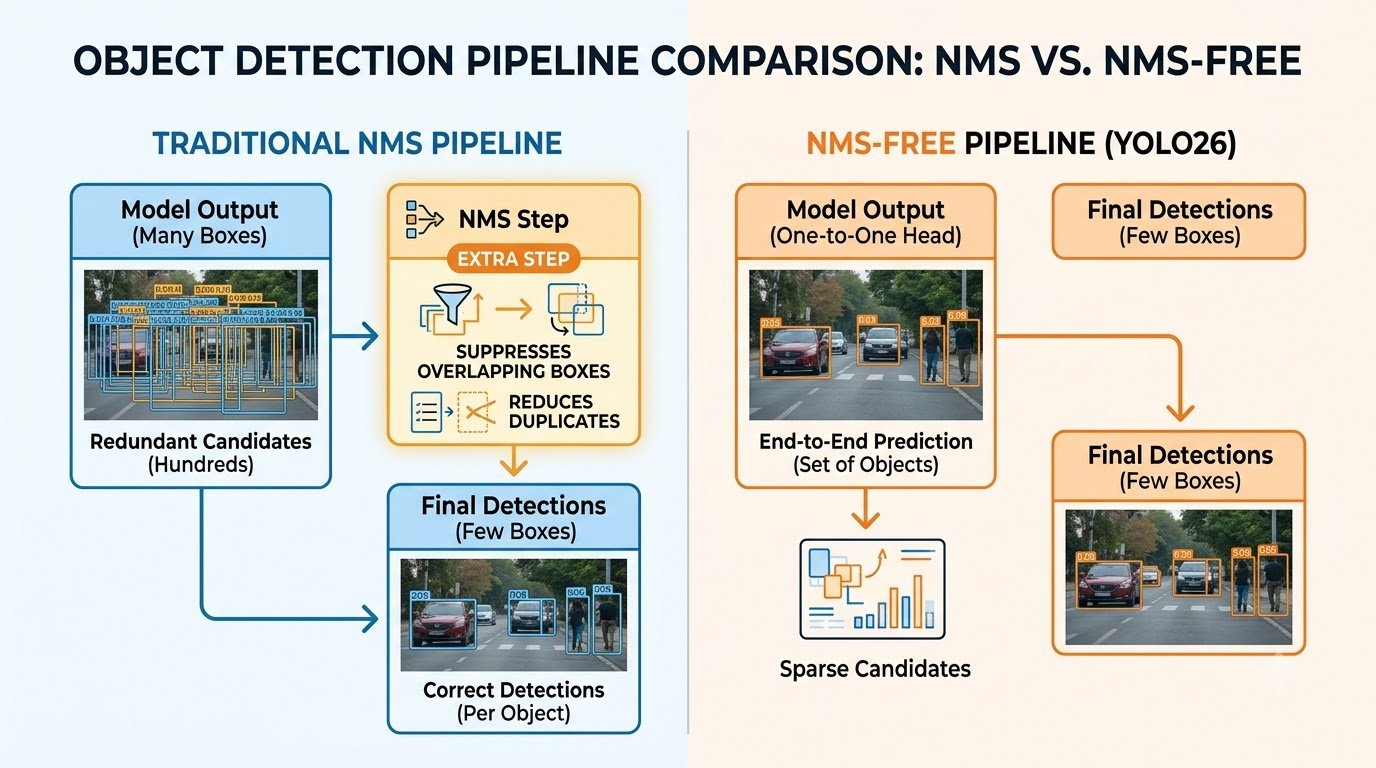
Non-Maximum Suppression (NMS) has long been a standard post-processing step in object detection. Its traditional role is to filter out duplicate and overlapping bounding box predictions, ensuring that each detected object is represented by a single, most confident box. While essential for clean results, NMS adds an extra computational step to the inference pipeline.
This additional post-processing can complicate deployment, especially on edge devices or systems with strict latency requirements. NMS often involves iterative processing and can be a bottleneck, making the overall inference time less predictable. Integrating NMS into various hardware accelerators or custom inference engines can also be a non-trivial task.
YOLO26 introduces a significant differentiator: optional NMS-free end-to-end object detection. This is achieved through its specialized one-to-one detection head, which is trained to directly produce a single, final detection for each object without generating redundant boxes. This eliminates the need for a separate NMS step, simplifying the entire inference pipeline.
The NMS-free path results in a cleaner, more efficient inference graph, which is particularly advantageous for deployment on resource-constrained hardware. It reduces post-processing overhead and can lead to faster, more predictable inference times. It is important to clarify that while the one-to-one head offers NMS-free inference, YOLO26's default one-to-many path still utilizes NMS for its predictions.
When considering an upgrade, developers often ask what tangible improvements YOLO26 brings over its predecessor, YOLO11. While both models are highly capable, YOLO26 introduces architectural and training refinements that translate into practical benefits. The core difference lies in YOLO26's explicit focus on deployment efficiency and simplified inference.
YOLO26's DFL-free regression and lighter detection head contribute to smaller model sizes and often faster CPU inference. The optional NMS-free path further reduces post-processing overhead, making it a compelling choice for edge devices. However, it's crucial to examine specific benchmarks to understand the nuanced performance differences.
Ultralytics' published benchmarks provide a clear comparison. For instance, YOLO26n achieves a higher mAP and significantly faster CPU ONNX inference compared to YOLO11n. This makes YOLO26 a strong contender for applications where CPU performance is paramount. However, it's worth noting that YOLO11n might still show a slight edge in certain highly optimized GPU environments like T4 TensorRT, indicating that the best choice depends on the specific deployment target.
| Metric | YOLO11n | YOLO26n |
|---|---|---|
| mAP (COCO val) | 39.5% | 40.9% |
| CPU ONNX Inference (ms) | 56.1 | 38.9 |
| T4 TensorRT Inference (ms) | 1.5 | 1.7 |
| Parameters (M) | 3.2 | 3.0 |
| GFLOPs | 8.2 | 7.5 |
| NMS Behavior | Required | Optional (NMS-Free) |
YOLO26, like its predecessors, comes in a range of model sizes to cater to diverse application requirements and hardware constraints. These variants include YOLO26n (nano), YOLO26s (small), YOLO26m (medium), YOLO26l (large), and YOLO26x (extra-large). Each variant represents a different trade-off between model size, computational requirements, inference latency, and detection accuracy.
Smaller variants, such as YOLO26n and YOLO26s, are specifically designed for edge devices, mobile applications, and scenarios where computational resources are severely limited. They offer extremely fast inference times with a respectable level of accuracy, making them ideal for real-time processing on CPUs or integrated GPUs. These models are perfect for smart cameras or embedded systems.
Conversely, larger variants like YOLO26l and YOLO26x prioritize maximum detection accuracy. These models are more suitable for environments with powerful hardware, such as cloud GPUs or high-end workstations, where achieving the highest possible mAP is critical. The choice of model size ultimately depends on the specific balance required between speed, accuracy, and available computing power for your application.
| Model Variant | Parameters (M) | GFLOPs | mAP (COCO val) | CPU ONNX Latency (ms) |
|---|---|---|---|---|
| YOLO26n | 3.0 | 7.5 | 40.9% | 38.9 |
| YOLO26s | 11.2 | 28.5 | 49.5% | 72.1 |
| YOLO26m | 25.9 | 65.0 | 53.5% | 125.0 |
| YOLO26l | 43.7 | 109.0 | 55.5% | 205.0 |
| YOLO26x | 71.6 | 179.0 | 56.8% | 310.0 |
Implementing YOLO26 for object detection is straightforward, thanks to the user-friendly Ultralytics Python package. This section provides a practical guide to setting up your environment and performing inference. You will be able to quickly integrate YOLO26 into your projects.
First, ensure you have Python installed (3.9 or newer is recommended). Then, install the Ultralytics package, which includes all necessary dependencies like PyTorch. This single command will prepare your system for YOLO26.
pip install ultralyticsOnce the environment is set up, you can load a pre-trained YOLO26 model and perform inference on an image or video. The Ultralytics API makes this process intuitive, allowing you to get detection results with just a few lines of code. Here's how to detect objects in an image.
from ultralytics import YOLO

# Load a pre-trained YOLO26n model
# You can choose other variants like 'yolo26s.pt', 'yolo26m.pt', etc.
model = YOLO('yolo26n.pt')

# Define the source for inference (e.g., an image file or URL)
sourceᵢmage = 'https://ultralytics.com/images/bus.jpg'

# Perform inference on the source
# The 'show=True' argument will display the results in a pop-up window
# The 'save=True' argument will save the annotated image to disk
results = model(sourceᵢmage, show=True, save=True)

# Iterate through the results to access bounding boxes, classes, and confidence scores
for r in results:
    # Get bounding box coordinates, confidence scores, and class IDs
    boxes = r.boxes.xyxy.tolist() # Bounding box coordinates in [x1, y1, x2, y2] format
    confidences = r.boxes.conf.tolist() # Confidence scores for each detection
    classᵢds = r.boxes.cls.tolist() # Class IDs for each detection

    # Print detected objects
    for box, conf, clsᵢd in zip(boxes, confidences, classᵢds):
print(f"Object: {model.names[int(clsᵢd)], Confidence: {conf:.2f, Box: {box")While YOLO models are renowned for object detection, YOLO26 extends its capabilities far beyond simple bounding-box predictions. It is part of a versatile vision-model family that supports a wide array of computer vision tasks. This makes it a comprehensive solution for many different visual analysis needs.
YOLO26 can perform instance segmentation, which identifies objects and delineates their exact pixel-level boundaries. It also supports semantic segmentation, classifying every pixel in an image into a predefined category. Furthermore, it excels at pose estimation, accurately locating key points on human bodies, and image classification, categorizing entire images.
The architecture also extends to more specialized tasks like oriented object detection, crucial for objects at arbitrary angles, and monocular depth estimation, inferring depth from a single 2D image. Additionally, the YOLOE-26 variant pushes the boundaries further by enabling open-vocabulary detection and segmentation, allowing the model to identify objects based on text or visual prompts, even if it hasn't seen them during training.
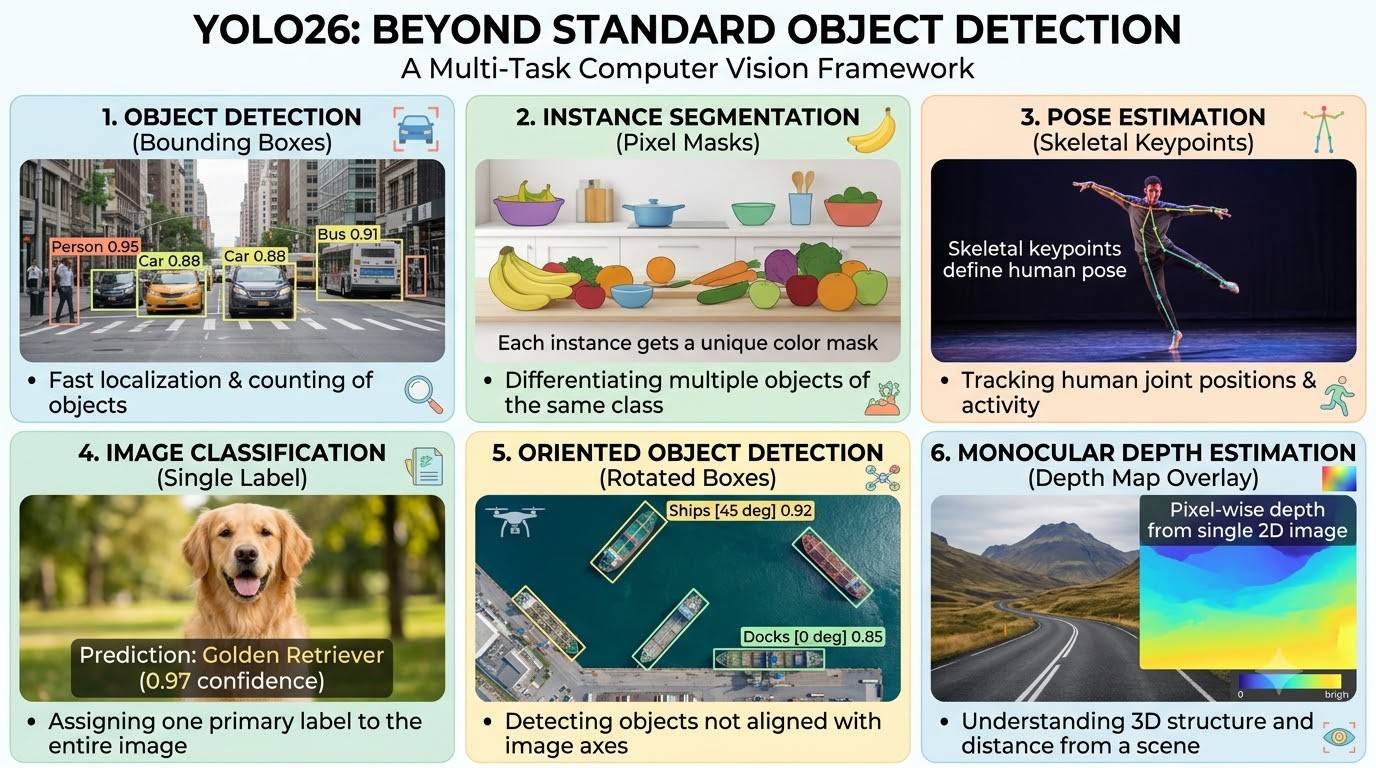
YOLO26 truly shines in practical applications where real-time inference and simplified deployment are paramount. Scenarios such as smart cameras for surveillance, robotics for navigation and manipulation, and drones for aerial inspection greatly benefit from its efficient architecture. Its capabilities are also highly valuable in manufacturing inspection, traffic monitoring, and security systems.
The model's design makes it particularly interesting for mobile applications and other edge-AI deployments. When models need to run outside powerful cloud GPU environments, YOLO26's lighter detection head, DFL-free regression, and optional NMS-free inference significantly reduce the computational footprint. This enables robust computer vision on devices with limited power and processing capabilities.
However, choosing the best model still depends on several factors. Developers should consider their target hardware, the required inference latency, the acceptable level of detection accuracy, and the specific computer vision task at hand. While YOLO26 offers compelling advantages in efficiency, careful evaluation against specific project requirements is always a best practice to avoid common pitfalls during deployment.
YOLO26 distinguishes itself with several key innovations that push the boundaries of practical computer vision. Its optional end-to-end NMS-free inference streamlines deployment, while the simplified DFL-free regression leads to a lighter and more efficient detection head. Coupled with an updated training strategy, YOLO26 offers improved accuracy/latency trade-offs across its model variants.
The model's strong focus on practical deployment, especially for edge and real-time applications, makes it a compelling choice for many developers. Whether upgrading from YOLO11 is worthwhile depends heavily on your specific hardware and workload. If you prioritize faster CPU inference, simpler deployment, and reduced post-processing, YOLO26 presents a significant advantage.
Ultimately, YOLO26 is a key part of the broader movement toward faster, simpler, and more production-oriented computer vision systems. It empowers developers to deploy powerful AI models in more diverse and resource-constrained environments, making advanced computer vision more accessible and impactful in the real world.
The NMS-free option in YOLO26 significantly streamlines the deployment pipeline. By eliminating the need for a separate Non-Maximum Suppression step, it reduces post-processing overhead and simplifies integration into various hardware platforms, especially those with limited computational resources or strict latency requirements. This leads to cleaner, more efficient inference graphs. This simplification is particularly beneficial for embedded systems and edge devices where every millisecond and computational cycle counts. It reduces the overall complexity of the inference stack, making models easier to optimize and deploy in production.
YOLO26's dual-head design offers remarkable flexibility for diverse applications. The traditional one-to-many head provides robust performance for general object detection tasks, often leveraging NMS for optimal results in complex scenes. This path is suitable for scenarios where slight post-processing overhead is acceptable for higher recall. The optional one-to-one head, however, is specifically optimized for end-to-end NMS-free inference. This makes it ideal for edge devices and real-time applications where minimal latency and simplified deployment are critical. Developers can choose the head that best aligns with their specific hardware constraints and performance requirements.
Yes, YOLO26 is fully designed for fine-tuning on custom datasets, leveraging its advanced training strategies like MuSGD and Progressive Loss. This allows users to adapt the powerful pre-trained models to their specific domain and data distribution. When fine-tuning, it's crucial to ensure your dataset is well-annotated and truly representative of your target environment to achieve optimal performance. Key considerations include selecting an appropriate pre-trained model variant (nano to extra-large) based on your hardware constraints and desired accuracy. Careful tuning of hyperparameters, such as learning rate schedules and augmentation strategies, is also essential for maximizing the model's effectiveness on your unique data.
YOLO26's design, particularly its lighter detection head and DFL-free regression, makes it exceptionally well-suited for edge deployment. Smaller variants like YOLO26n or YOLO26s can run efficiently on devices with limited CPU power or integrated GPUs, such as Raspberry Pi, NVIDIA Jetson Nano, or even some microcontrollers equipped with AI accelerators. For optimal performance, especially with larger models or higher frame rates, devices featuring dedicated neural processing units (NPUs) or small discrete GPUs are highly recommended. The NMS-free option further reduces the computational burden, enabling deployment on even more constrained hardware platforms.
Unlock the power of YOLO! Learn how this revolutionary real-time object detection system works, its architecture, evolution, and diverse applications
Unlock computer vision success by mastering image processing. Learn essential techniques, tools, and workflows to enhance images for accurate AI models
Master YOLOv9 object tracking with our comprehensive guide. Explore setup, implementation, optimization, and performance comparisons using Python code.