>_Programming Partner
Loading technical insights...
Loading technical insights...
Software Developer
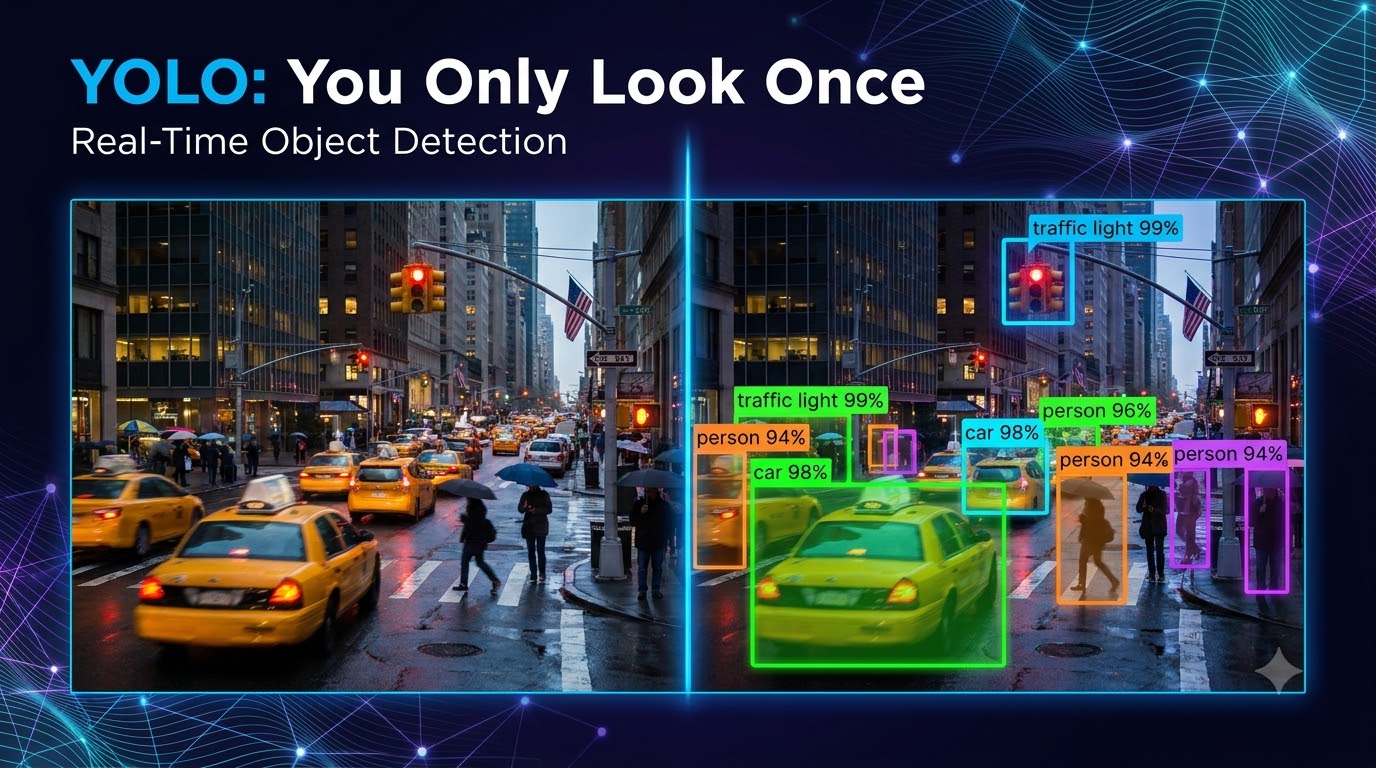
Object detection is a fundamental task in computer vision, enabling machines to identify and locate objects within images and videos. Among the various approaches, YOLO (You Only Look Once) stands out as one of the most widely used and influential methods. Its ability to perform real-time detection has revolutionized numerous applications across industries.
Real-time object detection is crucial for applications where immediate decision-making is necessary. This includes critical areas such as surveillance systems, autonomous vehicles, robotics, traffic monitoring, and industrial automation. The speed and accuracy offered by models like YOLO are indispensable for these dynamic environments.
Unlike traditional computer vision methods that often involve multiple sequential steps, YOLO processes visual information in a highly integrated manner. This streamlined approach allows it to achieve remarkable speeds while maintaining competitive accuracy. This article will delve into the mechanics, evolution, and impact of YOLO, providing a comprehensive understanding of its power.
YOLO, which stands for "You Only Look Once," is an innovative object detection system designed for speed and efficiency. Its core idea is to treat object detection as a single regression problem, directly predicting bounding boxes and class probabilities from full images in one go. This contrasts sharply with older methods that required multiple passes or region proposals.
The "look once" paradigm means that the neural network sees the entire image at inference time. It then simultaneously predicts all bounding boxes and class probabilities for objects present in that image. This unified architecture is the secret behind YOLO's incredibly fast detection capabilities.
By avoiding complex, multi-stage pipelines, YOLO significantly reduces computational overhead and latency. This makes it exceptionally well-suited for real-time applications where processing speed is paramount. Understanding this fundamental concept is key to appreciating YOLO's impact on modern computer vision.
To fully grasp object detection, it's essential to distinguish it from a related but different task: image classification. Imagine you have a picture of a cat. Image classification would tell you, "This image contains a cat." It provides a single label for the entire image.
Object detection, on the other hand, goes a step further. If you have an image with multiple cats and dogs, object detection would not only identify them but also tell you exactly where each animal is located. It answers both "what" is in the image and "where" it is.
The primary output of object detection includes bounding boxes, which are rectangular coordinates delineating the precise location of each object. It also provides a class label for each detected object and a confidence score. This capability to detect and localize multiple distinct objects is what sets it apart from simple classification or even image segmentation, which focuses on pixel-level masks.
Image classification is the task of assigning a single category label to an entire input image. Its primary purpose is to identify the main subject or overall content of the picture. For example, a classification model might label an image as 'dog', 'car', or 'landscape'.
The output is typically a probability distribution over a predefined set of classes, indicating the likelihood that the image belongs to each category. This task is foundational in computer vision but does not provide any spatial information about objects within the image.
Object localization extends image classification by not only identifying the object but also pinpointing its exact location within the image. This location is typically represented by a bounding box. For instance, if an image contains a single car, localization would draw a box around that car.
This task is a precursor to full object detection, often dealing with a single object per image. It provides the spatial coordinates necessary to highlight the object of interest. The bounding box usually consists of four values: the x and y coordinates of the top-left corner, and the width and height of the box.
Object detection combines classification and localization, but crucially, it handles multiple objects within a single image. Each detected object is enclosed by its own bounding box, which precisely delineates its spatial extent. This allows for a granular understanding of complex scenes.
For example, in a photograph of a park, an object detection model could identify and draw boxes around every person, tree, and bench. Each box would also come with a label identifying the object's class. This capability is vital for analyzing crowded or intricate visual data.
YOLO's core mechanism for detecting objects is elegantly simple yet highly effective. When an image is fed into the model, it undergoes a series of transformations through a deep neural network. This network is responsible for extracting rich visual features from the input.
Unlike older methods that might scan an image multiple times or propose regions of interest, YOLO processes the entire image in a single forward pass. The neural network directly predicts all the necessary information for object detection: bounding box coordinates, class probabilities, and confidence scores. This end-to-end approach is fundamental to its speed.
The model essentially learns to identify important features at various scales and locations within the image. It then uses these features to simultaneously predict where objects are and what they are. This neural-network-based detection pipeline eliminates the need for manual feature engineering or separate classification steps, making it incredibly efficient.
A key innovation in YOLO is its grid system. The input image is conceptually divided into a grid of S x S cells. Each grid cell is then responsible for predicting objects whose center falls within that cell.
For each grid cell, YOLO predicts a fixed number of bounding boxes, along with their confidence scores and class probabilities. A bounding box prediction includes five values: the x, y coordinates of the box center, its width, its height, and a confidence score indicating the presence of an object. Additionally, each cell predicts class probabilities for the objects it might contain.
This localized prediction strategy allows the model to detect multiple objects simultaneously across the entire image. It ensures that each object is assigned to a specific grid cell for prediction, simplifying the overall detection process.
At the heart of YOLO's ability to "understand" an image are convolutional neural networks (CNNs). These powerful networks are adept at extracting hierarchical features from raw pixel data. Early layers of the CNN might detect simple features like edges and textures.
Deeper layers then combine these basic features to recognize more complex patterns, such as parts of objects or entire object shapes. This process transforms the raw image into a rich, abstract representation that highlights important visual cues. These extracted features are then passed to the subsequent parts of the YOLO architecture for making predictions.
Modern YOLO models typically consist of three main components that work in concert to perform object detection. These components are the backbone, the neck, and the detection head. Each plays a distinct yet interconnected role in the overall pipeline, from raw image input to final object predictions.
This modular architecture allows for flexibility and continuous improvement, as different research efforts can focus on optimizing specific components. Understanding these parts conceptually helps in grasping how YOLO efficiently processes visual information. Let's explore each component's function.
The backbone is the initial and often the largest part of the YOLO architecture. Its primary function is to extract rich, hierarchical visual features from the input image. It typically consists of a deep convolutional neural network, similar to those used for image classification tasks.
Common backbone networks include Darknet, CSPDarknet, ResNet, or EfficientNet, often pre-trained on large datasets like ImageNet. The backbone processes the image through multiple layers, progressively reducing its spatial dimensions while increasing the depth of feature maps. This creates a multi-scale representation of the image, capturing both fine-grained details and high-level semantic information.
The neck component sits between the backbone and the detection head. Its purpose is to aggregate and combine feature maps from different layers of the backbone. This is crucial because objects can appear at various scales in an image; small objects might be better detected by fine-grained features from early layers, while large objects benefit from high-level semantic features from deeper layers.
Popular neck architectures include Feature Pyramid Networks (FPN) and Path Aggregation Networks (PAN). These networks create a more robust and information-rich feature representation by fusing features from different scales. This aggregation helps the model detect objects of diverse sizes more effectively.
The detection head is the final component of the YOLO architecture. It takes the aggregated features from the neck and generates the final object predictions. This involves predicting the bounding box coordinates, the class probabilities for each object, and a confidence score for each prediction.
The head typically consists of a few convolutional layers that process the refined feature maps. It outputs a tensor containing all the necessary information for each grid cell and anchor box. This output is then post-processed to filter out redundant detections and present the final results.
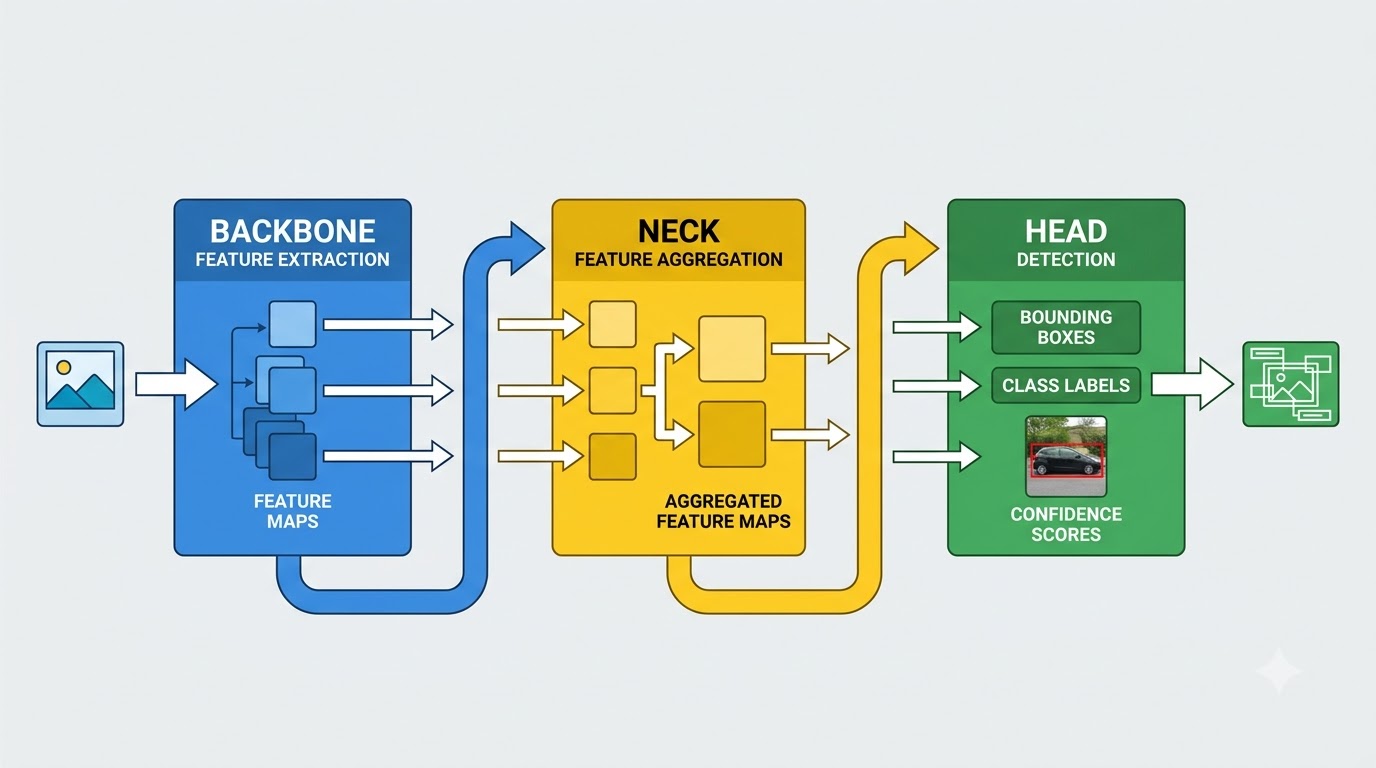
When a YOLO model detects an object, it provides three crucial pieces of information for each detection. These are the bounding box, the class label, and a confidence score. Understanding these outputs is fundamental to interpreting the model's results.
The bounding box defines the object's precise location and extent within the image. It is typically represented by four values: the x and y coordinates of its center, and its width and height. These coordinates allow us to draw a rectangle around the detected object, visually isolating it from the rest of the scene.
The class label identifies what type of object has been detected. For example, if the model detects a car, the class label would be 'car'. This label comes from a predefined set of categories the model was trained to recognize. Each detected object is assigned one of these categories.
Finally, the confidence score indicates the model's certainty that a detected object is actually present and that its classification is correct. This score is a probability, ranging from 0 to 1. A higher score means the model is more confident in its prediction.
Detections with very low confidence scores are often filtered out as unreliable. This thresholding helps to reduce false positives and ensures that only strong, trustworthy detections are presented as final results. It's a critical step in refining the model's output.
One of YOLO's strengths lies in its ability to efficiently identify multiple distinct objects within a single image. Consider a busy street scene: it might contain numerous cars, pedestrians, bicycles, and traffic signs, all at different sizes and positions. YOLO is designed to detect all of these simultaneously.
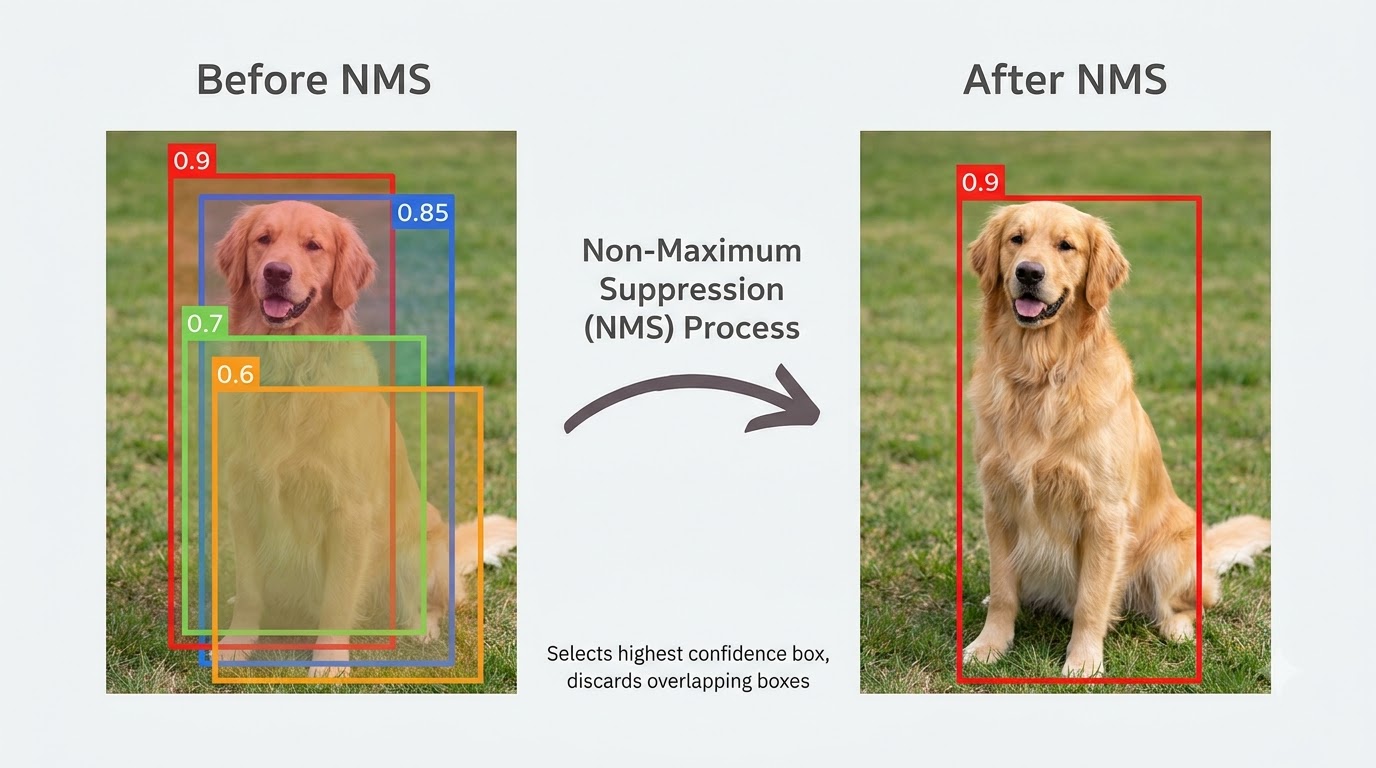
Because each grid cell in YOLO can predict multiple bounding boxes, the model often generates several overlapping predictions for the same object. For instance, a single car might have three or four slightly different bounding boxes predicted around it, each with varying confidence scores. This redundancy needs to be addressed to present clean, accurate results.
To resolve this, a post-processing technique called Non-Maximum Suppression (NMS) is applied. NMS is crucial for filtering out these duplicate detections and retaining only the most accurate and confident bounding box for each unique object. It ensures that each real-world object is represented by just one optimal detection.
Non-Maximum Suppression (NMS) is an algorithm that refines the raw predictions from YOLO. The process begins by selecting the bounding box with the highest confidence score for a particular class. This box is then considered the best detection for that object.
Next, NMS calculates the Intersection Over Union (IOU) between this highest-confidence box and all other overlapping boxes of the same class. IOU measures the ratio of the area of overlap to the area of union between two bounding boxes. If the IOU exceeds a predefined threshold (e.g., 0.5), it indicates significant overlap.
Any overlapping boxes with an IOU above the threshold are suppressed, meaning they are discarded as redundant detections of the same object. This process is then repeated iteratively with the next highest-confidence box among the remaining detections until all boxes have been either selected or suppressed. NMS effectively cleans up the output, providing a single, precise bounding box for each detected object.
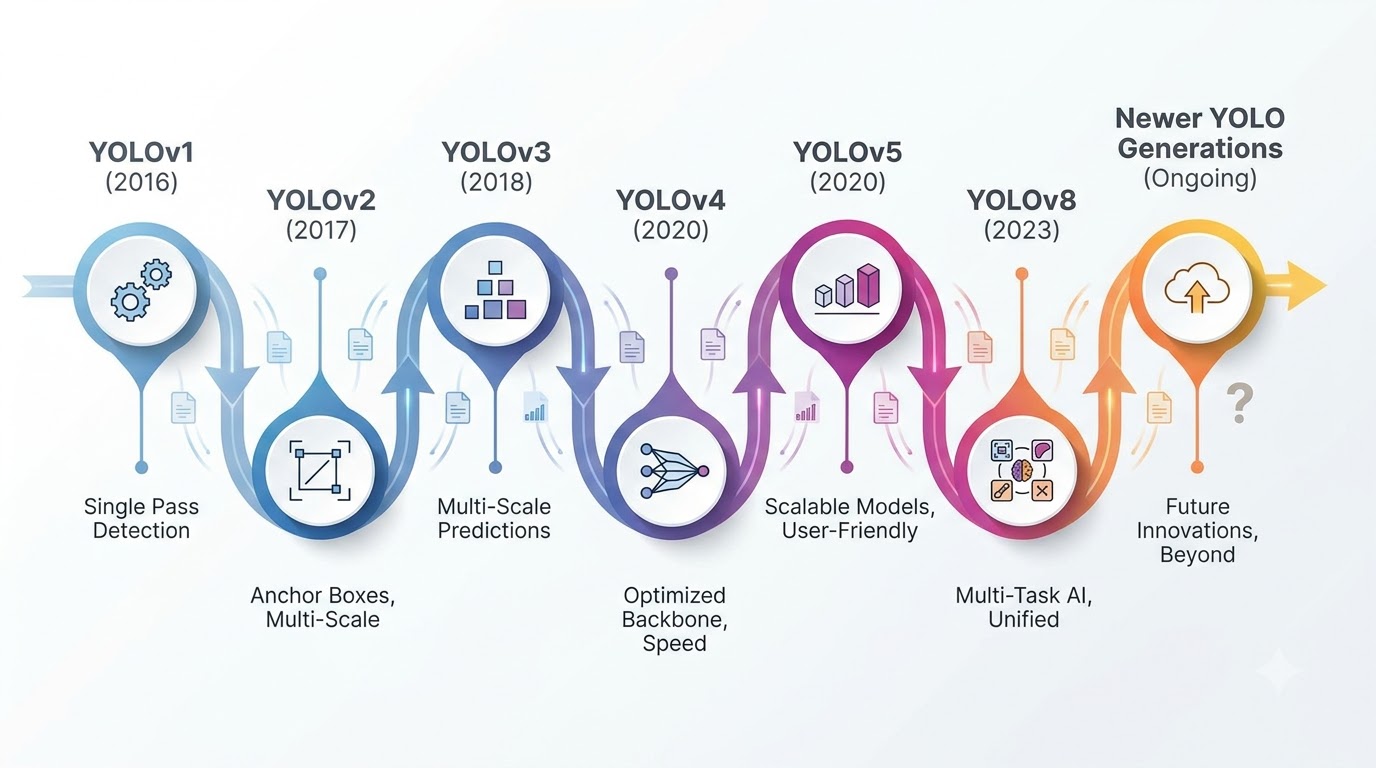
The YOLO family of models has undergone significant evolution since its inception, with each new version introducing notable improvements. Starting with YOLOv1 in 2016, the core idea of single-pass detection quickly gained traction due to its unprecedented speed. This initial version laid the groundwork for real-time object detection.
Subsequent versions, such as YOLOv2 (YOLO9000) and YOLOv3, brought advancements like anchor boxes, multi-scale detection, and improved backbone networks. These enhancements led to better accuracy and the ability to detect a wider range of objects. Each iteration refined the architecture and training strategies.
More recent generations, including YOLOv4, YOLOv5, and YOLOv8, have pushed the boundaries further. They introduced innovations like CSPNet, advanced data augmentation, and optimized network designs, leading to even higher accuracy, faster inference speeds, and easier deployment. The focus has consistently been on balancing speed, accuracy, and ease of use, making YOLO a versatile tool for various computer vision tasks.
The journey of YOLO began with YOLOv1, which introduced the revolutionary concept of a single-stage detector. It processed entire images to predict bounding boxes and class probabilities directly. While fast, it struggled with small objects and close groupings.
YOLOv2 (YOLO9000) improved localization and recall by introducing anchor boxes and batch normalization. It also allowed for detection of over 9000 object categories. YOLOv3 further enhanced accuracy with a more powerful Darknet-53 backbone and multi-scale predictions, improving detection of objects at different sizes.
YOLOv4 introduced a host of optimizations, including CSPDarknet53, PANet for the neck, and various data augmentation techniques, significantly boosting both speed and accuracy. YOLOv5, developed by Ultralytics, focused on ease of use, modularity, and offering different model sizes (nano, small, medium, large) to balance performance and computational cost.
YOLOv8, also from Ultralytics, represents a further refinement, offering state-of-the-art performance across various vision tasks beyond just detection, including segmentation and pose estimation. Newer iterations continue to emerge, pushing the envelope in terms of efficiency and capability. This continuous innovation ensures YOLO remains at the forefront of real-time object detection research and application.
The landscape of object detection models can broadly be categorized into two types: single-stage detectors and two-stage detectors. YOLO is a prime example of a single-stage detector, known for its speed. Traditional models, particularly the R-CNN family (e.g., R-CNN, Fast R-CNN, Faster R-CNN), represent the two-stage approach.
The fundamental difference lies in how they locate and classify objects. Two-stage detectors first propose regions of interest (potential object locations) and then classify and refine these regions in a separate step. This sequential process often leads to higher accuracy but comes at the cost of slower inference times.
YOLO, by contrast, performs both region proposal and classification simultaneously in a single network pass. This unified approach significantly reduces computational overhead and latency. While early YOLO versions sometimes traded a bit of accuracy for speed, modern YOLO models have largely closed this gap, making them exceptionally popular for real-time applications where rapid processing is critical.
Single-stage detectors, like YOLO, directly predict bounding boxes and class probabilities across the entire image in one forward pass. They are characterized by their simplicity and speed, making them ideal for applications requiring real-time performance. The entire detection pipeline is integrated into a single neural network.
Two-stage detectors, such as the R-CNN family, follow a more intricate process. The first stage involves a region proposal network (RPN) that identifies potential object locations. The second stage then takes these proposed regions, extracts features, and performs classification and bounding box regression. This two-step process generally yields higher accuracy, especially for small or complex objects, but is inherently slower due to the sequential nature of its operations.
To further illustrate the differences, here's a comparison table highlighting key aspects of YOLO (representing single-stage detectors) and the R-CNN family (representing two-stage detectors). This overview helps in understanding their respective strengths and typical use cases.
| Feature | YOLO (Single-Stage) | R-CNN Family (Two-Stage) |
|---|---|---|
| Detection Speed | Very Fast (Real-time) | Slower (Near real-time to Batch) |
| Accuracy | High (Competitive with two-stage) | Very High (Often slightly higher) |
| Complexity | Simpler, End-to-end | More Complex (Two-step process) |
| Computational Cost | Lower | Higher |
| Primary Use Case | Real-time applications, embedded systems | High-precision tasks, offline analysis |
| Object Proposal | Implicitly by grid cells/anchors | Explicit Region Proposal Network (RPN) |
| Training | Easier, single loss function | More complex, multi-stage training |
YOLO's design inherently prioritizes speed, making it exceptionally well-suited for real-time object detection applications. The concept of "real-time" in this context refers to the ability of the system to process incoming data and respond within a timeframe that is imperceptible to humans or critical for system operation. This is often measured by inference speed and frames per second (FPS).
Inference speed is the time it takes for the model to process a single image and produce detections. For real-time video analysis, this translates directly to frames per second (FPS), indicating how many video frames the model can process per second. A high FPS is crucial for maintaining a smooth and responsive analysis of dynamic environments.
YOLO's low latency ensures that there is minimal delay between an event occurring in the real world and the system detecting it. This rapid processing of video frames is critical for applications such as autonomous vehicles, where split-second decisions are vital for safety. Similarly, in robotics, surveillance cameras, and traffic monitoring, YOLO's ability to provide immediate feedback on detected objects is invaluable for effective operation and response.
Inference speed refers to the time a trained model takes to make a prediction on new, unseen data. For object detection, this means the time from feeding an image into the model to receiving the bounding box and class predictions. This metric is typically measured in milliseconds (ms).
Frames Per Second (FPS) is directly related to inference speed, especially in video processing. If a model can process an image in 20ms, it can theoretically achieve 50 FPS (1000ms / 20ms). For real-time applications, an FPS of 24 or higher is generally considered smooth, mimicking human visual perception. High FPS is crucial for applications like live video analytics and gaming.
Latency in real-time systems refers to the delay between an input (e.g., a new video frame) and the corresponding output (the detection results). Low latency is paramount for applications where immediate action is required. For example, in autonomous driving, even a few milliseconds of delay can have significant safety implications.
YOLO's single-stage architecture inherently minimizes this latency by avoiding complex, sequential processing steps. This contributes to its practical performance in dynamic environments, allowing systems to react quickly and effectively to changing conditions. The ability to maintain low latency while processing high-resolution video streams is a key differentiator for YOLO.
YOLO models are often released in various sizes or configurations, typically denoted as nano (n), small (s), medium (m), large (l), and extra-large (x). This range of models allows developers to choose an architecture that best fits their specific needs and available computational resources. Each size represents a different trade-off between speed and accuracy.
Smaller models, like YOLOv8n, are designed for maximum speed and minimal computational requirements. They are ideal for deployment on edge devices, mobile phones, or systems with limited processing power. While incredibly fast, they might offer slightly lower detection performance compared to their larger counterparts.
Conversely, larger models, such as YOLOv8x, provide stronger detection performance and higher accuracy. This comes at the cost of increased computational demands and slower inference times. These models are typically used in environments with powerful GPUs or for applications where detection precision is paramount, even if it means a slight reduction in speed.
Developers must carefully balance accuracy, speed, available hardware, and specific application requirements when selecting a YOLO model. Key evaluation metrics like precision, recall, mean Average Precision (mAP), FPS, and inference latency guide this decision. Understanding these metrics is crucial for optimizing model selection and deployment.
The relationship between detection speed and accuracy is an inherent trade-off in most computer vision models. Generally, achieving higher accuracy often requires more complex models and greater computational effort, which can slow down inference. Conversely, optimizing for speed might lead to a slight reduction in detection precision or recall.
Different YOLO model sizes are specifically designed to cater to various points on this speed-accuracy spectrum. A YOLOv8n model prioritizes speed, making it suitable for real-time applications on resource-constrained devices. A YOLOv8x model, on the other hand, aims for maximum accuracy, often at the expense of higher latency, for tasks where precision is critical.
The choice of model size depends heavily on the application's constraints. For instance, a security camera might prioritize speed to detect intruders instantly, while a medical imaging system might prioritize accuracy to identify subtle anomalies, even if it takes a bit longer. This flexibility is a significant advantage of the YOLO family.
Evaluating the performance of an object detection model like YOLO requires specific metrics that go beyond simple accuracy. These metrics help quantify how well the model identifies and localizes objects. Understanding them is crucial for comparing different models and fine-tuning their performance.
Intersection Over Union (IOU): This metric measures the overlap between a predicted bounding box and the ground-truth bounding box. It is calculated as the area of intersection divided by the area of union of the two boxes. An IOU threshold (e.g., 0.5) is used to determine if a detection is considered a True Positive.
Precision: Precision measures the proportion of correctly identified positive predictions (True Positives) out of all positive predictions made by the model (True Positives + False Positives). High precision means the model makes few false alarms. For example, if a model predicts 10 cars and 8 are actually cars, its precision is 80%.
Recall: Recall (also known as sensitivity) measures the proportion of actual positive cases that were correctly identified by the model. It is calculated as True Positives divided by all actual positives (True Positives + False Negatives). High recall means the model misses few actual objects. If there are 10 actual cars and the model detects 8, its recall is 80%.
Mean Average Precision (mAP): This is the most common and comprehensive metric for object detection. It is the mean of the Average Precision (AP) values calculated for each object class. AP is the area under the precision-recall curve for a given class. mAP provides a single number that summarizes the model's performance across all classes and various IOU thresholds, giving a holistic view of its accuracy.
Implementing YOLO for object detection has become remarkably straightforward, thanks to user-friendly libraries like Ultralytics YOLO. This section provides a practical, step-by-step guide to using a pre-trained YOLOv8 model in Python. You will learn how to set up your environment, load a model, perform inference on an image, and visualize the detection results.
This tutorial focuses on a common and accessible workflow, allowing you to quickly get started with real-time object detection. We will use the ultralytics library, which provides a clean API for interacting with YOLO models. The visualization will be handled using Pillow or OpenCV for drawing bounding boxes.
First, you need to install the necessary Python libraries. The ultralytics package provides the YOLO models and inference capabilities. opencv-python is useful for image loading and manipulation, and Pillow is a common image processing library.
pip install ultralytics opencv-python PillowEnsure you have a Python environment (3.9+) set up. After installation, you are ready to proceed with loading a model and performing detections. These libraries are widely used and well-documented, making the setup process smooth.
The ultralytics library makes loading a pre-trained YOLO model incredibly simple. You can specify the model version and size directly. For this example, we will use yolov8n.pt, which is the nano version of YOLOv8, known for its speed.
from ultralytics import YOLO

# Load a pre-trained YOLOv8n model
# 'n' stands for nano, a smaller, faster model
model = YOLO('yolov8n.pt')

print("YOLOv8n model loaded successfully!")
This single line of code downloads the model weights if they are not already present and initializes the YOLO object. The model is now ready to perform inference on images or video streams. You can easily swap 'yolov8n.pt' with 'yolov8s.pt', 'yolov8m.pt', etc., to experiment with different model sizes.
Once the model is loaded, performing inference on an image is straightforward. You just need to provide the path to your image file. The predict method handles all the preprocessing and forward pass through the neural network.
# Continued from previous block - requires the setup above

import cv2
import numpy as np
from PIL import Image, ImageDraw, ImageFont

# Path to your input image
# You can download a sample image or use your own
image_path = 'bus.jpg' # Make sure 'bus.jpg' is in the same directory or provide full path

# Perform inference on the image
# The 'results' object contains all detected objects
results = model.predict(source=image_path, conf=0.25, iou=0.7, show=False)

print(f"Detected {len(results[0].boxes) objects in {image_path")
The predict method returns a list of Results objects, one for each image processed. Each Results object contains information about the detected bounding boxes, class labels, and confidence scores. We set conf and iou thresholds to filter detections, ensuring only high-quality results are considered.
To visually inspect the detections, we need to draw the bounding boxes and labels onto the original image. We'll use Pillow for drawing and OpenCV for loading and saving the image. This step helps confirm that the model is working as expected and provides an intuitive understanding of its performance.
# Continued from previous block - requires the setup and model.predict() above

# Load the image using Pillow for drawing
img_pil = Image.open(image_path).convert("RGB")
draw = ImageDraw.Draw(img_pil)

# Try to load a default font, fallback if not found
try:
    font = ImageFont.truetype("arial.ttf", 20)
except IOError:
    font = ImageFont.load_default()

# Iterate through the detection results
for r in results:
    # Get bounding boxes, classes, and confidence scores
    boxes = r.boxes
    for box in boxes:
        # Extract coordinates (xyxy format: x1, y1, x2, y2)
        x1, y1, x2, y2 = map(int, box.xyxy[0])

        # Get confidence score and class ID
        confidence = round(float(box.conf[0]), 2)
        classᵢd = int(box.cls[0])

        # Get class name from model's names dictionary
        classₙame = model.names[classᵢd]

        # Define color for the bounding box (e.g., green)
        color = (0, 255, 0) # RGB for green

        # Draw the bounding box
        draw.rectangle([x1, y1, x2, y2], outline=color, width=3)

        # Prepare label text
        label = f"{classₙame {confidence"

        # Draw background for label text
        text_width, text_height = draw.textsize(label, font=font)
        draw.rectangle([x1, y1 - text_height - 5, x1 + text_width + 5, y1], fill=color)

        # Draw the label text
        draw.text((x1 + 2, y1 - text_height - 3), label, fill=(0, 0, 0), font=font)

# Save the image with detections
outputᵢmage_path = 'output_detections.jpg'
img_pil.save(outputᵢmage_path)

print(f"Detections saved to {outputᵢmage_path")
This code snippet loads the image, iterates through each detected object, and draws a bounding box, class label, and confidence score. The resulting image, output_detections.jpg, will visually represent all the objects identified by the YOLO model. This visualization is crucial for debugging and understanding model performance.
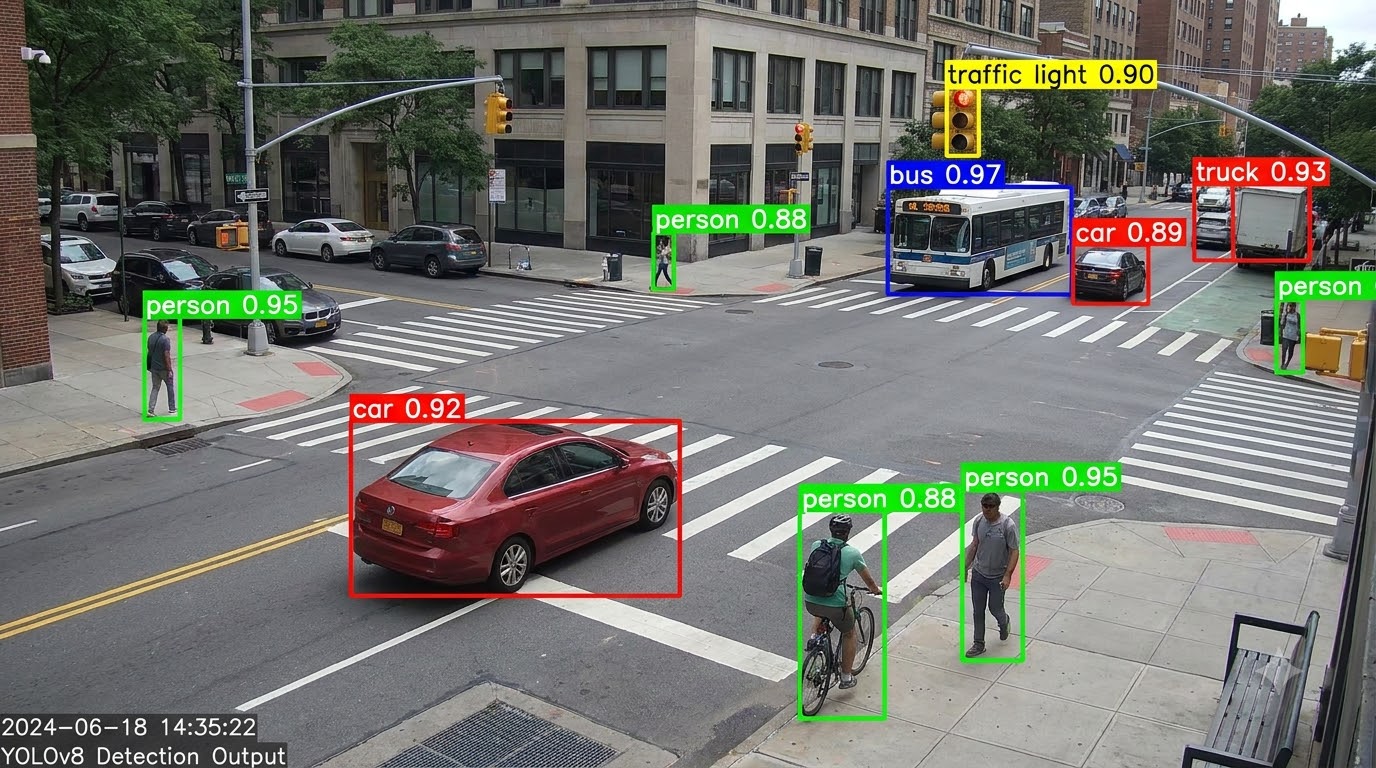
YOLO's speed and accuracy have made it an indispensable tool across a vast array of real-world applications. Its ability to detect objects in real-time provides significant value in scenarios where immediate visual understanding is critical. From enhancing safety to improving efficiency, YOLO powers diverse technological advancements.
The versatility of YOLO extends far beyond academic research, finding practical implementation in various industries. Its robust performance allows for deployment in challenging and dynamic environments. Let's explore some key areas where YOLO makes a tangible impact.
In autonomous vehicles, YOLO is crucial for real-time perception of the surrounding environment. It enables self-driving cars to instantly detect pedestrians, other vehicles, traffic signs, and lane markings. This rapid object identification is vital for navigation, collision avoidance, and ensuring passenger safety.
Similarly, in robotics, YOLO assists robots in understanding their workspace. It helps them identify objects for manipulation, navigate complex terrains, and interact safely with humans. The low latency of YOLO ensures that robots can react quickly to changes in their environment, making them more agile and effective.
YOLO significantly enhances security and surveillance systems by providing real-time monitoring capabilities. It can detect intruders, identify suspicious activities, and track individuals or objects in public spaces. This allows security personnel to respond proactively to potential threats.
For example, in smart city initiatives, YOLO can monitor traffic flow, detect abandoned packages, or identify unusual crowd behavior. Its ability to process live video feeds efficiently makes it a powerful tool for maintaining public safety and enhancing situational awareness.
In manufacturing and industrial settings, YOLO plays a vital role in automation and quality control. It can detect defects in products on assembly lines, verify correct component placement, and monitor machinery for anomalies. This leads to improved product quality and reduced waste.
YOLO is also used for inventory management, automatically counting and identifying items in warehouses. Its speed allows for continuous inspection without slowing down production lines. This contributes to greater operational efficiency and cost savings in various industrial processes.
While YOLO models are incredibly powerful and versatile, they are not without limitations. Understanding these challenges is crucial for effectively deploying and optimizing YOLO in real-world scenarios. Recognizing these constraints helps in designing robust computer vision systems.
One significant factor influencing YOLO's performance is the quality and diversity of its training data. Discrepancies between the training environment and real-world conditions can lead to reduced accuracy. Additionally, the computational demands of larger YOLO models can be a barrier for resource-constrained applications.
YOLO models, especially earlier versions, can sometimes struggle with detecting very small objects in an image. Since each grid cell predicts a fixed number of bounding boxes, very tiny objects might not be adequately represented or might fall between grid cells. Modern YOLO versions have improved this with multi-scale feature maps, but it remains a challenge.
Another difficulty arises with heavily overlapping or occluded objects. When objects are partially hidden by others, the model might have trouble distinguishing their individual boundaries or even detecting them at all. This is particularly problematic in crowded scenes where objects are tightly packed together.
The performance of any deep learning model, including YOLO, is heavily influenced by the quality, quantity, and diversity of its training data. If the model is trained on a dataset that does not adequately represent the real-world scenarios it will encounter, its accuracy will suffer. For example, a model trained only on daytime images might perform poorly in low-light conditions.
Generalization to unseen environments or novel object types is another challenge. While YOLO can detect a wide range of objects, it may struggle with categories it has never encountered during training. This often necessitates fine-tuning the model with domain-specific data to achieve optimal performance in specialized applications.
It's important to differentiate between object detection and object tracking, two closely related but distinct tasks in computer vision. While YOLO excels at detection, tracking involves an additional layer of complexity. Understanding this distinction helps in building more comprehensive visual intelligence systems.
Object detection focuses on identifying objects and their locations within a single image or a single frame of a video. It answers the questions: "What objects are present?" and "Where are they?" Each frame is processed independently, providing a snapshot of the objects at that specific moment.
Object tracking, however, extends this capability across a sequence of video frames. It not only detects objects but also maintains a consistent identity for each object over time. This allows for monitoring an object's movement, trajectory, and behavior as it moves through a scene.
The core function of object detection is to identify instances of objects from predefined classes within an image or a single video frame. For each detected object, it provides a bounding box indicating its spatial location and a class label identifying its category. This is a static analysis of a single moment in time.
YOLO's strength lies in performing this detection task very quickly and accurately. It processes each frame independently, providing a fresh set of detections for every new input. This makes it ideal for applications where the presence and location of objects are the primary concern, without necessarily needing to follow their individual journeys.
Object tracking builds upon detection by assigning a unique ID to each detected object and maintaining that ID across successive video frames. This allows the system to understand the movement, speed, and interactions of individual objects over a period. Tracking essentially connects the dots between detections in different frames.
For example, if a car is detected in frame 1, tracking ensures that the same car is recognized and assigned the same ID in frame 2, frame 3, and so on, even as it moves. This capability is vital for analyzing behavior, predicting trajectories, and understanding complex dynamic scenes. Tracking algorithms often employ techniques like Kalman filters or deep association networks.
YOLO detections often serve as the crucial input for object tracking algorithms. A common pipeline involves using YOLO to detect objects in each frame, and then a separate tracking algorithm links these detections across frames to form continuous trajectories. This synergy leverages YOLO's detection prowess for robust tracking.
Many modern tracking systems, such as DeepSORT or ByteTrack, integrate seamlessly with YOLO models. If you're interested in learning more about how YOLO detections are used to track objects over time, you can explore dedicated resources on YOLO-based object tracking, such as our article on "YOLOv9 Object Tracking" for deeper insights into this advanced topic.
The field of computer vision is rapidly evolving, and YOLO continues to be at the forefront of these advancements. Modern object detection systems are moving beyond simply drawing bounding boxes to achieve a more comprehensive understanding of visual environments. This shift is towards broader visual intelligence, where AI can interpret complex scenes with human-like comprehension.
Emerging areas like instance segmentation, which provides pixel-level masks for each object, and pose estimation, which identifies key points of human bodies, are becoming increasingly integrated. Multimodal AI, combining vision with language models, is enabling systems to not only see but also describe and reason about visual content. This opens doors for more intuitive human-computer interaction.
Continuous advancements in hardware, such as more powerful GPUs and specialized AI accelerators, are making it possible to run larger, more sophisticated models at real-time speeds. Coupled with innovations in AI architectures and self-supervised learning, computer vision systems are becoming increasingly capable of understanding and interacting with complex, dynamic environments, paving the way for truly autonomous robotics and advanced real-time AI applications.
YOLO, or "You Only Look Once," has fundamentally reshaped the landscape of object detection in computer vision. Its groundbreaking single-pass approach to simultaneously predicting bounding boxes and class probabilities has set new benchmarks for speed and efficiency. This innovation has made real-time object detection a practical reality for countless applications.
We've explored YOLO's core mechanism, from its grid system and feature extraction to its distinct backbone, neck, and head architecture. Understanding how it generates bounding boxes, class labels, and confidence scores, and how Non-Maximum Suppression refines these predictions, reveals the elegance of its design. The continuous evolution of YOLO models, from v1 to v8 and beyond, underscores its adaptability and enduring relevance.
YOLO's impact is evident in its widespread adoption across diverse real-world applications, including autonomous vehicles, security, and industrial automation. While it faces challenges with very small or occluded objects, its strengths in speed and accuracy make it indispensable where both are paramount. As computer vision continues to advance towards more comprehensive visual intelligence, YOLO remains a foundational technology, often synergizing with related fields like object tracking and segmentation to build increasingly sophisticated AI systems.
YOLO's single-stage approach processes an entire image in one pass, directly predicting bounding boxes and class probabilities. This significantly reduces computational overhead and inference time compared to two-stage detectors, making it ideal for real-time applications where speed is critical. It streamlines the detection pipeline, leading to faster results.
IOU is a crucial metric used to quantify the overlap between a predicted bounding box and the ground-truth bounding box. It helps determine if a detection is considered correct. During training, IOU is used in loss calculations, and during inference, it's vital for Non-Maximum Suppression (NMS) to filter out redundant detections, ensuring only the most accurate box for each object is kept.
Absolutely. While pre-trained YOLO models are excellent for general object detection, they can be fine-tuned or trained from scratch on custom datasets. This allows developers to adapt YOLO to highly specialized tasks, such as detecting specific defects in manufacturing, identifying unique species in wildlife monitoring, or recognizing custom inventory items in retail. The process involves collecting and annotating a relevant dataset, then training the model.
Deploying YOLO models often involves challenges like optimizing for specific hardware (e.g., edge devices with limited resources), ensuring low latency for real-time video streams, and managing model versioning. Data drift, where real-world data deviates from training data, can also degrade performance over time, requiring continuous monitoring and retraining. Additionally, integrating the model output into existing systems and handling error cases robustly are key considerations.
Modern GPUs and TPUs are designed for parallel processing, which is perfectly suited for the matrix multiplications and convolutions at the heart of deep learning models like YOLO. These hardware advancements dramatically accelerate both the training of complex YOLO architectures and the inference speed, enabling higher frames per second (FPS) and lower latency. This allows for the deployment of larger, more accurate YOLO models in real-time applications that were previously computationally prohibitive.
Object detection, as performed by YOLO, draws a bounding box around each detected object and assigns it a class label. Instance segmentation goes a step further by generating a pixel-level mask for each object, precisely outlining its shape within the image. This provides a much more detailed understanding of an object's boundaries, which is useful for tasks requiring fine-grained object manipulation or precise area calculations.
Explore Ultralytics' YOLO26, a vision model simplifying real-time edge AI with NMS-free detection and efficient deployment. Discover its full capabilities
Unlock computer vision success by mastering image processing. Learn essential techniques, tools, and workflows to enhance images for accurate AI models
Master YOLOv9 object tracking with our comprehensive guide. Explore setup, implementation, optimization, and performance comparisons using Python code.