>_Programming Partner
Loading technical insights...
Loading technical insights...
Software Developer
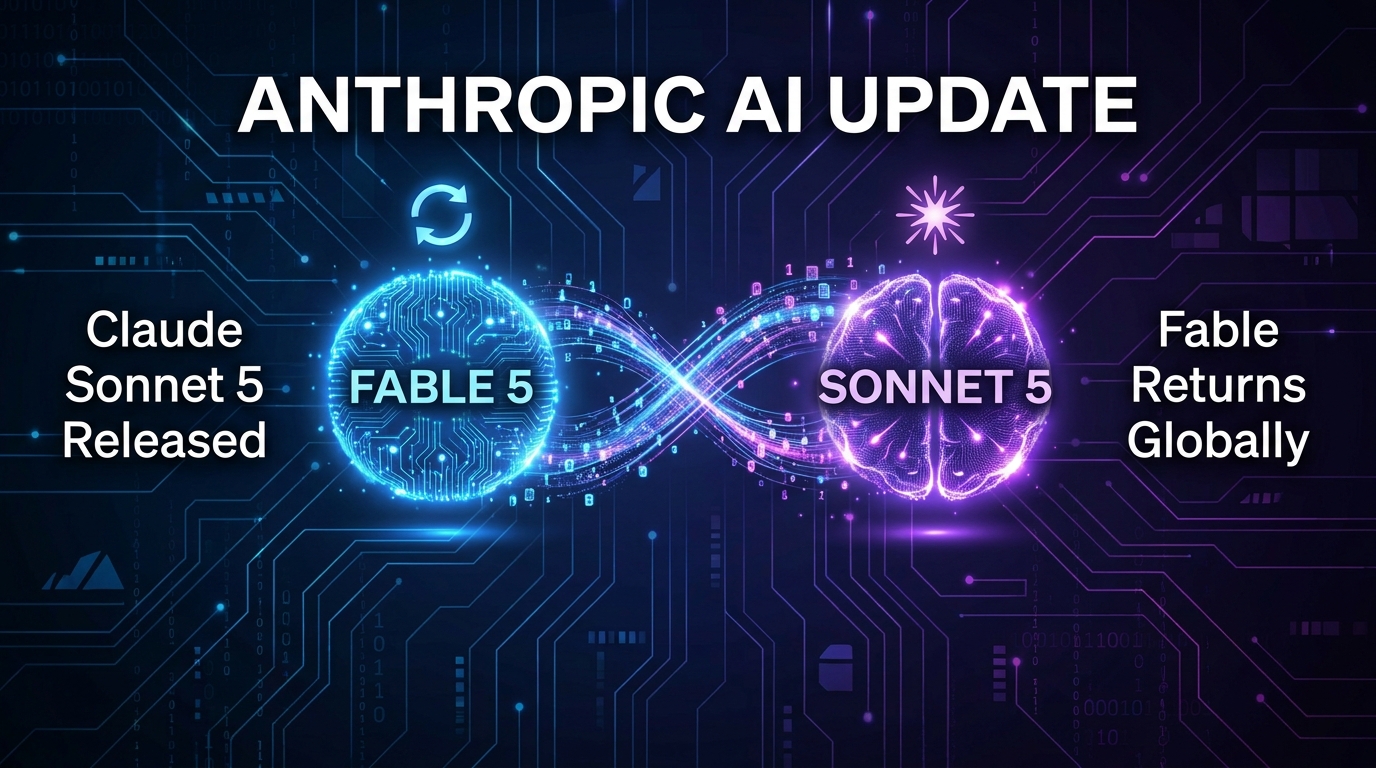
Anthropic has recently made significant waves in the artificial intelligence landscape with two major announcements. The highly anticipated Claude Fable 5 has been globally redeployed, bringing its advanced capabilities back to developers and businesses worldwide. Simultaneously, Anthropic has launched Claude Sonnet 5, an efficient new model designed for a wide range of practical applications.
These updates mark a pivotal moment for Anthropic, reinforcing its commitment to developing powerful yet responsible AI. This article will provide a technical deep dive into both models, offering insights into their features, use cases, and how they fit into the broader AI ecosystem. We will explore the 'Anthropic AI Update: Claude Sonnet 5 Released and Fable Returns Globally' in detail.
Claude Fable 5, initially launched with much fanfare, faced a temporary suspension due to evolving export control regulations. This pause allowed Anthropic to implement robust measures, ensuring the model's compliance and safe global distribution. Its return signifies a successful navigation of complex regulatory landscapes.
The redeployment highlights Anthropic's dedication to responsible AI development and deployment. They have worked closely with policymakers to establish a framework that balances innovation with security. This journey underscores the growing importance of ethical considerations in the rapidly advancing field of AI.

Anthropic has integrated several advanced safeguards into Claude Fable 5 to ensure its secure and ethical operation. These measures are designed to prevent misuse and enhance the model's reliability, particularly in sensitive applications. The focus is on proactive protection against potential vulnerabilities.
Key safeguard features include:
These technical and policy-driven enhancements underscore Anthropic's commitment to responsible AI. They ensure that Fable 5 can be deployed globally with confidence, even in applications requiring high levels of security and ethical oversight. This robust framework sets a new standard for AI safety.
Claude Sonnet 5 emerges as Anthropic's latest mid-tier model, striking an impressive balance between capability and cost-effectiveness. It is engineered for high-volume, general-purpose tasks where efficiency and speed are paramount. This model is a significant upgrade from its predecessors.
Sonnet 5 excels in a variety of use cases, including content generation, summarization of lengthy documents, and data analysis. Its optimized architecture delivers faster response times and reduced operational costs, making it an attractive option for businesses and developers. This efficiency does not compromise on quality.

Choosing between Claude Fable 5 and Claude Sonnet 5 depends heavily on your specific project requirements and budget. While both are powerful models, they are optimized for different types of tasks. Understanding their core differences is crucial for effective deployment.
Fable 5 is designed for the most demanding cognitive tasks, requiring deep understanding and complex reasoning. Sonnet 5, on the other hand, provides excellent performance for everyday AI applications at a more accessible price point. This table offers a detailed technical comparison.
| Feature | Claude Fable 5 | Claude Sonnet 5 |
|---|---|---|
| Primary Focus | Advanced Reasoning, Complex Problem-Solving, Strategic Analysis | Efficiency, High-Volume Tasks, General-Purpose Applications |
| Context Window | Very Large (e.g., 200K+ tokens) | Large (e.g., 100K+ tokens) |
| Speed | Moderate (optimized for depth, not raw speed) | Fast (optimized for quick, efficient responses) |
| Cost per Token | Higher (premium for advanced capabilities) | Lower (cost-effective for scalable use) |
| Ideal Use Cases | Software engineering, scientific research, legal analysis, strategic planning, complex content creation | Content summarization, marketing copy generation, customer support chatbots, data extraction, general Q&A |
| Strengths | Deep understanding, multi-step reasoning, creativity, handling ambiguity | Speed, cost-effectiveness, reliability for common tasks, scalability |
| Limitations | Higher latency, higher cost for simple tasks | Less capable for highly complex, nuanced reasoning or very long contexts |
| Complexity Handling | Exceptional for intricate, multi-faceted problems | Good for straightforward to moderately complex problems |
For projects demanding the highest level of intelligence, such as developing sophisticated AI agents or performing in-depth research, Fable 5 is the clear choice. Its ability to grasp nuances and execute multi-step reasoning is unparalleled. This makes it suitable for cutting-edge applications.
Conversely, if your application requires rapid responses, high throughput, and cost efficiency for tasks like generating marketing emails or summarizing articles, Sonnet 5 will be more suitable. It delivers excellent performance without the premium cost of Fable 5. This model is a workhorse for many businesses.
Understanding the specific strengths of each model helps in making an informed decision for your AI projects. Claude Fable 5 excels in scenarios where deep cognitive abilities are paramount. It can tackle tasks that require human-like understanding and strategic thinking.
Consider Fable 5 for:
Claude Sonnet 5, with its focus on efficiency, is ideal for scalable and high-volume applications. It provides reliable performance for common business operations. This model is built for speed and consistency.
Opt for Sonnet 5 when you need:
While specific public benchmarks for Sonnet 5 are still emerging, early anecdotal evidence suggests significant improvements in speed and cost-efficiency over previous Sonnet versions. Fable 5 continues to lead in benchmarks requiring deep reasoning and complex task completion. Both models offer compelling value for their intended applications.
Integrating Claude Fable 5 and Sonnet 5 into your applications is straightforward thanks to Anthropic's well-documented API. This section will guide you through the necessary setup and provide practical Python code examples. You'll learn how to leverage these powerful models in your projects.
We will cover environment setup, API key management, and distinct code blocks for interacting with each model. These examples will demonstrate their unique capabilities. Get ready to build with Anthropic's latest AI.
Before you can interact with Anthropic's models, you need to set up your Python environment and obtain an API key. It's best practice to use a virtual environment to manage your project dependencies. This keeps your project isolated and clean.
First, install the Anthropic client library using pip. Then, you'll need to get your API key from the Anthropic console. Always store your API key securely, preferably using environment variables, to prevent unauthorized access. Never hardcode API keys directly into your code.
python3 -m venv anthropic-env
source anthropic-env/bin/activate
pip install anthropic python-dotenv
Create a .env file in your project root and add your API key:
ANTHROPIC_API_KEY="your_anthropic_api_key_here"Now, let's initialize the Anthropic client in your Python script. This setup ensures secure and proper access to the models. You are now ready to make API calls.
import os
from dotenv import load_dotenv
import anthropic

# Load environment variables from .env file
load_dotenv()

# Retrieve the API key securely
ANTHROPIC_API_KEY = os.getenv("ANTHROPIC_API_KEY")

# Initialize the Anthropic client
# Ensure the API key is available, otherwise raise an error
if not ANTHROPIC_API_KEY:
    raise ValueError("ANTHROPIC_API_KEY environment variable not set.")

client = anthropic.Anthropic(api_key=ANTHROPIC_API_KEY)

print("Anthropic client initialized successfully.")Claude Fable 5 excels at complex tasks requiring deep understanding, logical reasoning, and multi-step problem-solving. We'll demonstrate its capabilities with an example involving code generation and explanation. This showcases its strength in software engineering contexts.
The following code snippet asks Fable 5 to generate a Python function for a specific, somewhat intricate task. It also requests an explanation of the generated code. This highlights Fable 5's ability to both create and reason about complex outputs.
# Continued from previous block - requires the client setup above

def generate_complex_code_with_fable(prompt_text: str):
    """
    Uses Claude Fable 5 to generate complex code and its explanation.
    """
    try:
        message = client.messages.create(
            model="claude-3-fable-5", # Specify Fable 5 model
            max_tokens=1024,
            messages=[
                {
                    "role": "user",
                    "content": prompt_text
                }
            ]
        )
        print("\n--- Claude Fable 5 Response ---")
        print(message.content[0].text)
    except anthropic.APIError as e:
        print(f"An API error occurred: {e}")
    except Exception as e:
        print(f"An unexpected error occurred: {e}")

# Example prompt for Fable 5: Generate a Python function to find the Nth prime number
fable_prompt = (
    "Generate a Python function `find_nth_prime(n)` that efficiently finds the Nth prime number. "
    "Include docstrings, type hints, and comments. Also, provide a brief explanation of the algorithm used."
)

generate_complex_code_with_fable(fable_prompt)Claude Sonnet 5 is ideal for scalable applications that require quick, reliable responses for common tasks. Its efficiency makes it perfect for scenarios like content summarization or generating marketing copy. We'll demonstrate its use for summarizing a long piece of text.
This example will show how to feed a lengthy article or document to Sonnet 5 and receive a concise summary. This highlights its ability to process information efficiently and extract key points. It's a powerful tool for information digestion.
# Continued from previous block - requires the client setup above

def summarize_text_with_sonnet(text_to_summarize: str):
    """
    Uses Claude Sonnet 5 to summarize a given text.
    """
    try:
        message = client.messages.create(
            model="claude-3-sonnet-5", # Specify Sonnet 5 model
            max_tokens=512, # Adjust max_tokens based on desired summary length
            messages=[
                {
                    "role": "user",
                    "content": f"Please summarize the following text concisely and highlight the main points:\n\n{text_to_summarize}"
                }
            ]
        )
        print("\n--- Claude Sonnet 5 Response (Summary) ---")
        print(message.content[0].text)
    except anthropic.APIError as e:
        print(f"An API error occurred: {e}")
    except Exception as e:
        print(f"An unexpected error occurred: {e}")

# Example text for Sonnet 5: A lengthy article snippet
long_article_text = (
    "The recent advancements in quantum computing have opened new frontiers in computational science. "
    "Researchers are exploring quantum entanglement and superposition to solve problems intractable for classical computers. "
    "While still in its early stages, quantum algorithms promise breakthroughs in drug discovery, material science, and cryptography. "
    "However, challenges remain in building stable and scalable quantum hardware, as well as developing robust error correction techniques. "
    "Governments and private companies are investing heavily, recognizing the transformative potential of this technology. "
    "The race to achieve quantum supremacy is accelerating, with various approaches like superconducting qubits, trapped ions, and photonic systems being pursued. "
    "Ethical considerations and the potential impact on global security are also critical discussion points as the field progresses. "
    "Public-private partnerships are crucial for fostering innovation and addressing the complex challenges ahead. "
    "Education and workforce development are also key to preparing for a quantum-ready future."
)

summarize_text_with_sonnet(long_article_text)Working with advanced AI models like Claude Fable 5 and Sonnet 5 requires more than just basic API calls. Optimizing your workflow involves strategic prompt engineering, careful cost management, and adherence to ethical guidelines. These practices ensure you get the most out of the models.
Effective prompt engineering is crucial for guiding the models to produce desired outputs. Understanding common pitfalls can save significant development time and resources. Let's explore some key strategies for success.
Best practices include:
Common pitfalls to avoid:

Anthropic's latest updates, featuring the global return of Claude Fable 5 and the launch of Claude Sonnet 5, represent significant advancements in the AI industry. These models offer a powerful combination of advanced reasoning and efficient performance, catering to a wide spectrum of applications. They empower developers to build more intelligent and responsive systems.
Fable 5's resurgence, backed by enhanced safeguards, underscores Anthropic's commitment to responsible AI deployment. Sonnet 5's efficiency opens new possibilities for scalable and cost-effective AI solutions. Together, they solidify Anthropic's position as a leader in developing cutting-edge, ethically-minded AI. The future of AI looks promising with these innovations.
We encourage you to experiment with both models using the provided API tutorials and explore their potential for your projects. Stay tuned for further developments from Anthropic as they continue to shape the evolving AI landscape. The journey of AI innovation is continuous and exciting.
Claude Fable 5 is built on a larger, more intricate neural network architecture, featuring a significantly higher parameter count and deeper layers. This allows it to process and synthesize information from vast contexts, enabling superior multi-step reasoning and complex problem-solving. Sonnet 5, while highly optimized, prioritizes efficiency and speed with a more streamlined architecture, making it ideal for general-purpose tasks.
Anthropic employs continuous monitoring and evaluation pipelines to detect model drift, which refers to performance degradation over time due to changes in data distribution or user interaction patterns. They regularly retrain models on updated, diverse datasets and use A/B testing in production environments to validate new versions before full deployment. This iterative process helps maintain high performance and reliability.
Currently, the primary method for developers to interact with Claude models is through Anthropic's official API. While direct fine-tuning capabilities for end-users are not publicly available in the same way as some other LLMs, developers can achieve significant customization through advanced prompt engineering techniques. This includes few-shot learning, chain-of-thought prompting, and integrating models into larger agentic workflows to tailor their behavior for specific tasks.
Claude Sonnet 5 is specifically engineered for speed and efficiency, offering significantly lower latency compared to Fable 5. For real-time applications like chatbots or interactive content generation, Sonnet 5 can provide responses much faster, often within milliseconds for shorter outputs. Fable 5, due to its larger size and more complex reasoning processes, will naturally have higher latency, making it more suitable for tasks where response time is less critical than depth and accuracy.
Harness Claude AI agents to create intelligent, autonomous workflows. Discover how to design, deploy, and adapt AI systems for powerful real-world automation
Discover how to earn $1000 monthly leveraging Claude Co-work. This guide shows normal people how to start a profitable content creation business step-by-step
Find the top AI transcription APIs for Indian languages like Hindi, Gujarati, and Tamil. We compare accuracy, speed, features, and pricing to guide your choice