>_Programming Partner
Loading technical insights...
Loading technical insights...
Software Developer
The FIFA World Cup 2026, co-hosted by the United States, Canada, and Mexico, is set to be the largest and most inclusive tournament in history. With an expanded format featuring 48 teams, it promises an unprecedented level of global excitement and competitive drama. As fans eagerly anticipate the kickoff, the age-old question of 'who will win?' takes on a new dimension with the rise of Artificial Intelligence.
AI is rapidly integrating into every facet of modern sports, from player performance analysis to strategic game planning. Its ability to process and interpret vast datasets offers a powerful new lens for understanding complex sporting events. This growing integration sets the stage for exploring AI's potential to accurately forecast the ultimate champion of the 2026 tournament.
The excitement surrounding the World Cup is palpable, and the prospect of AI contributing to or even dominating prediction markets adds another layer of intrigue. This article delves into how these advanced algorithms work, the data they consume, and whether they can truly cut through the unpredictability of football to name the next world champion.
Artificial Intelligence has fundamentally transformed how we approach sports analysis and prediction, moving far beyond the limitations of human intuition. It offers a sophisticated framework for dissecting complex game dynamics and player interactions. AI's core strength lies in its capacity to analyze immense volumes of data with unparalleled speed and objectivity.
These intelligent systems can ingest and interpret a diverse array of critical factors that influence football outcomes. This includes detailed historical match results, granular individual player statistics, comprehensive team performance metrics, and crucial injury reports. Furthermore, official FIFA rankings and head-to-head records are integrated to build a holistic understanding of each team's potential.
Unlike human analysts, who may be susceptible to biases, fatigue, or limited processing power, AI provides a consistently objective and data-driven perspective. It continuously learns and adapts from new information, refining its predictive models with every match played. This makes AI an indispensable tool for forecasting the intricate dynamics of major sporting events like the World Cup.
The efficacy and accuracy of any AI prediction model are directly proportional to the quality and comprehensiveness of the data it is trained on. For football, this necessitates the collection of an extraordinarily rich and diverse dataset, encompassing both historical archives and real-time information. This extensive data serves as the foundational fuel, enabling algorithms to uncover the subtle and complex relationships that dictate match outcomes.
Key data types include meticulously recorded past World Cup results, detailed statistics from recent international friendly and competitive matches, and granular player form indicators. Crucial elements like team chemistry, the specific tactical setups employed by coaches, and even the psychological state of a squad are also considered. Advanced metrics such as Expected Goals (xG), Expected Assists (xA), and possession statistics provide deeper, more analytical insights into offensive and defensive capabilities.
Injury reports are paramount, as the absence or reduced fitness of key players can dramatically alter a team's prospects and tactical flexibility. By meticulously combining these varied and interconnected data sources, AI systems are able to construct a robust and multi-dimensional understanding of team capabilities and their potential performance trajectories. This comprehensive data foundation is absolutely essential for generating reliable and insightful predictions.
| Data Type | Description | Importance for AI |
|---|---|---|
| Historical Match Results | Outcomes, scores, and events from past World Cups and international games. | High: Establishes baseline performance and historical trends. |
| Player Statistics | Goals, assists, passes, tackles, dribbles, disciplinary records for individual players. | High: Quantifies individual talent and contribution. |
| Team Performance Metrics | Expected Goals (xG), possession, shots on target, defensive solidity, passing accuracy. | High: Reveals team strengths, weaknesses, and playing style. |
| Injury Reports | Status of key players, severity of injuries, and expected return dates. | Critical: Directly impacts squad strength and tactical options. |
| FIFA Rankings | Official global ranking of national teams. | Medium: Provides a general indicator of team strength and seeding implications. |
| Head-to-Head Records | Past results between specific competing teams. | Medium: Can indicate psychological advantages or tactical matchups. |
| Home Advantage | Impact of playing in a host nation or familiar conditions. | Medium: Relevant for multi-host tournaments like 2026. |
Beyond the broader team-level statistics, AI models delve into an exceptionally granular level of data, focusing on individual player performance and specific match metrics. This detailed information allows for a far more nuanced and precise understanding of how teams and players operate. Player-level data encompasses a wide range of statistics, including goals scored, assists provided, successful passes, tackles won, successful dribbles, and even defensive clearances.
These individual statistics are critical for AI to assess the current form, overall impact, and specific contributions of each player on the pitch. For example, a striker with a consistently high xG conversion rate demonstrates clinical finishing ability, while a midfielder with high successful passes and tackles showcases exceptional control and defensive prowess. Such granular details are vital for evaluating squad depth, identifying key matchups, and understanding potential weaknesses.
Match-level metrics further refine the predictive picture, incorporating data points such as shots on target, fouls committed, corners won, offsides, and possession percentage. Analyzing these intricate details helps AI understand the flow of a game, the effectiveness of different tactical approaches, and how teams perform under varying conditions. This depth of analysis significantly enhances the accuracy and reliability of the overall prediction model.
At the core of any AI-driven football prediction system are sophisticated machine learning algorithms, each meticulously designed to identify intricate patterns and make highly informed probabilistic decisions. These powerful models learn from vast, historical datasets to predict individual match outcomes and, ultimately, the potential winner of an entire tournament. A fundamental understanding of their operational principles is crucial for appreciating AI's predictive capabilities.
Logistic Regression serves as a foundational algorithm, primarily used for binary classification tasks, such as predicting the probability of a win, loss, or draw for a given team. Random Forest models enhance accuracy by combining the predictions of multiple decision trees, effectively mitigating overfitting and handling complex, non-linear relationships within the data. XGBoost, an advanced gradient boosting algorithm, is highly favored for its exceptional speed, scalability, and superior performance in structured data prediction challenges.
Neural Networks, inspired by the intricate structure of the human brain, are particularly adept at learning highly complex, non-linear patterns and representations from raw data. This makes them exceptionally powerful for intricate prediction tasks where relationships are not easily defined. Each of these diverse models processes the input data in unique ways, extracting salient features and weighing various factors to generate a comprehensive probability distribution for potential match results.
import pandas as pd
from sklearn.model_selection import train_test_split
from sklearn.linear_model import LogisticRegression
from sklearn.metrics import accuracy_score

# Sample data for demonstration purposes
# In a real scenario, this would be extensive historical match data
data = {
    'team_a_elo': [1800, 1750, 1900, 1600, 1850, 1700, 1920, 1650, 1880, 1780],
    'team_b_elo': [1700, 1800, 1750, 1700, 1700, 1850, 1780, 1720, 1700, 1820],
    'team_a_form': [0.8, 0.6, 0.9, 0.5, 0.7, 0.6, 0.95, 0.55, 0.85, 0.75],
    'team_b_form': [0.7, 0.8, 0.6, 0.7, 0.6, 0.8, 0.65, 0.75, 0.6, 0.8],
    'home_advantage': [1, 0, 1, 0, 1, 0, 1, 0, 1, 0], # 1 if team A is 'home', 0 otherwise
    'result': [1, 0, 1, 0, 1, 0, 1, 0, 1, 0] # 1 for Team A win, 0 for Team B win (simplified)

df = pd.DataFrame(data)

# Define features (X) and target (y)
X = df[['team_a_elo', 'team_b_elo', 'team_a_form', 'team_b_form', 'home_advantage']]
y = df['result']

# Split data into training and testing sets
X_train, X_test, y_train, y_test = train_test_split(X, y, test_size=0.3, random_state=42)

# Initialize and train a Logistic Regression model
model = LogisticRegression(random_state=42)
model.fit(X_train, y_train)

# Make predictions on the test set
y_pred = model.predict(X_test)

# Evaluate the model's accuracy
accuracy = accuracy_score(y_test, y_pred)
print(f"Model Accuracy: {accuracy:.2f")

# Predict probabilities for a new match (e.g., Team A ELO 1850, Team B ELO 1750, Team A form 0.8, Team B form 0.7, Team A home)
new_match_features = pd.DataFrame([[1850, 1750, 0.8, 0.7, 1]], columns=X.columns)
probabilities = model.predict_proba(new_match_features)
print(f"Probability of Team A winning: {probabilities[0][1]:.2f")
print(f"Probability of Team B winning: {probabilities[0][0]:.2f")Once individual match probabilities are meticulously generated by the machine learning models, the subsequent and equally challenging step involves simulating the entire tournament structure. This is precisely where Monte Carlo simulations prove to be an invaluable and powerful technique. This method entails running thousands, or even millions, of hypothetical tournament scenarios to account for the inherent randomness and variability in football.
In each distinct simulation, the outcome of every single match is determined probabilistically, based on the AI's predicted win, draw, or loss percentages for the competing teams. For instance, if Team A has a 60% chance to win against Team B, a random number generator is employed to decide the outcome in that specific simulation run. This probabilistic determination is then meticulously repeated for every match across the group stage and subsequent knockout rounds.
By aggregating and analyzing the results from these numerous, independently run simulations, the AI system can effectively calculate the overall probability of each team reaching various stages, such as the quarterfinals, semifinals, and ultimately, winning the World Cup. This comprehensive statistical approach provides a robust and reliable estimate of tournament outcomes, effectively accounting for the inherent element of chance and unpredictability in football.
import random
import pandas as pd
import numpy as np
from collections import Counter
from sklearn.model_selection import train_test_split
from sklearn.linear_model import LogisticRegression

def simulate_match(team_a_win_prob, draw_prob):
    """Simulates a single match outcome based on probabilities."""
    rand_val = random.random()
    if rand_val < team_a_win_prob:
        return "Team A Wins"
    elif rand_val < team_a_win_prob + draw_prob:
        return "Draw"
    else:
        return "Team B Wins"

def simulate_knockout_round(team1ₙame, team2ₙame, team1_win_prob, draw_prob=0):
    """
    Simulates a knockout match. No draws in knockout, so draw_prob is effectively 0.
    team1_win_prob is the probability of team1 winning in regular time.
    For simplicity, we assume if not team1 win, then team2 win in knockout.
    """
    rand_val = random.random()
    if rand_val < team1_win_prob:
        return team1ₙame
    else:
        return team2ₙame

def run_monte_carlo_simulation(num_simulations, teams_and_probs):
    """
    Runs Monte Carlo simulations for a simplified tournament knockout stage.
    teams_and_probs: Dictionary where key is a tuple (team1, team2) and value is team1_win_prob.
    """
    tournament_winners = {

    for _ in range(num_simulations):
        # Simulate a simplified knockout bracket (e.g., 2 matches, then a final)
        # Match 1: Team A vs Team B
        winner_match1 = simulate_knockout_round(
            teams_and_probs[('Team A', 'Team B')]['team1'],
            teams_and_probs[('Team A', 'Team B')]['team2'],
            teams_and_probs[('Team A', 'Team B')]['prob']
        )

        # Match 2: Team C vs Team D
        winner_match2 = simulate_knockout_round(
            teams_and_probs[('Team C', 'Team D')]['team1'],
            teams_and_probs[('Team C', 'Team D')]['team2'],
            teams_and_probs[('Team C', 'Team D')]['prob']
        )

        # Final: Winner Match 1 vs Winner Match 2
        # For the final, we need to dynamically get probabilities based on who won previous matches.
        # This is a simplification: assume fixed probabilities for potential final matchups.
        final_winner_prob = 0.5 # Placeholder: In reality, this would come from ML model
        if winner_match1 == "Team A" and winner_match2 == "Team C":
            final_winner_prob = 0.6 # Example: Team A has 60% chance vs Team C
        elif winner_match1 == "Team A" and winner_match2 == "Team D":
            final_winner_prob = 0.7 # Example: Team A has 70% chance vs Team D
        elif winner_match1 == "Team B" and winner_match2 == "Team C":
            final_winner_prob = 0.4 # Example: Team B has 40% chance vs Team C
        elif winner_match1 == "Team B" and winner_match2 == "Team D":
            final_winner_prob = 0.55 # Example: Team B has 55% chance vs Team D

        final_winner = simulate_knockout_round(winner_match1, winner_match2, final_winner_prob)

        tournament_winners[final_winner] = tournament_winners.get(final_winner, 0) + 1

    # Calculate winning percentages
    total_sims = sum(tournament_winners.values())
    winning_percentages = {team: (count / total_sims) * 100 for team, count in tournament_winners.items()
    return winning_percentages

# Example usage: Define probabilities for initial knockout matches
# (These probabilities would come from your trained ML models)
teams_and_probs = {
    ('Team A', 'Team B'): {'team1': 'Team A', 'team2': 'Team B', 'prob': 0.65, # Team A has 65% chance vs Team B
    ('Team C', 'Team D'): {'team1': 'Team C', 'team2': 'Team D', 'prob': 0.58  # Team C has 58% chance vs Team D


num_simulations = 10000
results = run_monte_carlo_simulation(num_simulations, teams_and_probs)

print("Tournament Winning Probabilities:")
for team, prob in sorted(results.items(), key=lambda item: item[1], reverse=True):
print(f"{team: {prob:.2f%")An AI prediction system designed for a major event like the World Cup operates through a meticulously structured, multi-stage workflow, systematically transforming raw data into a definitive champion forecast. This comprehensive pipeline ensures that all relevant information is processed, analyzed, and interpreted in a logical sequence. Each individual step within this workflow is critically important for the overall accuracy and reliability of the final prediction.
The process commences with extensive data collection, involving the aggregation of everything from historical match statistics and player performance metrics to real-time injury updates and tactical insights. This raw, often disparate, data then undergoes rigorous preprocessing, where it is meticulously cleaned, transformed, and enriched through sophisticated feature engineering techniques. This crucial stage prepares the data for optimal consumption by the machine learning models.
Subsequently, various AI models are trained on this meticulously prepared dataset to learn complex patterns and predict individual match outcomes with high probability. These generated match probabilities then serve as inputs for a powerful Monte Carlo simulation engine, which simulates the entire tournament thousands of times. Finally, the aggregated results from these extensive simulations are analyzed to reveal the most probable champion and their associated winning likelihood.
# High-level Python pseudo-code for the AI prediction pipeline

def run_prediction_pipeline(data_sources):
    """
    Orchestrates the entire AI prediction workflow for a football tournament.

    Args:
        data_sources (list): List of paths or connections to various data sources.

    Returns:
        dict: Predicted winning probabilities for each team.
    """
    print("Step 1: Data Collection")
    raw_data = collect_data(data_sources)
    print(f"Collected {len(raw_data) records.")

    print("Step 2: Data Preprocessing and Feature Engineering")
    processed_data = preprocess_data(raw_data)
    features, labels = create_features_and_labels(processed_data)
    print(f"Processed data with {features.shape[1] features.")

    print("Step 3: Model Training")
    trained_model = train_prediction_model(features, labels)
    print("Model trained successfully.")

    print("Step 4: Generate Match Probabilities for Tournament Fixtures")
    tournament_fixtures = get_upcoming_fixtures()
    match_probabilities = predict_match_probabilities(trained_model, tournament_fixtures)
    print(f"Generated probabilities for {len(match_probabilities) matches.")

    print("Step 5: Simulate Tournament (Monte Carlo)")
    num_simulations = 10000 # Number of times to simulate the entire tournament
    tournament_results = simulate_tournament(match_probabilities, num_simulations)
    print(f"Completed {num_simulations tournament simulations.")

    print("Step 6: Determine Champion Probabilities")
    champion_probabilities = analyze_simulation_results(tournament_results)
    print("Champion probabilities calculated.")

    return champion_probabilities

def collect_data(data_sources):
    # Placeholder for data collection logic
    # In a real system, this would involve APIs, databases, web scraping
    print("  - Fetching historical match data, player stats, injury reports...")
    return [{"matchᵢd": i, "team_a": f"Team{i", "team_b": f"Team{i+1", "score_a": random.randint(0,5), "score_b": random.randint(0,5) for i in range(1000)]

def preprocess_data(raw_data):
    # Placeholder for data cleaning, handling missing values, normalization
    print("  - Cleaning data, handling missing values, normalizing features...")
    df = pd.DataFrame(raw_data)
    # Example: add a 'goal_difference' feature
    df['goal_difference'] = df['score_a'] - df['score_b']
    return df

def create_features_and_labels(processed_data):
    # Placeholder for feature engineering (e.g., ELO ratings, form indicators)
    print("  - Engineering features like ELO ratings, recent form, head-to-head stats...")
    # For demonstration, let's create dummy features and labels
    features = pd.DataFrame(np.random.rand(len(processed_data), 10), columns=[f'featureᵢ' for i in range(10)])
    labels = (processed_data['goal_difference'] > 0).astype(int) # 1 for Team A win, 0 otherwise
    return features, labels

def train_prediction_model(features, labels):
    # Placeholder for training ML models (Logistic Regression, XGBoost, etc.)
    print("  - Training Logistic Regression, Random Forest, or Neural Network models...")
    X_train, X_test, y_train, y_test = train_test_split(features, labels, test_size=0.2, random_state=42)
    model = LogisticRegression(random_state=42)
    model.fit(X_train, y_train)
    return model

def get_upcoming_fixtures():
    # Placeholder for getting actual tournament fixtures
    print("  - Retrieving 2026 World Cup fixture list...")
    # Example fixtures
    return [
        {'id': 1, 'team_a': 'Brazil', 'team_b': 'Argentina',
        {'id': 2, 'team_a': 'France', 'team_b': 'Germany',
        # ... more fixtures
    ]

def predict_match_probabilities(model, fixtures):
    # Placeholder for predicting probabilities for each match
    print("  - Predicting win/draw/loss probabilities for each fixture...")
    probabilities = {
    # For each fixture, prepare features and predict
    for fixture in fixtures:
        # Dummy features for prediction (in reality, derived from current team stats)
        dummy_features = pd.DataFrame(np.random.rand(1, model.n_featuresᵢn_), columns=[f'featureᵢ' for i in range(model.n_featuresᵢn_)])
        probs = model.predict_proba(dummy_features)[0] # [prob_loss, prob_win]
        # Assuming a simplified 2-class model for win/loss, need to adjust for draw
        # For simplicity, let's assume draw_prob = 1 - (prob_win + prob_loss)
        # Or, if model predicts 3 classes: [prob_loss, prob_draw, prob_win]
        probabilities[fixture['id']] = {'team_a_win': probs[1], 'team_b_win': probs[0], 'draw': 0.1 # Simplified
    return probabilities

def simulate_tournament(match_probabilities, num_simulations):
    # Placeholder for Monte Carlo simulation logic
    print("  - Running Monte Carlo simulations for the entire tournament bracket...")
    # This would involve simulating group stages, then knockout rounds
    # For simplicity, let's just return dummy simulation results
    simulation_winners = ['Brazil', 'Argentina', 'France', 'Germany']
    results = random.choices(simulation_winners, k=num_simulations)
    return results

def analyze_simulation_results(tournament_results):
    # Placeholder for aggregating simulation results to get champion probabilities
    print("  - Aggregating simulation results to determine champion probabilities...")
    winner_counts = Counter(tournament_results)
    total_sims = len(tournament_results)
    champion_probs = {team: (count / total_sims) * 100 for team, count in winner_counts.items()
    return champion_probs

# Example execution of the pipeline
# champion_predictions = run_prediction_pipeline(data_sources=['api_football', 'opta_stats', 'injury_feeds'])
# print("\nFinal Champion Probabilities:")
# for team, prob in sorted(champion_predictions.items(), key=lambda item: item[1], reverse=True):
# print(f"{team: {prob:.2f%")Data preprocessing is a critically important and often time-consuming phase that directly and significantly impacts the performance of any AI model. Raw football data is frequently characterized by messiness, containing missing values, inconsistencies, and potentially irrelevant information. Meticulously cleaning this data is absolutely essential to ensure that the models learn from accurate, reliable, and high-quality inputs, preventing biases or errors.
This crucial stage involves several key operations, including the careful handling of missing entries through imputation or removal, correcting any identified data errors, and normalizing numerical features to a consistent scale. Normalization is vital as it prevents features with larger numerical ranges from disproportionately influencing the model's learning process. It ensures that all features contribute equitably to the predictive power of the algorithm.
Feature engineering represents another vital aspect of data preparation, where new, more informative, and predictive features are intelligently derived from existing raw data. Practical examples include calculating dynamic ELO ratings to quantify team strength, creating robust recent form indicators based on a team's performance over the last five to ten matches, or compiling detailed head-to-head records between potential opponents. These expertly engineered features provide richer context and deeper insights for the AI, significantly enhancing its predictive accuracy.
import pandas as pd
from sklearn.preprocessing import MinMaxScaler

# Sample raw match data (simplified for demonstration)
raw_data = {
    'matchᵢd': [1, 2, 3, 4, 5, 6, 7, 8],
    'team_a': ['Brazil', 'Germany', 'Argentina', 'France', 'Brazil', 'Germany', 'Argentina', 'France'],
    'team_b': ['Argentina', 'France', 'Brazil', 'Germany', 'Germany', 'Brazil', 'France', 'Argentina'],
    'score_a': [2, 1, 3, 0, 1, 2, 2, 1],
    'score_b': [1, 2, 1, 1, 1, 0, 0, 2],
    'team_a_shots': [15, 10, 18, 8, 12, 14, 16, 9],
    'team_b_shots': [10, 12, 9, 10, 10, 8, 7, 11],
    'team_a_possession': [60, 45, 55, 50, 58, 48, 52, 47],
    'team_b_possession': [40, 55, 45, 50, 42, 52, 48, 53],
    'team_aᵢnjuries': [0, 1, 0, 2, 0, 0, 1, 0], # Number of key injured players
    'team_bᵢnjuries': [1, 0, 0, 0, 1, 0, 0, 1],
    'result': ['win_a', 'win_b', 'win_a', 'draw', 'draw', 'win_a', 'win_a', 'win_b']

df = pd.DataFrame(raw_data)

print("Original Data Head:")
print(df.head())
print("\n")

# --- Step 1: Handling Missing Values (if any) ---
# For this sample, we assume no missing values. If there were, you might use:
# df.fillna(df.mean(), inplace=True) # For numerical columns
# df.fillna(df.mode().iloc[0], inplace=True) # For categorical columns

# --- Step 2: Feature Engineering ---

# 1. Goal Difference
df['goal_diff'] = df['score_a'] - df['score_b']

# 2. Total Shots in Match
df['total_shots'] = df['team_a_shots'] + df['team_b_shots']

# 3. Possession Difference
df['possession_diff'] = df['team_a_possession'] - df['team_b_possession']

# 4. Injury Impact (simple sum of key injuries)
df['totalᵢnjuries'] = df['team_aᵢnjuries'] + df['team_bᵢnjuries']

# 5. Create a numerical target variable for model training
# Map results to numerical values: 1 for Team A win, 0 for Draw, -1 for Team B win
# Or, for binary classification, 1 for Team A win, 0 for not Team A win (draw/loss)
df['target_win_a'] = df['result'].apply(lambda x: 1 if x == 'win_a' else 0)

# --- Step 3: Normalization of numerical features ---
# Select numerical features for scaling
numerical_features = ['goal_diff', 'total_shots', 'possession_diff', 'totalᵢnjuries', 'team_a_shots', 'team_b_shots', 'team_a_possession', 'team_b_possession']
scaler = MinMaxScaler()
df[numerical_features] = scaler.fit_transform(df[numerical_features])

print("Processed Data Head with New Features and Scaling:")
print(df.head())
print("\n")

print("Descriptive Statistics of Scaled Features:")
print(df[numerical_features].describe())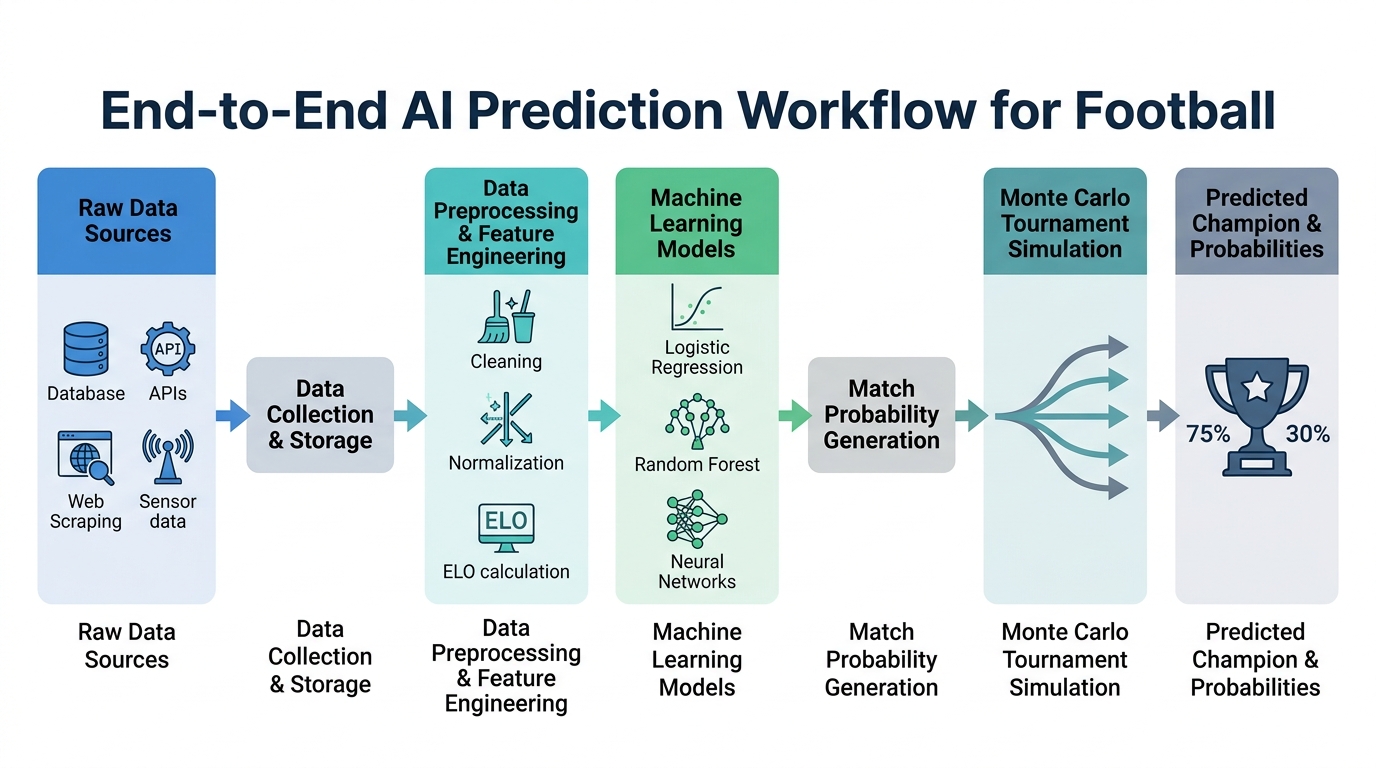
Based on current team form, the depth and quality of their squads, historical performance in major tournaments, and the hypothetical output of advanced AI models, several nations consistently emerge as leading contenders for the 2026 FIFA World Cup. These predictions are inherently dynamic, constantly updating with new match data, player developments, and tactical shifts. However, certain teams consistently demonstrate persistent strength and high potential.
Brazil and Argentina, with their unparalleled footballing heritage, a consistent supply of world-class talent, and recent successes, frequently feature prominently at the top of AI-generated lists. European powerhouses such as France, Germany, and England also possess formidable squads, deep benches, and proven tournament experience, making them strong candidates capable of going all the way. The AI considers a sophisticated blend of individual brilliance, cohesive team play, and tactical adaptability.
The following table presents a hypothetical, AI-generated list of top contenders for the 2026 World Cup, along with their estimated winning probabilities. These percentages are derived from the cumulative outcomes of thousands of simulated tournaments, meticulously considering all known and quantifiable factors. It's important to remember these are probabilities, not certainties, reflecting the complex interplay of variables.
| Team | Predicted Winning Probability (%) | AI Justification |
|---|---|---|
| Brazil | 22.5% | Strong squad depth, consistent performance, high individual player ratings, favorable historical record. |
| France | 19.8% | Exceptional talent pool, recent major tournament experience, robust tactical flexibility, strong defensive metrics. |
| Argentina | 17.2% | Reigning champions, strong team chemistry, high player form, tactical stability, experienced leadership. |
| England | 10.5% | Young, dynamic squad, strong league performance, improving tactical approach, good xG metrics. |
| Germany | 8.9% | Rebuilding phase showing promise, strong domestic league, tactical innovation, potential for upsets. |
| Spain | 7.1% | Possession-based play, technical proficiency, emerging young talents, strong midfield control. |
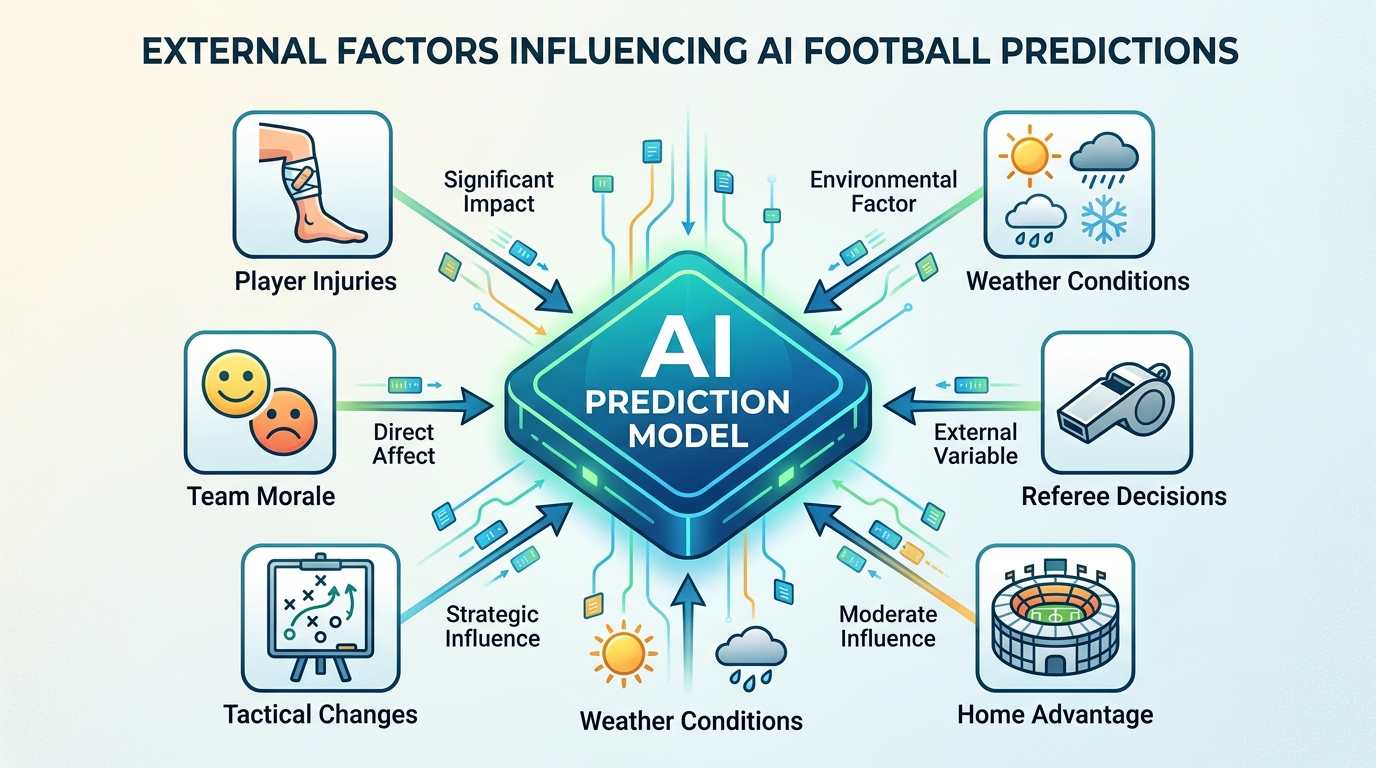
While Artificial Intelligence excels at processing vast quantities of quantitative data, football remains fundamentally a human sport, profoundly influenced by numerous qualitative and inherently unpredictable factors. These non-numerical elements can significantly shift match outcomes and, consequently, alter AI predictions in unexpected ways. Acknowledging these inherent limitations is crucial for a comprehensive understanding of AI's role.
Critical player injuries to key individuals can drastically weaken a team's overall strength and tactical options, even if their general squad depth appears robust on paper. Innovative team tactics and unexpected coaching strategies can surprise opponents and defy statistical expectations derived from past performance. Furthermore, the psychological aspect, encompassing team morale, individual player pressure in high-stakes games, and collective resilience, is notoriously difficult for algorithms to accurately quantify.
Additional influential factors include the significant impact of home advantage, particularly relevant for the host nations in the expanded 2026 tournament, and recent performance trends that might indicate a team's momentum or decline. Squad depth, weather conditions on match day, and the inherent unpredictability of 'black swan' moments-such as controversial referee decisions or freak goals-can completely alter a game's trajectory, proving exceptionally challenging for any algorithm to foresee or incorporate.
So, can Artificial Intelligence truly predict the FIFA World Cup 2026 winner with absolute certainty? The answer is nuanced and complex, requiring a careful balance between AI's immense analytical strengths and the inherent unpredictability that defines football. AI excels at processing vast, multi-dimensional datasets and identifying intricate patterns that human analysts might easily overlook, thereby providing highly informed probabilities for various match and tournament outcomes.
However, football is far more than just a game of numbers; it is a dynamic sport driven by human performance, raw emotion, and an undeniable element of chance. A sudden, game-changing injury, a moment of individual brilliance from an unexpected player, a controversial referee call, or even a lucky deflection can alter a match's trajectory in an instant. These 'black swan' events are incredibly difficult, if not impossible, for any algorithm to foresee or account for.
Therefore, while AI can offer incredibly sophisticated and data-driven insights into potential outcomes, it cannot guarantee a definitive prediction of the World Cup champion. It serves as a powerful tool for understanding probabilities, identifying strong contenders, and exploring potential scenarios, but it remains a probabilistic forecast, not a crystal ball. The enduring beauty and global appeal of football fundamentally lie in its dynamic and often surprising nature, which even the most advanced AI cannot fully tame.
Examining the historical performance of AI in past FIFA World Cups provides invaluable context for understanding its current capabilities and inherent limitations. Various research groups, academic institutions, and specialized data science companies have deployed sophisticated AI models for previous tournaments, yielding results that have been both insightful and, at times, surprisingly off the mark. Their collective track record highlights both notable successes and significant misses.
For instance, some advanced AI models successfully identified Germany's formidable strength leading to their victory in 2014, or accurately pinpointed France as a strong contender for their triumph in 2018. These successes typically stemmed from robust data analysis, effective feature engineering, and comprehensive simulation strategies. However, major upsets, such as Saudi Arabia's unexpected victory over Argentina in the 2022 group stage, often eluded even the most sophisticated predictive systems, showcasing football's capacity for surprise.
The overall accuracy of AI predictions varies considerably, depending heavily on the model's architectural complexity, the quality and breadth of its training data, and the specific metrics used for evaluating performance. While AI consistently outperforms random chance and often surpasses traditional human expert predictions, it rarely achieves 100% accuracy. This consistent pattern underscores the deeply unpredictable nature of elite-level football, where human factors and random events play a significant role.
| World Cup Year | AI Predicted Winner (Common) | Actual Winner | Accuracy Notes |
|---|---|---|---|
| 2014 (Brazil) | Brazil / Germany | Germany | Many models favored Brazil due to home advantage, but Germany's consistent strength was also identified. AI often had Germany in top 2-3. |
| 2018 (Russia) | Brazil / France | France | France was a strong contender in many AI models, often alongside Brazil. AI generally performed well in identifying finalists. |
| 2022 (Qatar) | Brazil / Argentina | Argentina | AI models heavily favored Brazil and Argentina. While Argentina won, some models struggled with early group stage upsets (e.g., Saudi Arabia vs Argentina). |
| Overall Trend | Top 3-5 teams often identified | Varies | AI consistently identifies top contenders but struggles with unexpected upsets and the precise final winner due to inherent unpredictability. |
The application of Artificial Intelligence in football extends far beyond the singular task of merely predicting tournament winners. It is fundamentally transforming various critical aspects of the sport, offering unprecedented insights and analytical capabilities to clubs, performance analysts, broadcasters, and even sophisticated betting companies. AI-powered tools are rapidly becoming indispensable for gaining a competitive advantage and enhancing the overall football experience.
Clubs extensively leverage AI for advanced player scouting, enabling them to identify hidden talents by meticulously analyzing vast databases of player statistics, performance metrics, and detailed video footage. Performance analysis benefits immensely, with AI systems tracking player movements, tactical adherence, physical output, and even fatigue levels in real-time during matches and training sessions. This granular data helps coaches optimize training regimes and refine match strategies.
Furthermore, AI plays a crucial role in injury prevention by continuously monitoring player load, biomechanical data, and identifying subtle patterns that often precede injuries, allowing for proactive interventions. Broadcasters utilize AI to generate real-time statistics, engaging visual overlays, and personalized content for viewers, enriching the fan experience. Betting companies, in turn, rely on AI to set more accurate and dynamic odds, reflecting the true probabilities of match outcomes with greater precision.
The future of Artificial Intelligence in football forecasting promises an even more sophisticated and granular level of insight, pushing the boundaries of what is currently possible. Emerging technological trends and continuous advancements in AI research are constantly refining predictive accuracy and deepening our understanding of the beautiful game. These innovations are set to revolutionize how we analyze, predict, and engage with football.
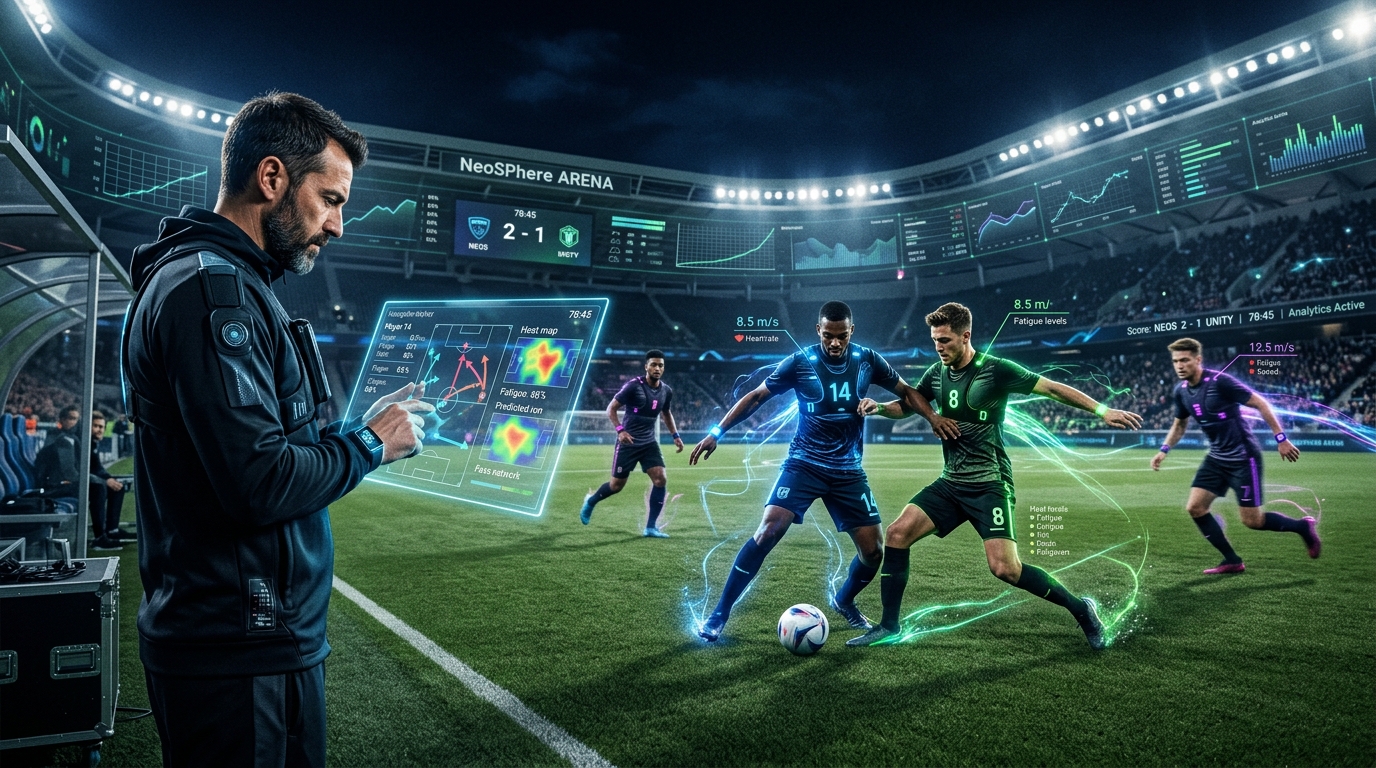
The integration of real-time data streams, combined with advanced sensor technology and cutting-edge wearable devices, will provide an unprecedented, continuous flow of live information during matches. This includes highly precise player positioning, real-time heart rates, dynamic fatigue levels, and even intricate biomechanical data. AI models will gain the capability to adapt and update their predictions dynamically, almost instantaneously, as a game unfolds, reacting to every pass, tackle, and shot.
Advanced computer vision techniques will enable fully automated tactical analysis, capable of identifying complex patterns in team formations, pressing schemes, individual player interactions, and off-ball movements that are extremely difficult for human analysts to track manually. More sophisticated predictive analytics models, potentially incorporating advanced techniques like reinforcement learning or causal inference, will offer deeper insights into 'what-if' scenarios and the true effectiveness of various tactical adjustments, providing a richer, more strategic understanding of the game.
In summary, Artificial Intelligence has unequivocally emerged as an incredibly powerful and transformative tool for analyzing and predicting football outcomes, including the highly anticipated FIFA World Cup 2026. Its unparalleled ability to process vast, multi-dimensional datasets, identify complex and subtle patterns, and execute millions of tournament simulations provides insights that extend far beyond human analytical capacity. This makes AI an invaluable asset for understanding probabilities and exploring potential scenarios.
However, it is absolutely crucial to recognize that AI, despite its sophistication, is not a crystal ball capable of absolute certainty. The inherent unpredictability of football, driven by the dynamic nature of human performance, the occurrence of unexpected events, and rapid tactical shifts, means that no algorithm can definitively guarantee the identity of the champion. AI offers highly sophisticated probabilistic forecasts, providing likelihoods rather than certainties.
As AI continues its rapid evolution, integrating real-time data and even more advanced models, its role in football will undoubtedly expand, enhancing player scouting, performance analysis, tactical planning, and fan engagement. While it may never entirely remove the thrilling element of surprise, AI will profoundly enrich our understanding and appreciation of the beautiful game, making the 2026 World Cup an even more fascinating and analytically rich spectacle.
AI predictions are generally more accurate than random chance or simple human intuition, often correctly identifying top contenders and potential finalists. However, achieving 100% accuracy is virtually impossible due to the sport's inherent unpredictability, including unexpected upsets, player form fluctuations, and unforeseen events during matches. Their accuracy typically ranges from 60-80% for individual match outcomes, but predicting a single tournament winner is much harder.
Ethical concerns include potential for addiction due to perceived higher accuracy, fairness if AI-driven insights are not equally accessible, and the risk of manipulating odds. There's also a debate about whether AI could diminish the human element and excitement of sports by making outcomes seem more predictable. Responsible use and transparency are key to mitigating these issues.
Yes, AI can analyze vast amounts of player data, including youth league performance, physical metrics, and tactical roles, to identify patterns indicative of future success. While it can't guarantee a 'breakout,' it can highlight players with high potential or those whose current form suggests they are poised for a strong tournament. This is often used in scouting and talent identification.
Directly quantifying psychological factors is challenging for AI. However, models can infer these aspects indirectly by analyzing proxy data. For example, a team's recent performance under pressure, comeback statistics, or disciplinary records can serve as features that reflect resilience or fragility. Sentiment analysis of social media or news articles could also provide qualitative insights, though this is more advanced.
Statistical models (like Poisson regression) often rely on predefined mathematical relationships and assumptions about data distribution. They are interpretable but can be limited by these assumptions. Machine learning models (like neural networks or random forests) learn complex patterns directly from data without explicit programming for every rule. They are more flexible and can capture non-linear relationships, often leading to higher predictive power, but can be less interpretable ('black box').
During a major tournament like the World Cup, AI models are typically updated after every matchday, or even after every match, to incorporate the latest results, player performances, and any new injury information. This continuous learning allows the models to adapt to evolving team forms and tactical adjustments, refining their predictions as the tournament progresses. Real-time updates are crucial for maintaining accuracy.
Harness Claude AI agents to create intelligent, autonomous workflows. Discover how to design, deploy, and adapt AI systems for powerful real-world automation
Discover how to earn $1000 monthly leveraging Claude Co-work. This guide shows normal people how to start a profitable content creation business step-by-step
Find the top AI transcription APIs for Indian languages like Hindi, Gujarati, and Tamil. We compare accuracy, speed, features, and pricing to guide your choice