>_Programming Partner
Loading technical insights...
Loading technical insights...
Software Developer
Reinforcement learning (RL) is a powerful paradigm enabling robots to acquire complex skills through interaction with their environment. Instead of explicit programming, robots learn by making decisions and observing the outcomes. This trial-and-error approach mimics how living beings learn new behaviors.
Imagine a robot learning to walk, grasp a delicate object, or navigate a cluttered room. RL allows it to discover optimal strategies by experimenting and receiving feedback. This adaptive learning capability is crucial for developing more autonomous and versatile robots.
The ability to learn from experience makes robots more flexible and robust in unpredictable real-world settings. This shift from pre-programmed actions to learned behaviors is a cornerstone of modern robotics, driving innovation across various applications.
Reinforcement learning is a type of machine learning where an "agent" learns to make decisions by interacting with an "environment." Unlike supervised learning, which uses labeled data, or unsupervised learning, which finds patterns, RL focuses on goal-directed learning. The agent's objective is to maximize a cumulative reward signal over time.
In this framework, the agent performs "actions" within its environment and, in response, receives "rewards" or "penalties." These signals provide feedback on the quality of its actions. The agent uses this feedback to refine its decision-making strategy.
Through repeated interactions, the agent gradually improves its understanding of which actions lead to desirable outcomes. This iterative process of action, observation, and reward forms the core of RL, enabling intelligent behavior to emerge without explicit programming.
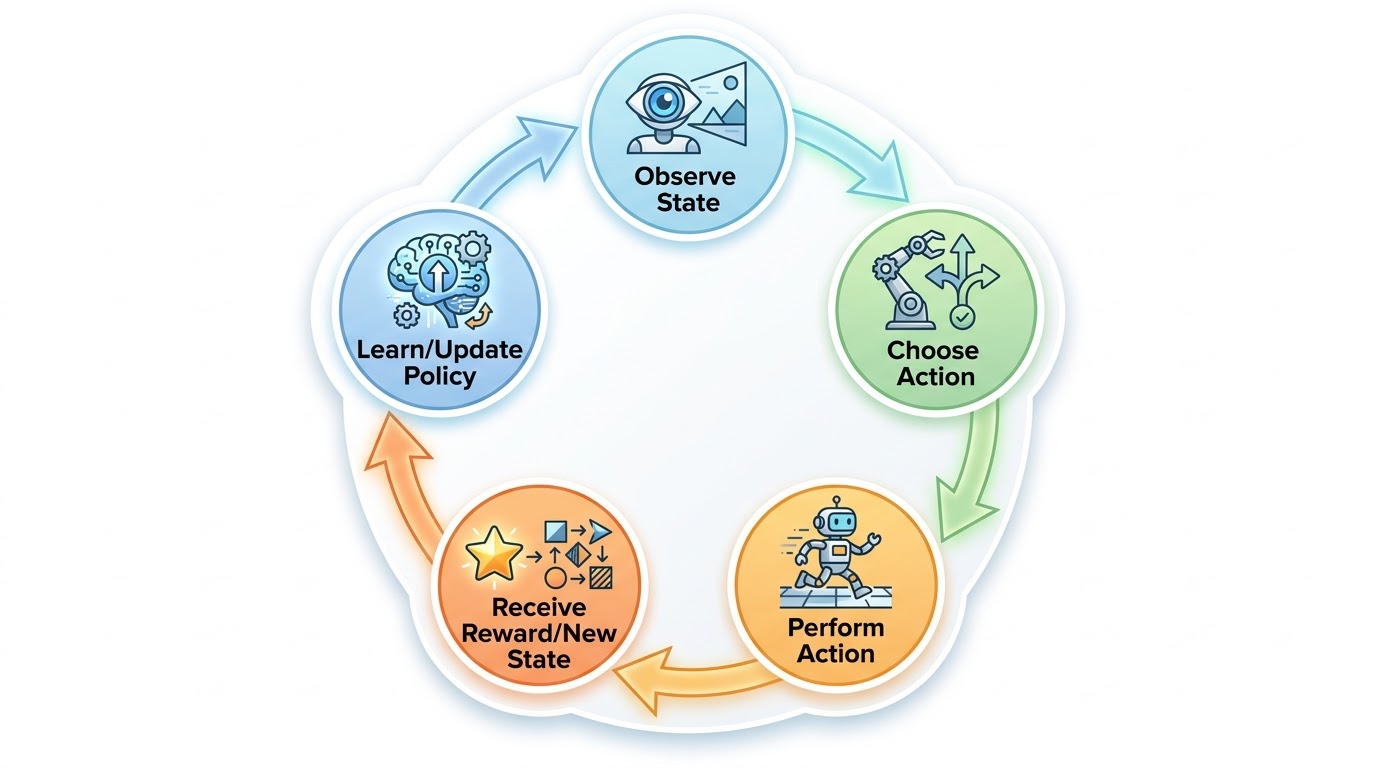
The reinforcement learning process unfolds as a continuous loop, guiding the robot's interaction with its world. First, the robot "observes" its current situation or "state" in the environment, gathering information from its sensors. Based on this observation, it then "chooses an action" to perform, deciding its next movement or command.
After executing the action, the environment changes, and the robot "receives a reward" (or penalty) indicating the quality of its action. This crucial feedback tells the robot whether its decision was good or bad. The robot then uses this information to "learn from the result," adjusting its decision-making strategy for future interactions.
Consider a robot learning to reach a specific target. If it moves closer, it gets a positive reward; if it moves away or hits an obstacle, it gets a negative reward. Through countless trials, the robot refines its movements, encouraging successful paths and discouraging unsuccessful ones, until it reliably reaches the target.
This iterative cycle allows the robot to gradually improve its performance, transforming initial random movements into skilled, goal-oriented behaviors. The continuous feedback loop is essential for adapting to dynamic environments and mastering complex tasks.
To apply reinforcement learning to robots, we define several key components that structure the learning process. The "agent" is the robot itself, serving as the learner and decision-maker within its operational context. The "environment" is the physical or simulated world the robot operates in, encompassing all objects, obstacles, and goals.
The "state" describes the current situation of the robot and its environment at any given moment. This could include the robot's joint angles, sensor readings from cameras or lidar, or the precise positions of objects around it. An "action" is a movement or command the robot can execute, such as rotating a joint, driving forward, or activating a gripper.
The "reward" is the numerical feedback received after an action, guiding the learning process by indicating success or failure. The "policy" is the agent's learned strategy, a mapping from observed states to actions, which dictates what the robot should do in any given situation to maximize future rewards.
Finally, an "episode" is a complete sequence of interactions from a starting state to a terminal state or a predefined time limit. For a robotic arm, an episode might be a single attempt to grasp an object, ending in success or failure. These components provide a structured framework for robotic learning.
Reward functions are absolutely critical for guiding a robot's learning process. They provide immediate and delayed feedback, telling the robot whether its recent action was good or bad in the context of its overall goal. This feedback mechanism is how the robot understands what behaviors are desirable.
For instance, a robot could receive a positive reward for successfully grasping an object, reaching a target location, or maintaining balance. Conversely, negative rewards or penalties are given for undesirable outcomes, such as colliding with an obstacle, falling over, or expending excessive energy. These penalties discourage harmful or inefficient actions.
Designing an appropriate and well-shaped reward function is often one of the most challenging and crucial aspects of reinforcement learning in robotics. A carefully crafted reward function can significantly accelerate learning and lead to more robust behaviors. It requires a deep understanding of the task and the robot's capabilities.
A poorly designed reward function can lead to unintended or even dangerous behaviors, where robots find "loopholes" to maximize rewards in ways not anticipated by the designer. This can result in suboptimal performance or unsafe actions in real-world scenarios, highlighting the importance of thoughtful reward engineering.
A fundamental dilemma in reinforcement learning is balancing "exploration" and "exploitation." Exploration involves trying new, potentially unknown actions to discover better strategies or more rewarding paths. This is essential for discovering optimal behaviors that might not be immediately obvious.
Exploitation, on the other hand, means using the actions that the robot already knows yield high rewards. Once a robot discovers a successful method, it can exploit that knowledge to consistently perform the task efficiently. This ensures the robot leverages its learned experience.
Consider a robot learning different ways to move toward an object. It might explore various joint configurations or movement speeds to find the most efficient and stable approach. Once it identifies a reliable method, it can then exploit that specific movement pattern to consistently reach the object.
Too much exploration can be inefficient, time-consuming, and potentially unsafe for a physical robot, leading to unnecessary wear or damage. Conversely, too little exploration might prevent the robot from discovering optimal or safer strategies, trapping it in a suboptimal local maximum. Finding the right balance is key for effective and safe learning in real-world environments.
At the heart of reinforcement learning is the "policy," which is the robot's learned strategy for deciding what action to take in any given state. Essentially, the policy is a mapping from observed states to actions. During training, the reinforcement learning algorithm continuously updates and improves this policy.
The robot starts with an initial, often random, policy and refines it based on the rewards it receives from its interactions with the environment. Over many episodes, the policy evolves to favor actions that lead to higher cumulative rewards. This means the robot learns to make better decisions over time, optimizing its behavior.
Policies can range from simple lookup tables for discrete states and actions to complex deep neural networks. These neural networks are capable of handling high-dimensional sensor information, like camera images or lidar scans, to make sophisticated decisions. The complexity of the policy often scales with the complexity of the task.
This learned policy enables robots to make continuous decisions while performing tasks such as walking, driving, grasping, or navigating. The policy effectively becomes the robot's 'brain,' dictating its behavior in response to its perception of the world. It is the ultimate output of the reinforcement learning process.
Several powerful reinforcement learning algorithms are widely used in robotic control, each with its strengths and suitable applications. These algorithms differ in how they learn the optimal policy or value function, impacting their efficiency and performance. Understanding their basic principles helps in choosing the right tool for a specific robotic task.
For problems with discrete actions (e.g., move left, move right, pick up), algorithms like Q-Learning and Deep Q-Networks (DQN) are popular. DQN extends Q-Learning by using deep neural networks to approximate the Q-values, enabling it to handle larger and more complex state spaces effectively. These are often used for simpler, grid-world-like navigation or discrete manipulation tasks.
For continuous action spaces, which are very common in robotics (e.g., joint torques, motor velocities, force control), Policy Gradient methods, Actor-Critic algorithms, Proximal Policy Optimization (PPO), Soft Actor-Critic (SAC), and Twin Delayed DDPG (TD3) are frequently employed. These algorithms directly learn a policy that outputs continuous actions, making them highly relevant for controlling the smooth, fluid movements of robots.
Algorithms designed for continuous control are especially relevant to robotic movement, as most physical actions involve continuous values. PPO, SAC, and TD3 are particularly favored for their stability and sample efficiency in complex robotic control tasks, enabling more practical real-world applications. They represent the cutting edge of robotic RL.
| Algorithm Family | Characteristics | Typical Robotic Applications |
|---|---|---|
| Q-Learning/DQN | Value-based, discrete actions, off-policy, often uses replay buffers | Simple navigation, discrete manipulation tasks, game playing |
| Policy Gradients | Policy-based, continuous/discrete actions, on-policy, directly optimizes policy | Robot locomotion, grasping, complex control, learning from scratch |
| Actor-Critic (A2C/A3C) | Combines value and policy, continuous/discrete actions, often parallelized | Real-time control, complex manipulation, humanoids, continuous tasks |
| PPO (Proximal Policy Optimization) | Policy-based, on-policy, good stability and sample efficiency, popular for continuous control | Quadruped locomotion, robotic arm control, dexterous manipulation, balancing |
| SAC (Soft Actor-Critic) | Actor-critic, off-policy, maximum entropy RL, excellent for continuous control, high sample efficiency | High-dimensional continuous control, complex manipulation, bipedal walking, robust learning |
| TD3 (Twin Delayed DDPG) | Actor-critic, off-policy, addresses overestimation bias in DDPG, stable for continuous control | Robotic arm control, continuous locomotion tasks, precise trajectory following |
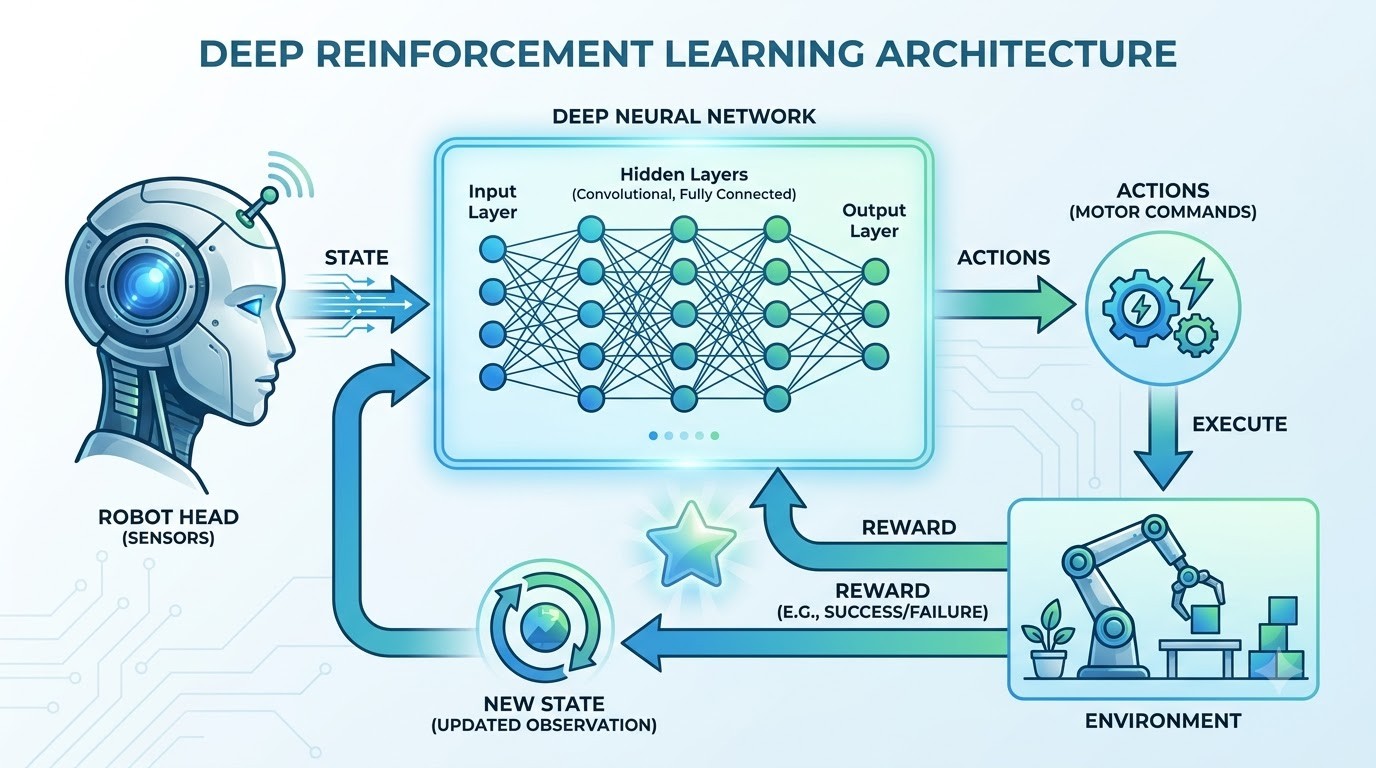
Deep reinforcement learning (Deep RL) combines the power of deep neural networks with reinforcement learning algorithms. This synergy allows robots to process high-dimensional, raw sensor data, such as images from cameras or point clouds from lidar, directly to make decisions. It eliminates the need for manual feature engineering.
Neural networks act as powerful function approximators, capable of learning complex mappings from states to actions or state-action values. This means a robot can learn intricate behaviors without engineers having to manually extract features or define rules for every possible scenario. The network learns representations directly from raw data.
This capability allows robots to learn behaviors that would be incredibly difficult, if not impossible, to program manually. Deep RL has enabled robots to achieve impressive feats, from learning to play complex games to performing highly dexterous manipulation tasks in unstructured environments. It's a game-changer for robotic autonomy.
Deep RL connects reinforcement learning with the broader deep-learning concepts already prevalent in AI. By leveraging advancements in neural network architectures and training techniques, robots can develop more sophisticated perception and decision-making capabilities, pushing the boundaries of what autonomous systems can achieve.
Training reinforcement learning agents directly on physical robots is often impractical due to several significant limitations. It can be extremely time-consuming, as real-world interactions are slow, and expensive due to hardware wear and tear from repeated trials. Moreover, it's potentially dangerous if the robot performs erratic or unsafe actions during early learning stages.
This is where robotic simulators become invaluable tools in the development process. Simulators provide virtual environments where robots can perform thousands or even millions of training interactions in a fraction of the time and cost. They offer a safe sandbox for experimentation without risking damage to real hardware.
These virtual worlds allow robots to learn complex tasks such as walking, grasping, navigation, or intricate manipulation before being transferred to a physical robot. The rapid iteration possible in simulation significantly accelerates the development cycle, allowing engineers to test and refine policies much faster.
Modern robotic simulators offer increasingly realistic physics engines and accurate sensor models, closely mimicking real-world conditions. This fidelity is crucial because it enables the learned policies to be more easily transferred to physical robots, accelerating the deployment of autonomous systems into practical applications.
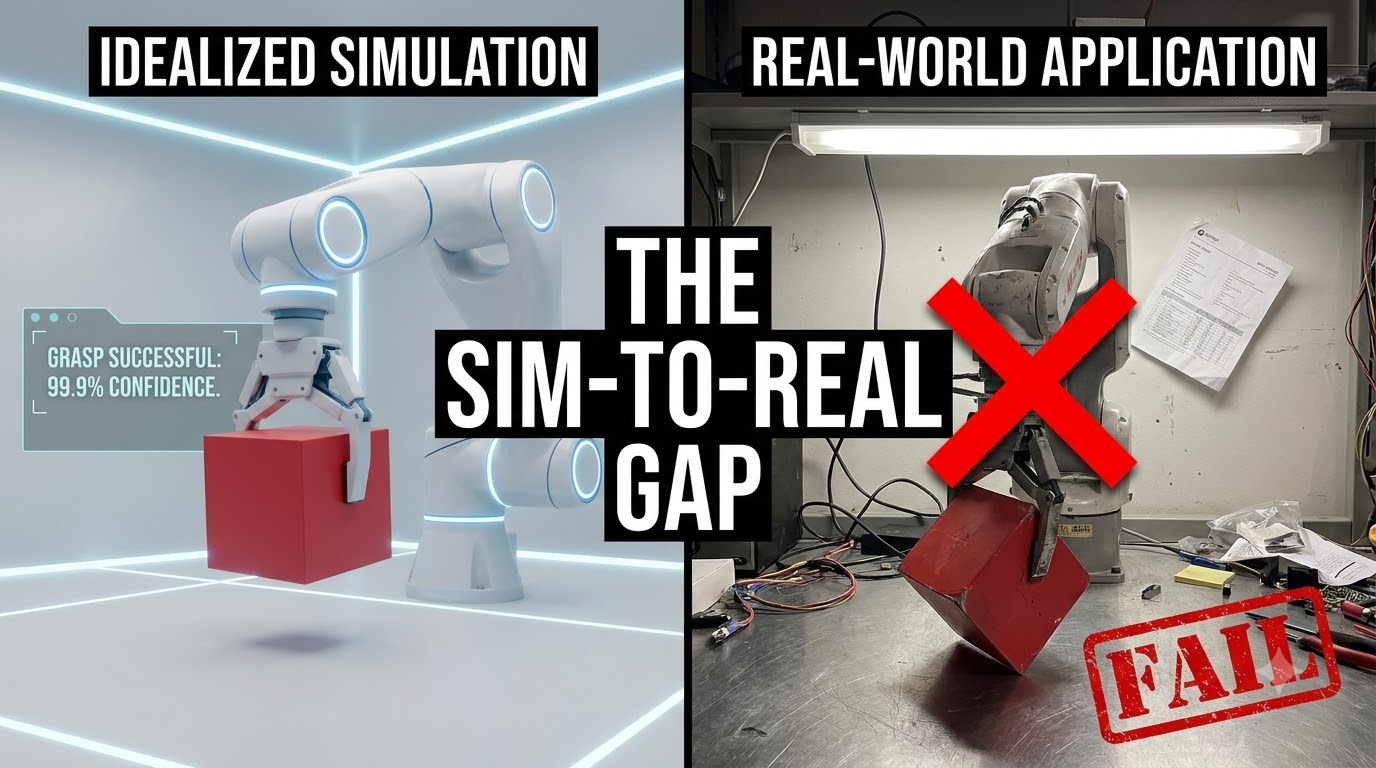
Despite the immense benefits of simulation, a significant hurdle in robotic reinforcement learning is the "sim-to-real gap." This refers to the discrepancy between a robot's behavior in a simulated environment and its performance when deployed on a physical robot. A policy that works perfectly in simulation might fail unexpectedly in the real world.
This gap arises from numerous subtle differences that are difficult to perfectly model. These include inaccuracies in physics (e.g., friction coefficients, material properties, gravity variations), sensor noise, motor inaccuracies, communication latency, and variations in lighting or object textures. Even minor discrepancies can drastically impact a robot's learned behavior.
To bridge this gap, techniques like domain randomization are employed. This involves systematically varying environmental parameters (e.g., textures, lighting, object masses, robot parameters) within the simulation during training. By exposing the robot to a wide range of conditions, the learned policy becomes more robust and generalizes better to the unpredictable real world.
The sim-to-real challenge is an important consideration because it explains why successful robotic RL is more difficult than simply training a model in simulation. Overcoming this gap is crucial for the widespread adoption of RL-trained robots in practical, real-world applications, requiring careful engineering and validation.
Let's explore a basic implementation of a reinforcement learning agent for a simplified robotic control task. We'll use Python and the popular stable-baselines3 library, which provides robust implementations of various RL algorithms. Our goal is to train an agent to balance a pendulum, a classic control problem that mimics aspects of robotic arm control.
The Pendulum-v1 environment from OpenAI Gym (now part of Gymnasium) is an excellent starting point for continuous control. It represents an inverted pendulum that the agent must learn to swing up and keep upright by applying torques. This task demonstrates continuous action spaces, which are common in real-world robotics.
We will define a PPO (Proximal Policy Optimization) agent, known for its stability and performance in continuous control. PPO is an on-policy algorithm that directly optimizes the policy, making it suitable for tasks where the agent needs to learn a direct mapping from observations to actions. This hands-on example will solidify the theoretical concepts we've discussed.
The process involves several key steps: setting up the simulation environment, defining the reinforcement learning agent, running a training loop to allow the agent to learn, and finally evaluating the performance of the trained policy. This structured approach is typical for developing RL solutions in robotics.
# Install necessary libraries if you haven't already
# pip install gymnasium stable-baselines3[extra]
import gymnasium as gym
from stable_baselines3 import PPO
from stable_baselines3.common.env_util import make_vec_env
from stable_baselines3.common.evaluation import evaluate_policy

# Create the environment
# Pendulum-v1 is a classic control task with continuous action space
# The goal is to swing up and balance an inverted pendulum
envᵢd = "Pendulum-v1"
vec_env = make_vec_env(envᵢd, n_envs=1)

print(f"Observation space: {vec_env.observation_space")
print(f"Action space: {vec_env.action_space")# Continued from previous block - requires the setup above
# Define the PPO agent
# PPO is an on-policy algorithm suitable for continuous action spaces
# MlpPolicy uses a Multi-Layer Perceptron (neural network) for the policy
# verbose=1 provides training progress output
# tensorboard_log specifies a directory for logging training metrics
model = PPO("MlpPolicy", vec_env, verbose=1, tensorboard_log="./ppo_pendulum_tensorboard/")
print("PPO agent defined with MlpPolicy.")# Continued from previous block - requires the setup above
# Train the agent
# The agent will interact with the environment for a specified number of timesteps
# During this time, it collects experiences, updates its policy, and learns
print("Starting training...")
model.learn(total_timesteps=50000) # Train for 50,000 timesteps
print("Training finished.")
# Save the trained model for future use or evaluation
model_path = "ppo_pendulum_model"
model.save(model_path)
print(f"Model saved to {model_path.zip")# Continued from previous block - requires the setup above
# Load the trained model for evaluation to ensure it works correctly
loaded_model = PPO.load("ppo_pendulum_model", env=vec_env)
# Evaluate the policy's performance over multiple episodes
# This calculates the average reward and its standard deviation
print("Evaluating the learned policy...")
mean_reward, std_reward = evaluate_policy(loaded_model, vec_env, n_eval_episodes=10)
print(f"Mean reward: {mean_reward:.2f +/- {std_reward:.2f")
# Visualize the agent's behavior in the environment (optional)
# This will render the environment window and show the robot acting based on the learned policy
print("Rendering one episode of the learned policy (close window to finish)...")
obs = vec_env.reset()
for _ in range(200): # Run for 200 steps to observe behavior
# Predict the action to take based on the current observation
action, _states = loaded_model.predict(obs, deterministic=True)
# Take a step in the environment with the chosen action
obs, rewards, dones, infos = vec_env.step(action)
# Render the environment to visualize the robot's actions
vec_env.render("human")
# If the episode is done, reset the environment for a new start
if dones:
obs = vec_env.reset()
vec_env.close() # Close the rendering window
print("Visualization complete.")Reinforcement learning is revolutionizing how robots acquire fundamental physical skills, moving beyond rigid programming. Tasks like walking, maintaining balance, reaching for objects, grasping, and complex manipulation are inherently challenging to program manually due to the vast number of variables and uncertainties. RL offers a powerful and adaptive alternative.
For a robot learning to walk, each joint movement and foot placement can be treated as an action, with rewards given for forward progress and penalties for falling or instability. Similarly, a robotic arm can learn to grasp objects of varying shapes and sizes by optimizing its grip force and approach trajectory based on visual feedback and tactile rewards. This allows for nuanced and adaptive control.
This approach is particularly effective when the exact sequence of movements is difficult to pre-define, or when the environment is unpredictable. RL enables robots, from agile quadruped robots to dexterous humanoid arms, to discover nuanced and efficient behaviors that adapt to their environment. This leads to more robust and versatile physical capabilities than traditional methods.
Whether it's a bipedal robot learning to navigate uneven terrain or a robotic hand manipulating delicate items, RL provides the framework for learning complex motor skills. The continuous optimization through rewards allows robots to achieve fluid, natural movements that were once the exclusive domain of biological systems, pushing the boundaries of robotic dexterity.
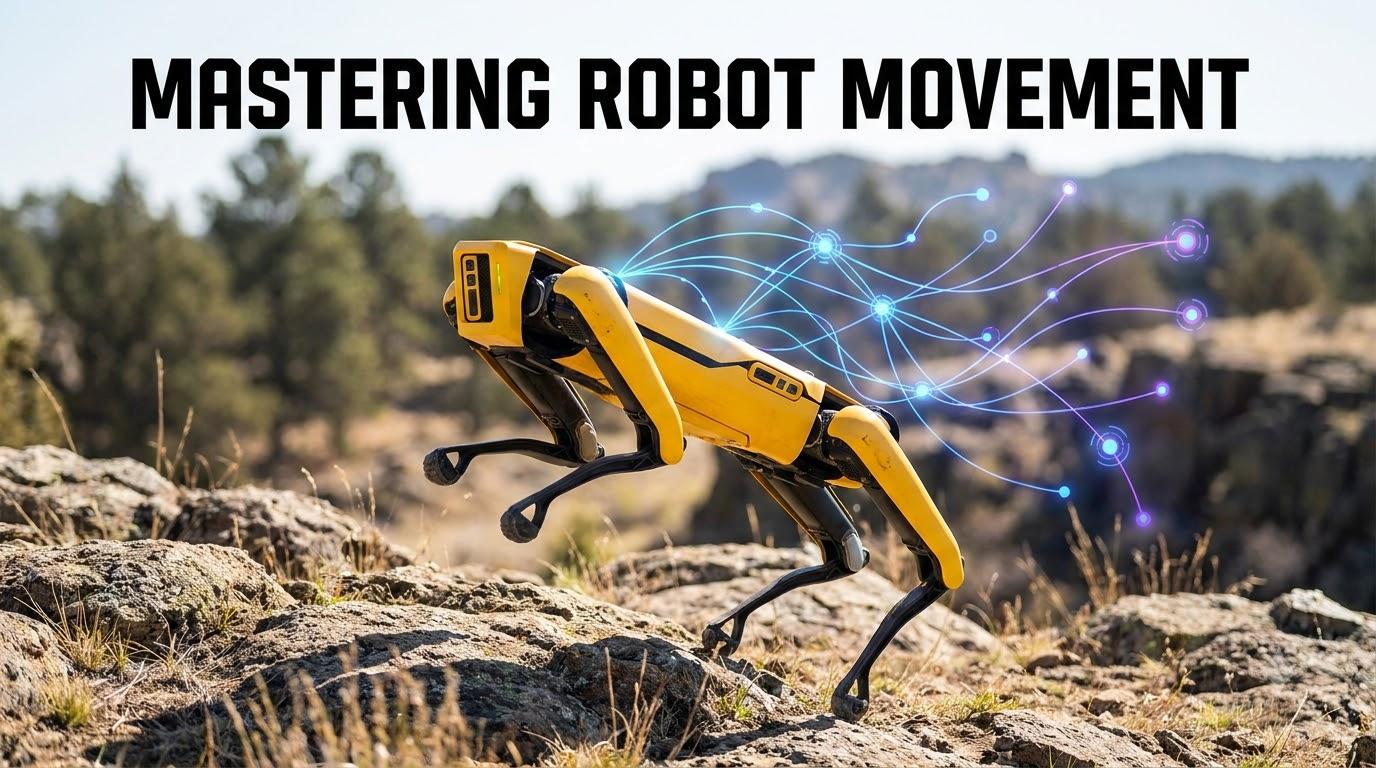
Beyond physical movement, reinforcement learning is crucial for enabling autonomous robots to make intelligent decisions in dynamic and unpredictable environments. This includes complex applications such as navigation, obstacle avoidance, and sophisticated path planning. Robots can learn to adapt their behavior based on real-time sensory input, rather than relying on static maps or rules.
For example, an autonomous mobile robot can learn to navigate a crowded warehouse, choosing optimal paths and avoiding collisions without explicit programming for every possible scenario. In autonomous driving, RL agents can learn complex driving policies, including lane keeping, merging, and reacting safely to other vehicles and pedestrians. This adaptability is key for real-world deployment.
RL also plays a role in resource management for autonomous systems, such as optimizing battery usage or task scheduling. The robot can learn to select actions based on its surroundings and internal state, instead of following a completely fixed sequence of instructions. This allows for more efficient and intelligent operation over extended periods.
When combined with advanced perception systems like computer vision, RL allows robots to interpret their surroundings and make context-aware decisions. This integration empowers robots to operate more intelligently and safely in complex, human-centric environments, moving beyond simple pre-programmed routines to truly autonomous behavior.
Despite its immense promise, applying reinforcement learning to physical robots presents significant challenges that must be carefully addressed. One major hurdle is sample efficiency; physical robots require an enormous number of training interactions to learn complex tasks, which can be prohibitively time-consuming and costly. Each real-world interaction consumes valuable resources.
Safety is another paramount concern during the learning process. During early training, a robot might perform unpredictable or dangerous actions, risking damage to itself, its environment, or nearby humans. This necessitates careful supervision, robust safety protocols, and often, the use of protective caging or remote operation.
Hardware wear and tear is also a practical limitation, as repeated, often forceful, interactions can degrade mechanical components. Furthermore, real-world environments are inherently unpredictable, with variations in lighting, friction, and object properties that are hard to account for, making robust learning difficult.
Other challenges include designing effective reward functions that truly capture the desired behavior, managing the high dimensionality of robotic state and action spaces, and successfully transferring policies learned in simulation to physical hardware (the notorious sim-to-real gap). These factors mean that successful robotic RL often requires extensive engineering and careful experimentation, providing a realistic view of the technology's current limitations.
Traditionally, robots are programmed using explicit rules, inverse kinematics, and predefined control logic. Engineers meticulously define every movement, sensor threshold, and decision-making branch. This approach offers high precision and predictability for well-defined, static tasks in controlled environments, such as assembly lines.
Reinforcement learning, conversely, allows robots to learn these behaviors from experience, much like a child learns by doing. Instead of being told exactly what to do, the robot discovers the optimal strategy through trial and error, guided by a reward signal. This makes RL ideal for tasks that are difficult to model or program manually due to their complexity or variability.
While traditional methods excel in structured industrial settings where repeatability is key, RL shines in dynamic, uncertain environments where adaptability is paramount. Traditional programming offers guarantees but lacks flexibility, whereas RL offers flexibility but requires extensive training and careful validation. Each approach has its distinct advantages and disadvantages.
Modern robotics often combines both approaches, leveraging the strengths of each. This hybrid strategy might use traditional control for low-level stability and safety, while RL handles high-level decision-making and adaptive behaviors. This integration of traditional control, machine learning, computer vision, and reinforcement learning creates more capable and robust robotic systems.
| Feature | Reinforcement Learning | Traditional Programming |
|---|---|---|
| Learning Method | Learns from trial and error, rewards, and feedback | Explicitly programmed rules, logic, and control algorithms |
| Adaptability | Highly adaptive to changing environments and novel situations | Limited adaptability, requires reprogramming for new scenarios |
| Task Complexity | Excels in complex, ill-defined tasks with high variability | Best for well-defined, structured, and repetitive tasks |
| Development Time | Can be long due to training, but less manual coding for complex behaviors | Can be faster for simple tasks, but complex tasks are tedious and error-prone |
| Safety | Potential safety risks during exploration, requires careful management | High predictability and safety with proper design and validation |
| Environment | Dynamic, uncertain, unstructured, and partially observable | Static, predictable, structured, and fully observable |
| Data Needs | Requires large amounts of interaction data (simulated or real) | Requires expert knowledge and detailed task analysis to define rules |
The future of reinforcement learning in robotics is incredibly promising, driven by advancements in related AI fields. We are seeing increasing integration with foundation models, which provide robots with vast pre-trained knowledge, and vision-language-action (VLA) models that allow robots to understand and execute high-level human commands. This convergence is creating more intuitive and powerful robotic systems.
Techniques like imitation learning, where robots learn by observing human demonstrations, are also being combined with RL to accelerate training and improve safety. By providing a strong starting point, imitation learning reduces the need for extensive trial-and-error, making RL more practical for real-world deployment. This hybrid approach leverages both human expertise and autonomous learning.
Furthermore, advancements in simulation fidelity and sim-to-real transfer methods are making it easier to deploy learned policies on physical hardware with greater reliability. Researchers are continuously developing new techniques to minimize the gap between virtual and physical worlds, enabling faster and safer deployment of advanced robotic behaviors.
The ultimate goal is to move towards more general-purpose robots that can learn a wide array of skills and adapt to entirely new environments with minimal human intervention. This convergence of technologies promises to unlock unprecedented levels of robotic autonomy and capability, transforming industries and daily life with intelligent, adaptive machines.
Reinforcement learning stands as a cornerstone technology for developing truly autonomous and intelligent robots. By enabling robots to learn behaviors through interaction, feedback, and repeated experience, RL empowers them to master complex tasks that are otherwise impossible or impractical to program manually. It represents a fundamental shift in how we approach robot control.
Throughout this article, we've explored key concepts such as states, actions, rewards, policies, and the crucial balance between exploration and exploitation. The vital role of simulation in accelerating training and the ongoing efforts to bridge the sim-to-real gap are also essential for practical applications. These elements form the foundation of modern robotic learning.
Ultimately, RL is invaluable for creating robots that can perceive their surroundings, make informed decisions, and act effectively in dynamic, real-world scenarios. This capability is driving the next generation of robotics, from advanced industrial automation and logistics to personal assistance and exploration in challenging environments, leading to a future with more capable and intelligent machines.
Inverse reinforcement learning (IRL) is a technique where, instead of explicitly defining a reward function, the robot observes expert demonstrations and tries to infer the underlying reward function that explains the expert's behavior. This approach is particularly valuable in robotics when it's challenging to hand-design a reward function for complex tasks. By inferring the reward, the robot can then learn to perform the task in a way that maximizes that inferred reward, often leading to more human-like or intuitive behaviors. It helps bridge the gap between human intuition and robotic control.
Multi-agent reinforcement learning (MARL) involves multiple independent or cooperative agents learning within a shared environment. In robotics, MARL can be applied to coordinate teams of robots, such as a swarm of drones performing surveillance or multiple robotic arms collaborating on an assembly line. Each robot learns its own policy while considering the actions and states of other robots, leading to emergent collective behaviors and improved overall system performance in complex, distributed tasks.
Transfer learning is crucial for accelerating robotic reinforcement learning by leveraging knowledge gained from one task or environment to improve learning in another. For instance, a robot might learn basic grasping skills in a simple simulated environment and then transfer that learned policy, or parts of its neural network, to a more complex real-world grasping task. This significantly reduces the amount of training data and time required for new tasks, making RL more practical for real-world deployment. It allows robots to build upon existing knowledge rather than learning every skill from scratch.
Yes, reinforcement learning is increasingly being explored for enhancing robot safety and improving human-robot interaction. Robots can be trained with reward functions that penalize unsafe actions or encourage behaviors that are predictable and comfortable for humans. This can involve learning to maintain safe distances, respond appropriately to human gestures, or even infer human intentions to avoid collisions. Such applications lead to more collaborative, trustworthy, and socially aware robotic systems that can operate safely alongside people.
Training advanced robotic RL agents, especially those using deep neural networks, is computationally intensive. It often requires powerful GPUs or TPUs to handle the large number of calculations involved in neural network forward and backward passes during policy updates. Additionally, large amounts of memory are needed to store experiences, model parameters, and replay buffers for off-policy algorithms. Distributed computing and cloud-based platforms are frequently used to scale up training efforts for complex robotic tasks, making high-performance computing essential.
Online reinforcement learning requires the agent to continuously interact with the environment to collect new data and update its policy in real-time. This can be problematic in robotics due to safety concerns, hardware wear, and the cost of real-world interactions. In contrast, offline reinforcement learning (also known as batch RL) trains an agent using a fixed dataset of previously collected experiences, without any further interaction with the environment. This approach is valuable for leveraging large datasets of past robot operations, but it faces challenges in ensuring the learned policy performs well on actions not present in the training data.